
The True Story of the Library of Alexandria’s Fall
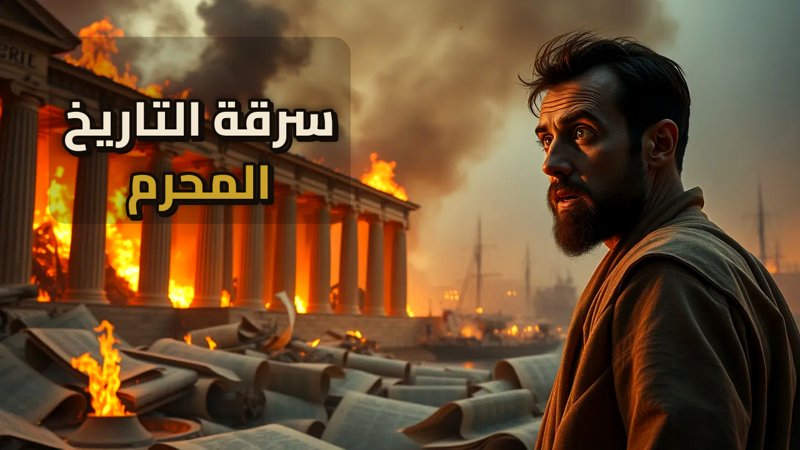
The True Story of the Library of Alexandria’s Fall
Ancient Alexandria during the Ptolemaic era was a cosmopolitan city pulsating with life and culture, standing as a nexus where Eastern and Western thought converged. At its heart arose the Library of Alexandria, an monumental initiative meant to gather all the ‘books of the world’ under a single roof. While popular myth blames Julius Caesar’s fires entirely for its demise, the real story involves centuries of shifting politics, religious transformations, and ideological conflict.
Navigate Content
The Grand Scale of Antiquity’s Greatest Knowledge Hub
The Library of Alexandria was far more than a static archive. Historians estimate it housed upwards of half a million manuscripts spanning philosophy, medicine, astronomy, mathematics, and literature. It operated as a comprehensive university and research institute, drawing brilliant minds such as Euclid, Archimedes, Eratosthenes, and Manetho. Scholars resided within its precincts to study, debate, and propel human civilization forward. Similar to the fascinating archaeological insights found when researchers study ancient Egyptian history, the library represented the pinnacle of ancient intellectual ambition.
Julius Caesar and the 48 BCE Fire: Myth Versus Reality
In 48 BCE, Julius Caesar arrived in Egypt amidst a power struggle between Cleopatra and Ptolemy XIII. During the Alexandrian War, Caesar ordered the burning of warships in the harbor, and the flames spread to nearby warehouses containing thousands of scrolls.
- The Popular Myth: The fire instantly and permanently destroyed the entire Library of Alexandria.
- Historical Reality: The fire consumed commercial warehouses and scrolls meant for export.
- Continued Operation: The main library and Mouseion complex survived and functioned for centuries afterward, as documented by geographers like Strabo.
The Mother Library and the Daughter Library at the Serapeum
As Roman influence grew and the Ptolemaic dynasty waned, Alexandria experienced profound cultural shifts. To understand the timeline of the library’s decline, one must distinguish between two major sites:
- The Mother Library: Located in the royal quarter, which suffered gradual decline and early fire damage.
- The Daughter Library: Housed within the magnificent Serapeum, serving as an alternative cultural center preserving a vast portion of the surviving legacy.
Just as researchers explore structural mysteries like those investigated when exploring ancient Egyptian chambers, the architectural complexity of the Serapeum made it a formidable stronghold of classical learning.
The 391 CE Decree and the Destruction of the Serapeum
The true and decisive threat to Alexandria’s intellectual heritage did not stem from military battles, but from ideological and religious transformation. By the end of the fourth century CE, Christianity became the official state religion, generating friction with the city’s ancient pagan heritage.
In 391 CE, by decree of Emperor Theodosius and led by Patriarch Theophilus, a campaign was launched to demolish pagan temples. The Serapeum was targeted, and its priceless scientific and philosophical collections were looted and destroyed because they were viewed as symbols of a conflicting ideology.
Hypatia and the Retreat of Scientific Inquiry
Amidst this charged political and religious climate emerged Hypatia, a renowned scholar who taught philosophy and mathematics. Her tragic murder transcended a simple crime; it served as a signal that the era of unconstrained scientific inquiry was in retreat before dogmatic struggles. Alexandria began to shed its identity as the ‘repository of the world’s intellect’ as natural sciences receded in favor of theological debates, leaving historians to wonder what truly survived into the medieval era.
Frequently Asked Questions
Generated by AI Content Architect
About The Author