
Why Did Atomic Scientists Search Khafre’s Pyramid for Secret Chambers?
Why Did Atomic Scientists Search Khafre’s Pyramid for Secret Chambers?
In 1968, the Giza Plateau witnessed a bizarre intersection of modern atomic physics and ancient wonders. Nobel laureate Luis Alvarez brought particle physics to Khafre’s Pyramid, sparking decades of speculation about secret chambers and lost ancient technologies.
Navigate Content
Cosmic Rays and the Pyramid of Khafre
In 1968, American physicist and Nobel laureate Luis Alvarez walked the corridors of Khafre’s Pyramid equipped with complex electronic gear instead of traditional tools. As a Manhattan Project veteran, Alvarez decided to use particle physics to scan the pyramid’s interior. By installing spark chambers in the lower burial chamber, his team recorded cosmic-ray particles called ‘muons’ to detect hidden voids within the massive stone structure. For a deeper look into decoding ancient mysteries, read about The Rosetta Stone: How a Single Discovery Decoded Ancient Egyptian.
The Birth of Nuclear-Age Rumors
The timing of Alvarez’s experiment—at the height of the nuclear age—ignited wild public imagination. Whispers quickly spread asking whether the atomic scientist was merely looking for empty rooms or searching for unconventional ancient energy sources. People preferred to attribute the incredible feat of the pyramids to forgotten nuclear powers rather than human engineering and willpower. This fascination with lost technological marvels often mirrors other historical anomalies, much like the enigma explored in The Secret of the Plain of Jars in Laos: Myths vs. Reality.
The Dendera Lightbulb and Crookes Tubes
The controversy surrounding ancient technology did not stop at Khafre’s Pyramid. Theorists pointed to strange reliefs in the subterranean crypts of the Hathor Temple in Dendera.
- A figure holding an oval object resembling a modern lightbulb.
- A wavy, serpent-line resembling a filament inside.
- A thick cable and a base mimicking an electrical insulator.
Proponents claimed these were ancient Crookes tubes. However, archaeologists emphasize that these interpretations project modern electrical concepts onto ancient art.
Granite Sarcophagi and the Saqqara Tunnels
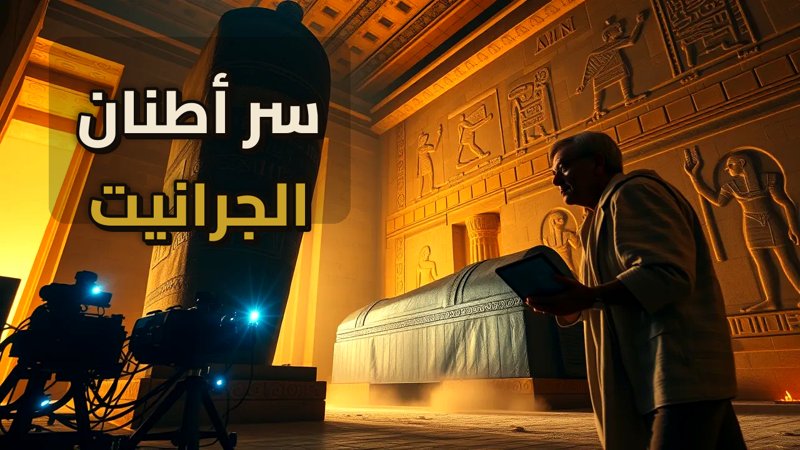
Another focal point for alternative theories was the Serapeum tunnels in Saqqara, home to twenty-six massive basalt and granite sarcophagi weighing up to seventy tons each. Theorists argued these dense blocks were ‘isolation containers’ for radioactive materials rather than burial vaults, requiring advanced mechanical engines to transport. Yet, practical historical evidence continually points to the immense power of human organization and manual labor. To understand how ancient peoples achieved monumental feats without futuristic technology, consider How Ancients Transported Water Over Long Distances Without Lasers.
Decoding the True Religious Meanings
When imagination is set aside in favor of rigorous epigraphy, the mystery of the Dendera reliefs dissolves. The hieroglyphic texts explicitly name the imagery as ‘Hor Sema Tawy’ (Horus, Uniter of the Two Lands), depicting his birth as a serpent emerging from a lotus flower during the New Year festival. Furthermore, the supposed ‘high-voltage insulator’ is actually the sacred Djed pillar, an ancient symbol of stability associated with Osiris. Historical artifacts often hold profound symbolic rather than mechanical meaning, a theme also seen in The Secret Registry of Fallen Stars: Tutankhamun’s Dagger & Meteors.
Frequently Asked Questions
Generated by AI Content Architect
About The Author