
Water Wars: Why ‘Blue Gold’ is More Valuable Than Oil & Reshaping the World
Water Wars: Why ‘Blue Gold’ is More Valuable Than Oil & Reshaping the World
Imagine a world where a single drop of water outweighs a carat of diamonds. The coming conflict will not ignite over barrels of black oil, but over a transparent liquid you see every day in your cup. Are you prepared to confront the bitter truth that geopolitical maps conceal behind a veil of sophisticated diplomacy? You are currently living through a pivotal historical moment that experts call the “Era of Great Thirst.” While you may have believed wars were fought over ideologies or political borders, geography is now redrawing itself around river sources and freshwater courses. “Blue gold” is not merely a metaphor; it is the true currency that will determine who endures and who perishes in the coming decades.
Navigate Content
-
Rivers as Battlegrounds: The Nile’s Struggle for Existence
-
The Cradle of Civilizations: Water as Leverage in the Middle East
-
Asia’s Third Pole: A Fuse for Potential Nuclear War
-
Beyond Desalination: The Economic & Political Weight of Virtual Water
-
The Commodification of Water: Privatization, Climate Change, and Mass Migration
-
FAQ
Rivers as Battlegrounds: The Nile’s Struggle for Existence
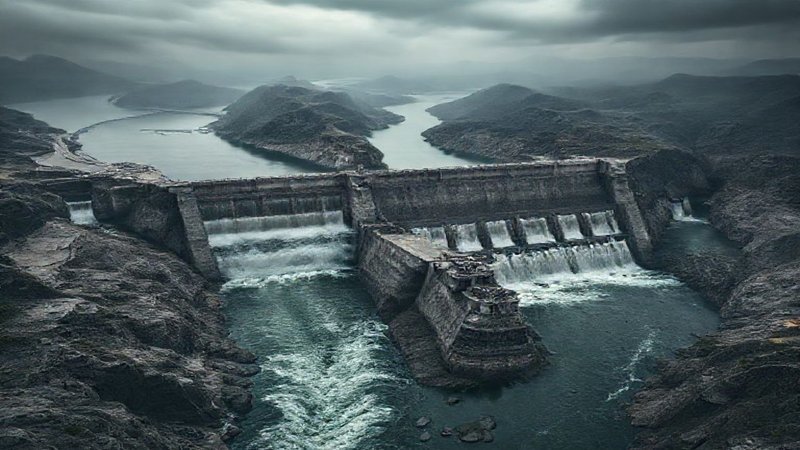
Look closely around you. Rivers that symbolized life for millennia have now transformed into silent battle trenches. Have you ever asked yourself why nations construct colossal dams upstream? They are not merely building concrete walls for electricity generation, but rather constructing keys to control the destinies of downstream populations. Let us begin our journey in the heart of the African continent where the Nile River flows. This lifeline, which has sustained Egypt and Sudan for millennia, now faces an unprecedented challenge. The Grand Ethiopian Renaissance Dam (GERD) is not merely an energy generation project; it represents a complete redefinition of the balance of power in East Africa. Imagine being an Egyptian citizen whose entire life depends on this mighty river. Suddenly, the volume of water reaching you becomes contingent on a political decision in Addis Ababa. The conflict here is not solely over cubic meters of water, but fundamentally a struggle for existence and sovereignty. Old colonial agreements dating back to 1929 and 1959 have been rendered obsolete. Ethiopia asserts its right to development, while Egypt views water scarcity as an existential threat that cannot be tolerated. This tension creates a state of perpetual uncertainty in an already unstable region.
The Cradle of Civilizations: Water as Leverage in the Middle East
Now, let us turn to the Middle East, specifically the Tigris and Euphrates basin. This was once the cradle of civilizations; it may now become the graveyard of geopolitical ambitions. Turkey, which controls the headwaters of these two rivers, has implemented the Southeastern Anatolia Project (GAP), comprising 22 dams and 19 power plants. This project has made Ankara the de facto controller of the water tap supplying Syria and Iraq. In Iraq, the marshes, once described as the “Garden of Eden,” are drying up, and fertile farmlands are turning into arid deserts. The Iraqi farmer who once exported wheat now searches for a measure of water to quench his family’s thirst. Here, the conflict intertwines with ethnic and political tensions, with water being used as a tool for political leverage in unending struggles. Do you grasp the scale of the catastrophe when millions realize their lives depend on the will of a neighboring state that possesses these dams?
Asia’s Third Pole: A Fuse for Potential Nuclear War
Let us venture further east, to where the peaks of the Himalayas touch the sky. Scientists refer to this region as the “Third Pole” due to its vast collection of ice outside the Arctic and Antarctic. From here spring Asia’s greatest rivers, such as the Indus, Brahmaputra, and Mekong. China, the rising superpower, controls the Tibetan Plateau, the source of all these rivers. India, Pakistan, Vietnam, and Thailand all rely on these waters. When China constructs dams on the Brahmaputra, it places a stranglehold on India and Bangladesh. In South Asia, water is not merely a resource but a fuse for a potential nuclear war between India and Pakistan, who share the Indus River waters under a treaty dating back to 1960. This treaty, which has endured through three major wars, is now imperiled by climate change and immense population growth.
Beyond Desalination: The Economic & Political Weight of Virtual Water
You might now wonder, why don’t we seek alternatives? Technology exists, does it not? Indeed, seawater desalination is an option, but it is an extremely costly process that consumes immense energy. Saudi Arabia, the UAE, and Qatar are pioneers in this field, yet can all nations worldwide bear such a cost? Then there is the issue of virtual water. Have you ever considered the amount of water consumed to produce the piece of meat you ate today? To produce one kilogram of beef, approximately fifteen thousand liters of water are required. When a nation imports meat or grain, it is, in effect, importing water. International trade is, at its core, trade in hidden water. Water-scarce nations become economically and politically indebted to water-abundant nations.
The Commodification of Water: Privatization, Climate Change, and Mass Migration
The danger does not stop at national borders; it has reached the very heart of the global capitalist system. In 2020, Wall Street began trading water futures for the first time in history. Water has become a commodity to be speculated upon, just like oil, gold, and wheat. Major corporations are now acquiring water rights in vast regions of the world. When water transforms into a commodity solely driven by profit, what will become of the poor who cannot afford a sip? Privatization threatens to turn water into a privilege for the wealthy, rather than a fundamental human right. This economic shift will create a social and structural divide unprecedented in global history, compelling millions to displace themselves, fleeing thirst and poverty. Climate change pours fuel on the fire. Glacial peaks are melting, and rainfall patterns are shifting erratically. Regions once fertile now suffer from prolonged droughts, while others are submerged by devastating floods. By 2050, scientists predict that over five billion people will suffer from severe water scarcity. This figure represents more than half of the Earth’s population. These individuals will not remain in place to die of thirst. We will witness waves of mass migration, termed “climate migration.” Millions will cross borders in search of water, leading to cultural and security clashes in host nations.
Frequently Asked Questions
Generated by AI Content Architect
About The Author