Secrets of the Sahara: Lost Cities, Green Pastures, and Ancient Civilizations
Secrets of the Sahara: Lost Cities, Green Pastures, and Ancient Civilizations
Navigate Content
The Green Sahara: A Paradise Lost
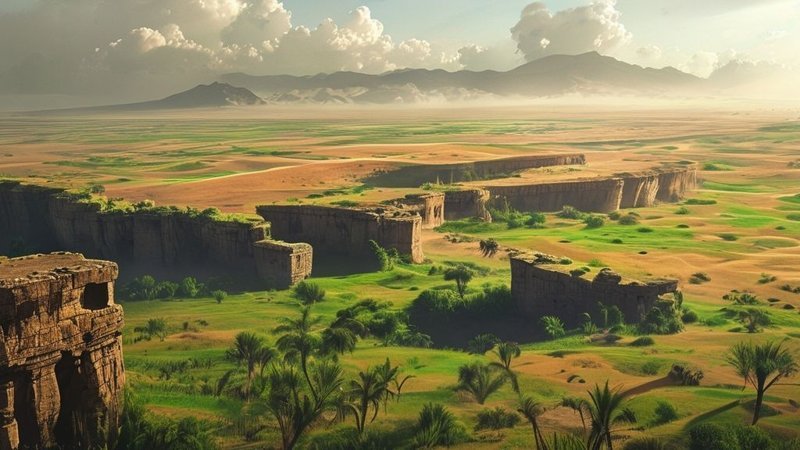
Thousands of years ago, the Sahara was unrecognizable. It was a vast expanse of green plains and savannas sustained by heavy rainfall, supporting immense biodiversity, including elephants, giraffes, and crocodiles. This period, spanning from roughly 10,000 to 4,500 years ago, provided the perfect environment for early human development. These early inhabitants transitioned from hunter-gatherers to established pastoralists and farmers living alongside great rivers and lakes. Evidence of their sophisticated lifestyle is etched into rock art, such as the depictions found in Tassili n’Ajjer, showing daily life and animals now extinct in the region.
Technological Revelation: Reading the Sands from Above
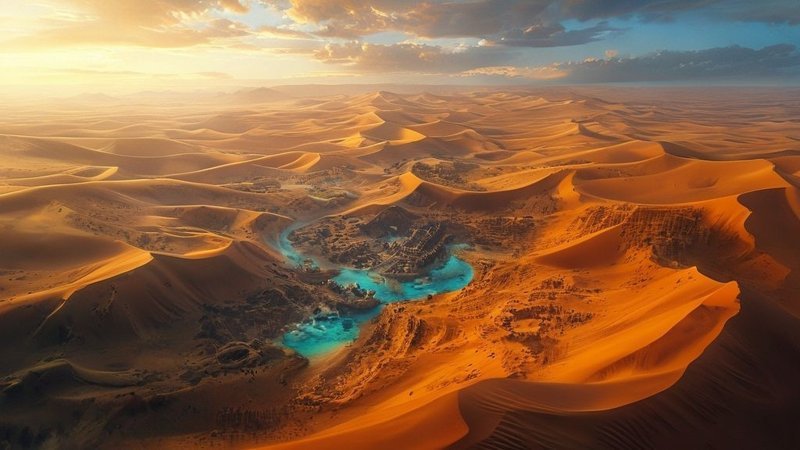
How do we know about this buried world? The sand itself conceals the truth, but modern science acts as a powerful lens. Satellite imagery revealed strange geometric patterns—signs that could not be natural. When these patterns were investigated using advanced methods like Ground-Penetrating Radar (GPR), undeniable proof emerged:
- Traces of ancient, dried-up river systems.
- Intricate networks of irrigation canals built by ancient engineers.
- The clear outlines of buried villages, camps, and entire settlements.
This ongoing discovery process is akin to uncovering a massive, historical archive previously hidden by geology. For more on lost ancient knowledge, explore theories regarding Lost Technology: Ancient Wonders, Vanished Knowledge & Shocking Historical Mysteries.
The Astounding Nabta Playa Culture
Among the most significant findings is the Nabta Playa culture in Egypt’s Western Desert. Approximately 7,500 years ago, this society achieved remarkable feats of engineering and astronomy. They constructed a massive stone circle, recognized as potentially one of the world’s oldest astronomical observatories. This structure allowed them to accurately track the solstices and monitor celestial movements long before the age of the Pharaohs. Their existence raises profound questions about the depth of their societal structure, spiritual beliefs, and potential governance systems that remain largely unknown.

The Slow Death: Climate Shift and Forced Migration
The end of the Green Sahara was not an abrupt disaster but a gradual, crushing environmental siege. Starting around 6,000 years ago, slight shifts in Earth’s orbit reduced solar radiation reaching the region during the critical summer months. This weakened the African monsoon system responsible for the life-giving rains. Water sources began shrinking, turning fertile pastures into arid zones. Faced with relentless drought, the populations were forced into epic migrations:
- Some moved south toward the coast.
- Others migrated east, potentially fueling the rise of the Pharaonic civilization along the Nile.
These mass movements likely resulted in the transfer of knowledge and technology to nascent societies, showcasing the resilience of human culture even when facing ecological collapse.
The Desert’s Graveyard and Future Discoveries
For those who remained, the end was inevitable as the sands reclaimed everything—villages, rivers, and even monuments. Today, the Sahara acts as a colossal vault, safeguarding untold treasures. Every application of new technology—be it advanced radar or orbital imaging—opens another window into this mysterious, buried past. The discovery of a half-buried statue emerging from the dunes serves as a poignant reminder of the powerful forces of nature and the civilizations that once stood firm against them. These ongoing archaeological quests redefine our timeline of human achievement, challenging what we thought possible for ancient peoples.
Frequently Asked Questions
About The Author