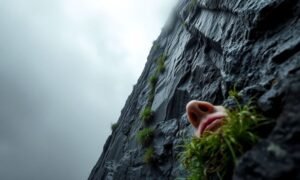
Beneath Our Feet: Hidden Oceans, Ancient Civilizations & Earth’s Unsolved Mysteries

0
image_1-143


Beneath Our Feet: Hidden Oceans, Ancient Civilizations & Earth’s Unsolved Mysteries

Envision that everything you know about your planet is merely a thin crust concealing secrets both terrifying and astonishing. Beneath your very feet lie colossal voids and networks of passages that may harbor the remnants of civilizations we believed to be extinct, or perhaps advanced societies that never departed. Are you prepared to entertain the notion that we are not the sole inhabitants of this planet, and that the true history of humanity is silently inscribed within the dark depths of the Earth?


The Earth’s Hidden Depths: A Geological Enigma

Close your eyes for a moment and perceive the weight pressing down. You now descend into abyssal depths, where time itself stands still and sunlight completely vanishes. The air here is heavy with the scent of minerals and primordial humidity. The rock walls constrict around you, then abruptly expand to reveal chasms large enough to contain entire cities. These are not mere cinematic fictions; they are a geological reality whose contours are slowly and eerily coming into view. In 2018, explorers in Verëvkina Cave in Georgia reached a depth exceeding 2,212 meters below the Earth’s surface. There, in that absolute darkness, they discovered that Earth is not a solid mass as we were taught in schools, but rather a fragile edifice teeming with holes and endless passages. This profound lack of exploration in our own backyard, much like the deep sea secrets we are only beginning to uncover, makes the mysteries of the deep even more compelling. You may believe you live in an era of grand discoveries, yet the truth is we have mapped distant galaxies with greater precision than we have charted the interior of our own planet.

The Earth's Hidden Depths: A Geological Enigma


The Unseen Oceans and Subterranean Life

Scientists now speak of oceans trapped within ringwoodite rocks at a depth of 660 kilometers. The volume of this water surpasses that of all surface oceans combined by three times. If such a colossal amount of water exists, what precludes the existence of life? And what prevents the presence of civilizations that have adapted to thrive in these harsh conditions, far removed from climatic fluctuations, wars, and the meteor strikes that have impacted the surface over millions of years? The implications of such hidden water worlds beneath us are truly astonishing.


Ancient Wonders: Cities Below the Surface

Consider the city of Derinkuyu in Turkey. It was discovered fortuitously in 1963 when a man demolishing a wall in his home found a passage leading to a subterranean city capable of accommodating 20,000 inhabitants. This city is not merely a collection of rudimentary caves; it is an engineering marvel spanning eighteen subterranean levels. It is equipped with:

  • Water wells
  • Oil presses
  • Horse stables
  • Intricate ventilation systems that reach profound depths to provide fresh air for each level

The doors consist of massive circular stones, weighing hundreds of kilograms, designed to be opened exclusively from within. From whom were these people concealing themselves? And why did they undertake such a monumental effort to construct an entire world within the rock? The conventional explanation is to evade invaders, yet the sheer scale of the engineering suggests something far more enduring—something akin to survival from a comprehensive global cataclysm. Such revelations about secret underground cities make us question many historical narratives.

Our attention now shifts to South America, specifically to the Tayos Caves in Ecuador. In 1976, a significant exploratory expedition was launched, notably including astronaut Neil Armstrong. Why would the first man to walk on the moon abandon his myriad commitments to descend into a mysterious chasm in the Ecuadorian jungle? Accounts claim that the Hungarian explorer Juan Moricz discovered a golden library there, comprising metallic plates inscribed with unknown languages. Armstrong himself recounted in his memoirs that this experience was more daunting than his journey into space. The walls in Tayos appear as if laser-cut, with precisely right angles that natural erosional processes cannot explain. One senses being within an exceedingly ancient artificial structure, one that transcends the capabilities of Stone Age humanity. These sites hint at past civilizations with technologies far beyond our understanding.

Ancient Wonders: Cities Below the Surface


Myths, Anomalies, and Hidden Agendas

Let us now delve into the psychological and mythical dimension that unites all peoples across the globe. From the legends of Agharta in Tibet to the tales of indigenous North American peoples concerning their ancestors who emerged from the Earth’s interior after the destruction of a previous world. Could these myths constitute humanity’s collective memory? When the Earth cools, or is subjected to meteorite impacts or lethal radiation, its interior becomes the sole sanctuary. The immense pressure and heat in the depths could represent an inexhaustible source of sustainable energy. Envision a society that developed its technologies based on geomagnetism rather than carbon combustion—a society that observes us from below, much as we observe ants in our gardens.

Contemporary scientific evidence has begun to yield unusual signals. Seismic monitoring devices record waves propagating at anomalous velocities in certain sub-crustal regions. These seismic anomalies suggest the presence of colossal caverns, not filled with magma, but with air or other gases. In 2014, radar satellite imagery unveiled a vast network of passages beneath the Amazon rainforests, extending for thousands of kilometers and connecting disparate archaeological sites. Who excavated these tunnels? And how were the excavated earth and rocks removed without leaving any discernible trace on the surface? These are the profound unsolved mysteries that challenge our understanding of Earth’s geology and history.

You are now likely pondering the reasons why governments might suppress such discoveries. Consider the potential for civilizational shock. If the existence of a civilization more advanced than our own, dwelling beneath us, were to be unequivocally proven, then all our concepts of sovereignty, religion, and history would instantaneously collapse. We prefer to perceive ourselves at the apex of the pyramid, yet the reality may be that we are merely vulnerable surface inhabitants, while the true elite resides in a secure subterranean sanctuary, much like shadow emperors observing from the depths. Observe the natural world around you. Bees construct their hives, ants excavate their intricate cities, and numerous animals seek refuge underground to protect their young. Why do we presume humanity to be the exception? During the periods of great glaciations that Earth has endured, surface temperatures would have made subterranean shelters not just convenient, but essential for survival.


Frequently Asked Questions

What scientific evidence suggests the Earth is not a solid mass but contains vast voids?
Explorers in Verëvkina Cave in Georgia reached depths exceeding 2,212 meters, revealing that the Earth is a fragile edifice teeming with holes and passages. Additionally, scientists have identified colossal oceans trapped within ringwoodite rocks 660 kilometers deep.
What are Derinkuyu and Tayos Caves, and why are they significant?
Derinkuyu in Turkey is an ancient 18-level subterranean city capable of housing 20,000 people, featuring advanced engineering like ventilation systems and massive stone doors. Tayos Caves in Ecuador, explored by Neil Armstrong, contain structures with laser-cut-like precision and are rumored to hold a ‘golden library,’ suggesting advanced, non-natural origins.
What are the ‘hidden oceans’ mentioned in the text?
These are vast quantities of water believed to be trapped within ringwoodite rocks deep within the Earth, specifically at a depth of 660 kilometers. Their estimated volume is three times that of all surface oceans combined, raising questions about potential subterranean life.
Why might governments suppress discoveries of advanced subterranean civilizations?
The text suggests such revelations could cause ‘civilizational shock,’ leading to the collapse of existing concepts of sovereignty, religion, and history. It implies that acknowledging a more advanced civilization below could challenge humanity’s perceived apex position and reveal a ‘true elite’ residing in secure subterranean sanctuaries.

Generated by AI Content Architect

About The Author

Leave a Reply

Your email address will not be published. Required fields are marked *