Fire from the Sky: The Mystery of King Tut’s Extraterrestrial Scarab
Fire from the Sky: The Mystery of King Tut’s Extraterrestrial Scarab
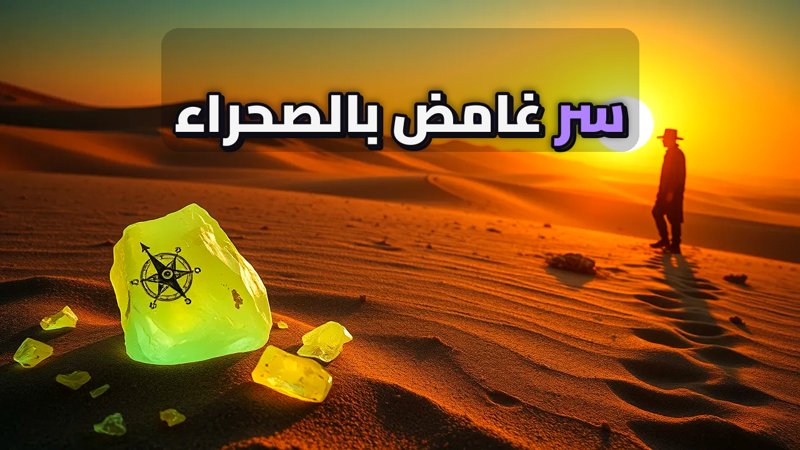
The Sahara Desert is an endless expanse of harsh dunes and scorching heat, hiding secrets that defy logic. Among these is the existence of Libyan Desert Glass—the purest natural glass on Earth—found scattered across the sand without any trace of volcanoes or traditional manufacturing sources. Discover the incredible geological mystery behind this celestial material.
Navigate Content
A Mirage of Pure Glass in the Sahara
Walking through the vast emptiness of the Sahara can play tricks on the mind, but some discoveries are entirely real. Amidst the endless dunes lie fragments of transparent, greenish-yellow glass. This is not ordinary glass; it is remarkably pure, leading many to wonder how glassware ended up in a place devoid of ancient factories or volcanic activity. It resembles phenomena explored in other historical anomalies, much like the mysteries found in Tassili n’Ajjer: The Ancient Sahara Writing Discovery.
Patrick Clayton and the Discovery of 1932
In 1932, English explorer Patrick Clayton, working for the Egyptian Survey Department, ventured into the uncharted Saad region of the Sahara. While mapping the harsh landscape, he stumbled upon vast quantities of glittering glass fragments. Initially believing he had found an unclaimed gemstone mine, laboratory analysis soon revealed a much more baffling reality: the material was composed of 98% silica, making it the purest natural glass on the planet.
The Stubborn Nature of Libyan Desert Glass
To truly understand the anomaly of Libyan Desert Glass, one must look at its physical properties.
- Requires temperatures exceeding 1,600 degrees Celsius to melt.
- Contains an astounding 98% silica content.
- Lacks the impurities typically found in volcanic obsidian or manufactured glass.
Trying to melt a piece in a standard oven would destroy the appliance while leaving the glass completely unaffected.
Solving the Puzzle: Volcanoes, Meteorites, and Airbursts
For years, scientists searched for the immense heat source required to create this glass. Since the region lacks any volcanic history, scientists ruled out obsidian. Direct meteorite impact was also considered, but the complete absence of a crater presented a paradox. This led to the widely accepted ‘airburst’ theory—a cosmic rock that exploded in the atmosphere, unleashing a massive blowtorch-like wave of heat that melted the sand instantly without leaving a physical impact crater.
Frequently Asked Questions
Generated by AI Content Architect
About The Author