Gigantopithecus: Earth’s Largest Ape & The Real King Kong That Lived Alongside Humans
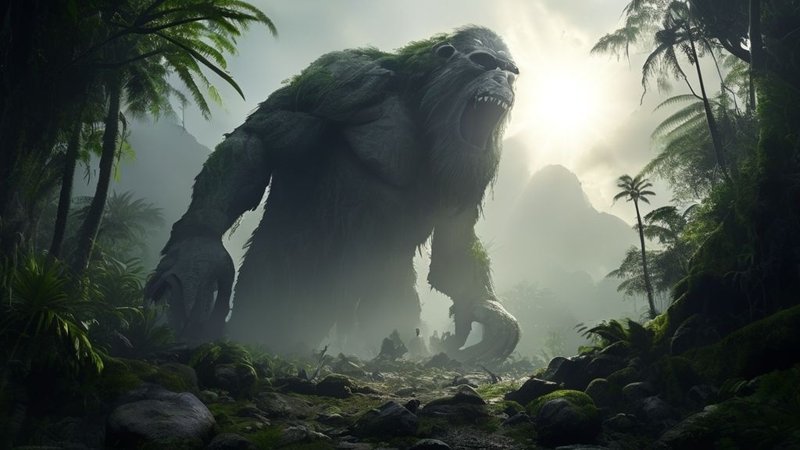
Imagine a shadow stretching to cover a vast expanse of wet forest floor, while a colossal stature completely blocks the sunlight from your eyes. You are now standing before a creature weighing five hundred kilograms and reaching three meters in height, deep within the heart of ancient Asian forests. This is not a scene from a fantasy film, but the terrifying reality of Gigantopithecus, the largest ape ever to walk the Earth.
The story began in 1935, inside a traditional pharmacy in the bustling city of Hong Kong. The German scientist Gustav von Koenigswald was examining what were known as “dragon teeth,” sold as traditional folk remedies. His attention was caught by an immense molar that was bafflingly large, exceeding the size of a human molar by two and a half times. In that moment, the scientist realized he was holding a piece of a historical puzzle that would fundamentally change our understanding of biological evolution in Asia. These teeth did not belong to an ordinary predator; rather, they belonged to a species of giant ape that reached a size no primate had dared to achieve before. It was a discovery that unveiled one of nature’s most formidable creatures, akin to other colossal beings like the Titanoboa or the Basilosaurus that once dominated their respective domains.
King of the Ancient Rainforests
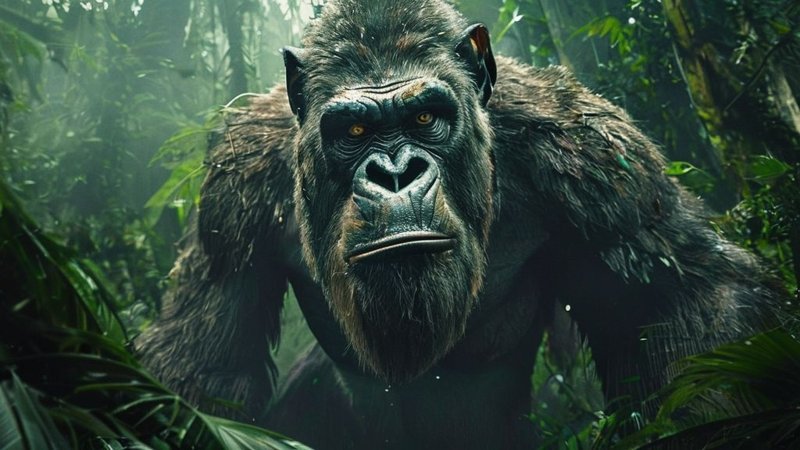
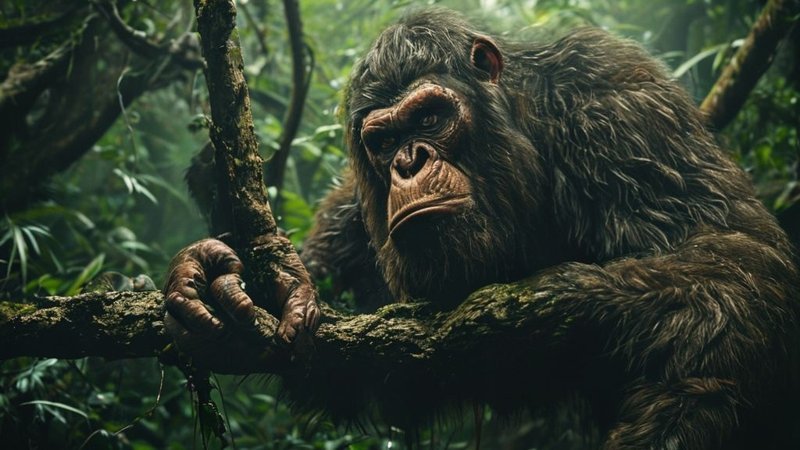
Transport your imagination back to the Pleistocene epoch, approximately two million years ago, when the rainforests of Southern China, Vietnam, and Thailand teemed with strange life. These forests were so dense that daylight barely touched the water-saturated soil. There, Gigantopithecus roamed as the uncrowned king of the jungle. Sense the texture of its coarse, reddish hair as it forced its way through massive bamboo stalks that snapped under the weight of its feet like flimsy matchsticks. You can hear the echo of its heavy breaths reverberating among the tall trees, warning every creature that approached its sovereign territory.
The sheer size of this creature was not merely a number in fossil records, but a complex survival strategy. Due to its enormous bulk, Gigantopithecus had no natural predators that dared to attack it directly. Even the saber-toothed tigers roaming the region would think twice before approaching this giant, who could crush bone and tear flesh with a single swing of its massive hand. Look at the powerful lower jaw discovered by scientists in the caves of Guangxi Province: it is broad, robust, and specifically designed for grinding tough plant fibers. This giant spent most of its day chewing enormous quantities of bamboo and wild fruit to supply its body with the necessary energy to move that tremendous muscle mass.
Coexistence: When Humans Met the Giant Ape
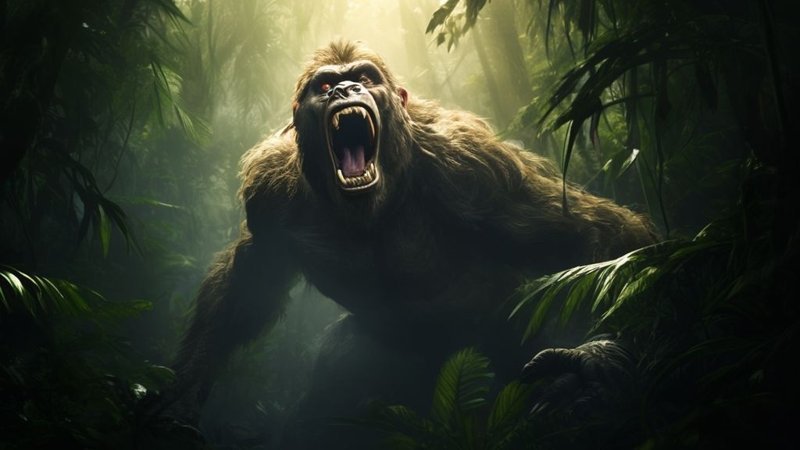
While this giant dominated the forests, small eyes watched it from a distance with caution and awe. These were the eyes of our early human ancestors, specifically Homo erectus. Imagine the first encounter between a short, primitive human and this moving mountain of flesh. Early humans coexisted with Gigantopithecus for an astonishing period spanning hundreds of thousands of years. This coexistence represented an enormous evolutionary and psychological pressure on our ancestors. Can you feel the terror that must have gripped them upon hearing the roars of this behemoth in the dead of night? This constant friction left an indelible mark on the collective memory of Asian peoples, seeping into their myths and folklore concerning giant forest men and ape-like monsters inhabiting misty mountains. This era was fraught with challenges for early humanity, not unlike the existential threats posed by events like The Great Toba Volcano.
The Ecological Trap: Specialization Leads to Extinction
The life of Gigantopithecus depended on an extremely delicate ecological balance. Through the study of carbon isotopes in the enamel of its teeth, scientists discovered that this creature was hyper-specialized in consuming rainforest vegetation. It did not lean toward carnivory, preferring the sugars found in seasonal fruits and the fibers in bamboo. This extreme specialization was its strength during times of abundance, but it became its fatal Achilles’ heel when climatic conditions began to shift. About 300,000 years ago, the Earth entered harsh glacial cycles that caused the desiccation of tropical regions, transforming dense rainforests into expanses of savanna and open grassland.
Imagine the suffering this giant endured as it watched its sustenance gradually vanish. The forest that provided it with protection and abundant food began to shrink, its trees becoming more sparse. Gigantopithecus could no longer find enough calories to maintain its massive size. It was forced to traverse long distances between the remaining patches of forest, making it vulnerable to starvation and exhaustion. Meanwhile, Homo erectus possessed a major competitive advantage: the ability to adapt, use tools, and hunt diverse, smaller prey. The adaptable smaller mind triumphed over the rigid, massive body, a harsh lesson in evolution’s unforgiving nature.
A Legacy in Legend: From Fossils to Folklore
The extinction of Gigantopithecus was not a sudden event, but a slow, agonizing decline. The last populations died out in isolated pockets of mountain forests, leaving behind only those teeth and jaws that, over time, fossilized into hard rock to tell their story. But has its existence truly ended? If you examine the map of Asian folklore, you will find a striking similarity between descriptions of Gigantopithecus and the legends of the Yeti in the Himalayas or the Yeren in the Chinese forests. Some researchers believe these myths are not mere fantasies, but remnants of inherited memories from our ancestors who saw these giants face-to-face and passed down their tales of terror through countless generations. This connection between ancient history and modern legend often fuels unsolved mysteries that captivate us.
Reflect on evolution, and how merciless it is to creatures that refuse to change. Gigantopithecus represented the zenith of gigantism within the primate order and served as living proof that nature can push evolution to its utmost physical limits, much like the strange adaptations seen in the octopus. Studying this creature offers us a unique window into Asia’s turbulent past and illustrates how minor climatic shifts in temperature can erase the mightiest of beings from existence. The bones of this ape tell us that brute strength and massive size are not always the key to survival on an ever-changing planet. When we look at its closest living relatives today, the orangutan, we see glimpses of that ancient history.
Frequently Asked Questions
What was Gigantopithecus and how large was it?
Gigantopithecus was the largest ape to ever live, weighing approximately 500 kilograms (1,100 pounds) and standing up to 3 meters (10 feet) tall. It was a giant primate that roamed ancient Asian forests.
When and where did Gigantopithecus live?
Gigantopithecus lived during the Pleistocene epoch, approximately two million years ago, in the dense rainforests of Southern China, Vietnam, and Thailand.
Did Gigantopithecus coexist with early humans?
Yes, Gigantopithecus coexisted with early human ancestors, specifically Homo erectus, for hundreds of thousands of years. This interaction likely left a significant impact on human collective memory and folklore.
Why did Gigantopithecus go extinct?
Gigantopithecus went extinct primarily due to its extreme dietary specialization in rainforest vegetation. When climatic shifts about 300,000 years ago transformed dense rainforests into savannas and grasslands, its food sources dwindled, leading to starvation and decline.
Is there a connection between Gigantopithecus and folklore creatures like the Yeti?
Some researchers suggest that legends of giant forest men or ape-like monsters in Asian folklore, such as the Yeti or Yeren, could be remnants of inherited memories from early human ancestors who encountered Gigantopithecus, passing down tales of these formidable giants through generations.