The White Pyramids of China: Ancient Secrets, Cover-Ups & Lost Civilizations
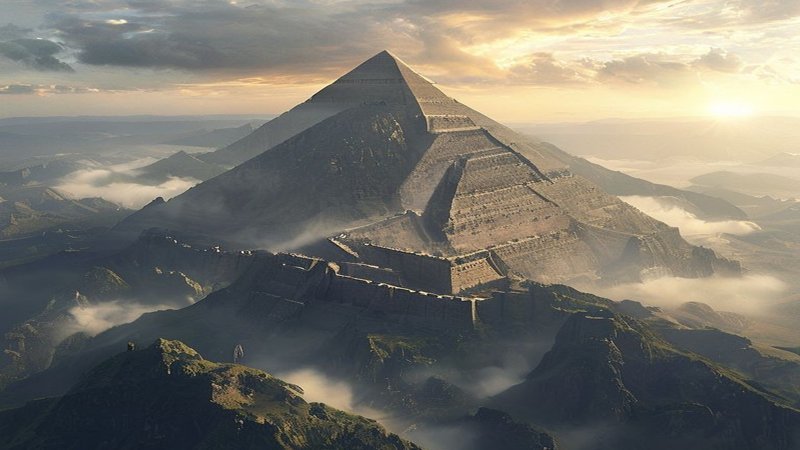
Imagine standing atop a colossal pyramid, surpassing the Giza pyramids in Egypt in sheer size, yet you are not in the Nile Valley, but in the heart of China’s Shaanxi province, where the land conceals deeply silenced secrets beneath its folds. You look around and see no exposed stone, but dense forests of trees meticulously planted to obscure geometric features that nature could not have created by mere chance. You now confront the enigma of the Chinese pyramids, structures that appear via satellite imagery as geometric specters challenging the official historical narrative.
In 1945, American pilot James Gaussman was flying his aircraft over this region when he witnessed something his mind struggled to comprehend. Gaussman described a massive white pyramid, shining intensely in the sunlight, topped by a colossal jewel that reflected the light. This was not merely a pilot’s tale; it marked the beginning of satellite imagery revelations that later uncovered over a hundred scattered pyramid-like structures across the plains of Shaanxi. These structures are not merely earthen mounds, as authorities sometimes suggest. They are precise engineering marvels, oriented towards the stars with astonishing astronomical sophistication.
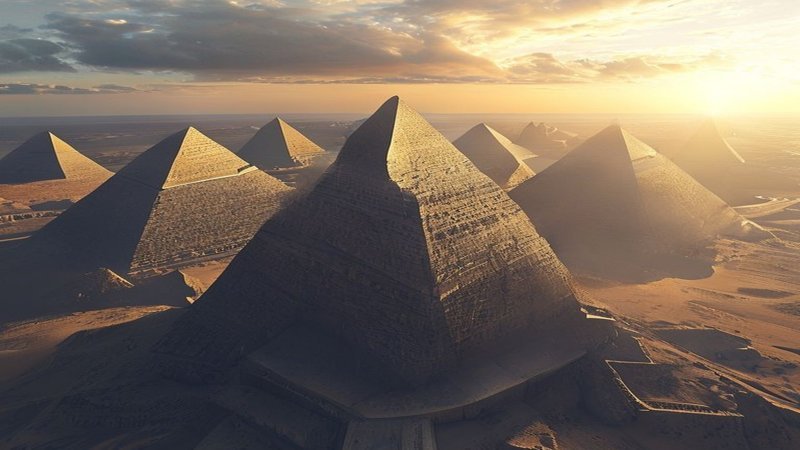
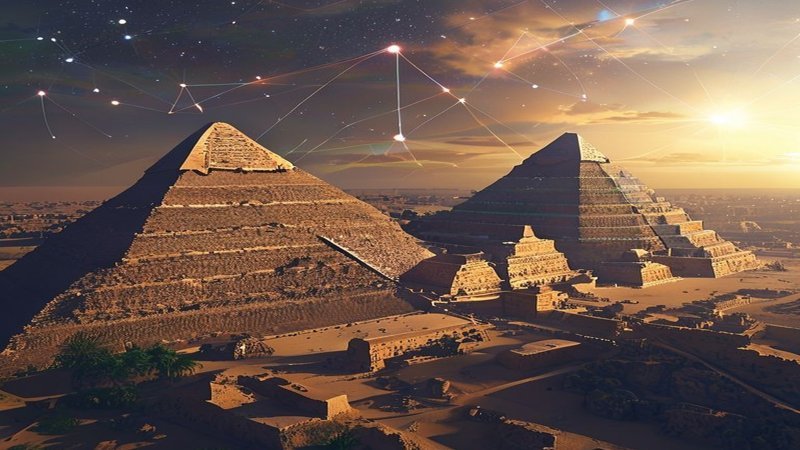
When examining satellite imagery, one observes that these pyramids follow a rigorous geometric distribution. Some align with astonishing precision to the constellation Orion, mirroring the arrangement found in the Giza pyramids in Egypt and the structures of Teotihuacan in Mexico. This global resemblance poses a pressing question: How did civilizations separated by thousands of kilometers and vast oceans arrive at the same geometric design and astronomical orientation? You now realize you are not merely looking at tombs of local emperors, but at a component of a global network of lost knowledge that someone appears intent on keeping concealed. For another ancient enigma, explore Göbekli Tepe: The 12,000-Year-Old Enigma That Rewrites Human History.
The Veil of Secrecy: Why China Hides Its Pyramids
Why does the academic world prevent access to these sites? The answer lies in the complex intersections of science and politics. Chinese authorities impose stringent restrictions on archaeological surveys in this region, prohibiting foreign researchers from conducting comprehensive field studies. They designate them as restricted military zones or justify the prohibition by citing the protection of relics for future generations. However, when viewed through satellite imagery, something suspicious emerges: The Chinese government has planted fast-growing pine trees on the slopes of these pyramids. These trees are not for aesthetic purposes; they serve as an effective means of visual camouflage. With years, these sharp geometric structures will transform into mere natural green hills to the uncritical eye, erasing their original identity as artificial constructions.
This deliberate suppression of information presents a harsh reality. Available academic research is not entirely unrestricted; it is constrained by national agendas aimed at preserving a specific historical narrative. If these pyramids are proven to date back much further than known imperial dynasties, or if their builders are found not to be of indigenous Chinese ethnicity, China’s national history would face an intellectual earthquake. Are you prepared to discover that the identity of these structures’ builders might be linked to a mysterious civilization that predates all others? This reminds us of other historical puzzles, like The Voynich Manuscript: Decoding History’s 600-Year-Old Unbreakable Cipher, where hidden truths challenge established views.
Ancient Builders and Mysterious Legends
In the early 20th century, researchers in a nearby region discovered unusual mummies that sparked widespread controversy. The Tarim mummies, as they are called, possessed traits atypical for the region: blonde and red hair, tall statures, and textiles reminiscent of ancient European civilizations. These findings suggest the presence of migrations and intermingled civilizations in the heart of Asia millennia ago. Could these “white giants” or “sons of heaven,” as described in ancient Chinese legends, be the true engineers of the Shaanxi pyramids? Legends speak of beings who descended from the heavens on iron dragons and aided in constructing these magnificent structures. To you, these might seem like fictional tales, but the precise engineering visible in the images cannot be explained by primitive tools.
Scientific analysis of the terrain reveals that these pyramids were constructed from compacted soil, known as ‘hangtu’. This technique renders the earth as hard as concrete, enabling these structures to withstand erosion for thousands of years. Yet, what raises suspicion is the absence of large stones in the external construction. Some researchers believe that the pyramid’s outer casing, which Gaussman observed, was deliberately dismantled or hidden. Consider this: if these pyramids contain advanced technologies or secret chambers housing sophisticated sciences, possession of such knowledge would represent immense political and scientific power.
Beyond Tombs: Advanced Machines and Suppressed Truths
You now sense the vast disparity between what is disclosed and what is concealed. Politics intervenes to steer science towards a path that serves the stability of the official narrative. Ground-penetrating radar surveys in these areas have revealed massive cavities and passages beneath these pyramids, yet the results remain confined to sealed drawers. Why do they fear the truth? Perhaps because the truth would compel us to re-evaluate the very origin of human civilization. Was there an advanced global civilization that perished in a cosmic catastrophe, leaving behind only these silent pyramids?
The challenge you face as an astute observer is to read between the lines. Consider the Great Pyramid of Shaanxi, sometimes identified as the Mausoleum of Emperor Qin Shi Huang. The official narrative states it remains unopened due to fears of poisonous mercury traps. However, aerial images reveal that the surrounding area is replete with geometric formations resembling integrated circuits on electronic boards. Is it merely a tomb, or is it a defunct ancient machine? Or perhaps an energy transmission device utilized by ancient peoples? These questions are similar to those posed by other ancient high-tech mysteries, such as the Baghdad Battery: Did Ancient Iraqis Use Electricity 2,000 Years Ago? or the advanced techniques of Damascus Steel: Ancient Nanotechnology, Lost Secrets, and Unsolved History. The possibility of advanced ancient technology hidden within these structures raises profound implications for our understanding of history.
Frequently Asked Questions
What are the ‘white pyramids’ of China?
The ‘white pyramids’ refer to over a hundred pyramid-like structures located in China’s Shaanxi province. They are often described as colossal, larger than the Giza pyramids, and are shrouded in mystery due to government restrictions on access and archaeological study. American pilot James Gaussman first reported seeing a ‘massive white pyramid’ in 1945.
Why are these pyramids controversial and kept secret?
These pyramids are controversial because their existence and potential origins challenge official historical narratives. Chinese authorities restrict access to the sites, often citing military reasons or relic protection, and have reportedly planted trees to camouflage them. Researchers suspect this is to prevent foreign study that might uncover evidence of a civilization predating known Chinese dynasties or non-indigenous builders, potentially rewriting history.
What evidence suggests these pyramids are more than just tombs?
Evidence includes their precise astronomical alignment (mirroring Giza and Teotihuacan), their construction from ‘hangtu’ (compacted soil as hard as concrete), and satellite imagery revealing geometric formations around the Great Pyramid of Shaanxi resembling integrated circuits. Legends of ‘white giants’ or ‘sons of heaven’ descending from the heavens to aid construction also hint at advanced origins. Ground-penetrating radar has reportedly detected massive cavities and passages beneath them.
Who might have built the Chinese pyramids?
The true builders are unknown. The text speculates that they might be linked to a mysterious civilization that predates known imperial dynasties. Discoveries of the ‘Tarim mummies’ with European features (blonde/red hair, tall stature) in a nearby region suggest the presence of diverse ancient migrations, leading some to hypothesize these ‘white giants’ from ancient Chinese legends could be the engineers.