The Mystery of Nan Madol: The Stone City on the Water
The Mystery of Nan Madol: The Stone City on the Water
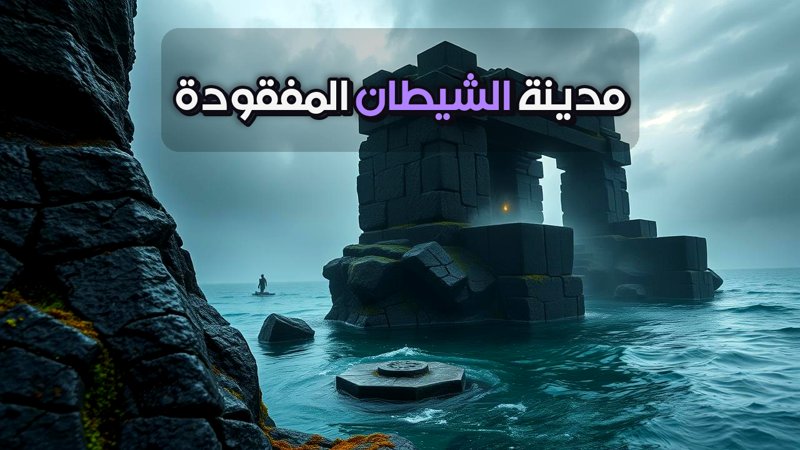
If you open a map in the middle of the Pacific Ocean, you will find an isolated dot called Pohnpei Island. At first glance, it is an ordinary tropical island with green forests and clear waters. However, when we approach the eastern coast, we encounter a completely different reality. Thousands of tons of black volcanic rock are arranged in a way that forces us to ask: How did a city of this scale manage to survive amidst the waves?
Navigate Content
The Impossible Foundation on Coral Reefs
The issue goes beyond mere skill in stacking stones; the true challenge lies in the foundation. We are looking at more than 90 artificial islands built neither on solid ground nor even on sand; they are precisely anchored atop coral reefs. The very idea of raising house-height walls—with stone blocks weighing up to several tons each—upon an underwater coral structure is an incomprehensible engineering risk. Similar ancient wonders, such as The Mystery of Puma Punku: Ancient Engineering or Lost Technology?, force us to rethink what early civilizations could achieve. The contrast between the blackness of the volcanic stone and the nature of the coral supporting it prompts us to ask: Why would anyone choose the most difficult terrain in the region to build their kingdom?
Columnar Basalt and the Quarry Mystery
Look closely at the shape of these stones, and you will notice they are not merely random rock masses; they take the form of hexagonal columns so uniform that you might suspect they were carved by human hands. However, scientific fact says otherwise. These stones are a type of basalt known as columnar basalt, which forms completely naturally when lava cools and contracts, fracturing into precise geometric longitudinal lines.
Yet here we hit our first real enigma. The quarries yielding this type of rock are not located where the city is; they are situated on the completely opposite side of Pohnpei Island. We are talking about long distances and extremely difficult terrain between the source and the construction site over the water.
A Logistical Nightmare Without Metal or Wheels
If we look at the matter from an engineering angle, we face a logistical mystery long before an archaeological one. Estimates indicate the city was constructed using approximately 750,000 tons of basalt rock, precisely distributed across 92 artificial islands. This figure raises a logical question: How did a mass of this weight settle atop coral reefs in a volatile aquatic environment without the foundations collapsing or sinking under the load pressure?
- No metal lifting tools available
- No pulleys or wheels recorded
- Stone blocks weighing up to 50 tons each
- Long-distance transport over dense forests and water
Folklore, Magic, and the Saudeiler Dynasty
The people of Pohnpei Island are convinced that those who built Nan Madol were not ordinary mortals, but rather two sorcerer brothers named Olosohpa and Olosihpa. Local folklore recounts that they arrived at the island from a distant place and used occult powers to make these basalt blocks fly from the quarries and settle into place over the water. Beyond magic, the reality is that what moved these people was an ironfisted governance system established by the Saudeiler dynasty.
A Political Prison on the Water
Behind every stone in Nan Madol, we see the outlines of a rigid social order. The Saudeiler forced rival tribal leaders to reside together within this stone city. The concept was pure political brilliance: isolating the nobles from their popular bases and placing them in a single location under the constant watch of guards. To ensure discipline, they imposed a system of forced labor and heavy food tributes, much like the urban complexities explored in studies of ancient settlements such as The Cahokia Enigma: America’s First Metropolis and Its Sudden Disappearance.
Frequently Asked Questions
Generated by AI Content Architect
About The Author