The Eye of the Sahara: Richat Structure, Astronauts’ Enigma, and the Lost Atlantis
The Eye of the Sahara: Richat Structure, Astronauts’ Enigma, and the Lost Atlantis
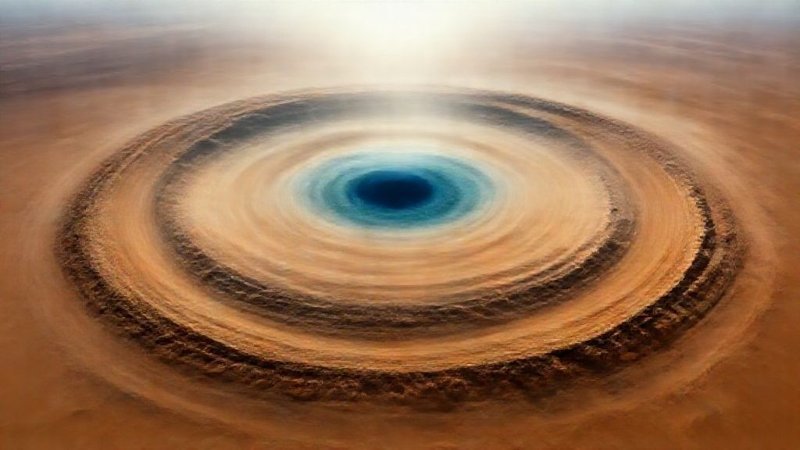
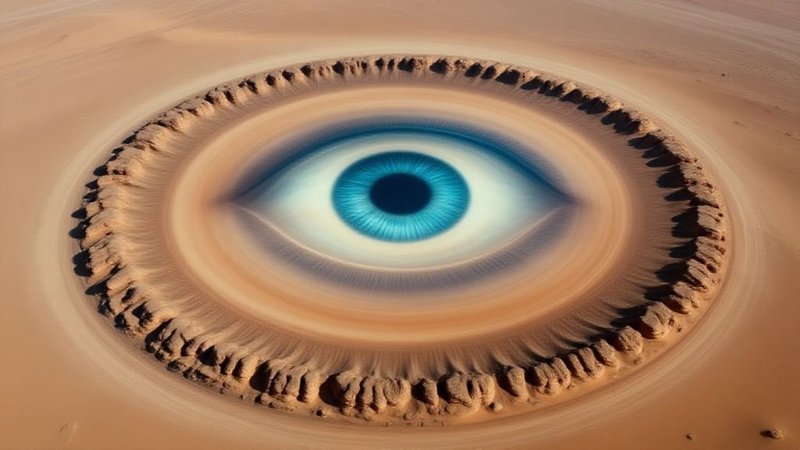
This is the beginning, the inception of a journey that transcends conventional logic, where eyes open to the unexpected, and where silence whispers secrets buried by the sands for millennia. Imagine standing in the heart of the Great Sahara, where nothing exists but the expansive horizon and the iron-smelting heat. You might believe you are alone, yet you are actually standing atop “something” immense, something whose true nature can only be grasped by ascending high, very high, until one brushes the edge of outer space. There, amidst the earth’s dust and the pale color of the sand, a gigantic, unwavering, chillingly blue eye suddenly emerges, as if the Earth has opened its eyelid to observe the stars. This is the “Richat Structure,” or as the world knows it, the “Eye of the Sahara.”
Navigate Content
The Cosmic Fingerprint: A Desert Enigma from Space
Contemplate this magnificent spectacle: interlocking circles of unsettling geometric precision, stretching across an area exceeding forty kilometers. This eye remained unknown to humanity in its full magnitude until human endeavor first reached out into space. Only then were astronauts shocked by the presence of this formation, resembling a cosmic fingerprint on the face of the Earth. However, this is where the unsettling mystery begins: How can a natural formation assume such a perfect circular shape? And why does this location, in all its geographical detail, align precisely with the descriptions found in one of history’s greatest legends?
Plato’s Lost City: Is the Eye of the Sahara Atlantis?
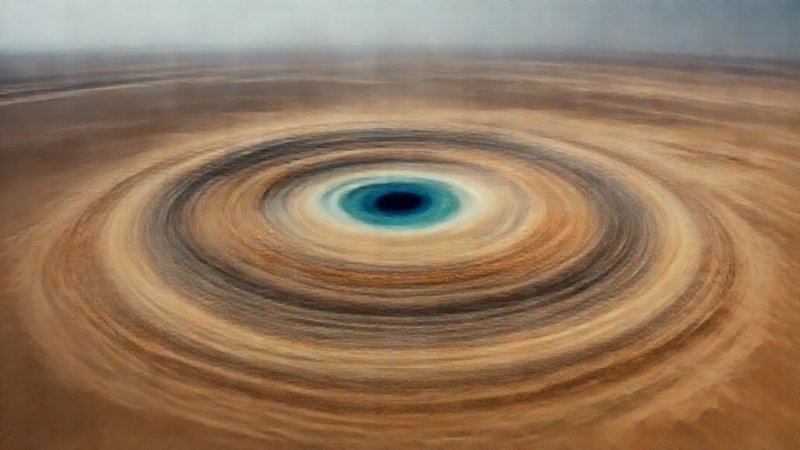
The Greek philosopher Plato spoke over two thousand four hundred years ago of a lost city, an ideal polity, encircled by alternating rings of water and land—the legendary lost city of “Atlantis.” Everyone assumed it was mere fancy, or that it had sunk into the depths of the Atlantic Ocean. But what if the search has been directed at the wrong location? What if the city that drowned did not sink into water, but rather plunged into seas of shifting sand? The comparison between Plato’s precise description of the city’s diameter and topography, and what we observe today in the Richat Structure in Mauritania, confronts us with a terrifying question: Are we witnessing a rare geological coincidence, or are we looking upon the ruins of the greatest vanished civilization known to mankind? This intriguing possibility intertwines ancient myths with geological wonders, urging us to reconsider the history we thought we knew.
Unraveling the Geological Puzzle: Beyond Simple Explanations
Initially, scientists attempted to close this file quickly, claiming it was merely a crater resulting from a massive meteorite impact millions of years ago. Yet, the Earth refuted this explanation; there is no evidence of the molten metals or the shock metamorphism typically left by meteorites. Then, they proposed it was a dormant volcano, but it resembles no volcano known to us. The question hung suspended like a thin thread in the wind: What created these rings? And why do they manifest in this specific location? We are not discussing mere topography, but a mystery rooted deeply in both geology and history, where inert rock intertwines with ancient myths to create a perplexing reality that resists superficial explanations. The journey to decipher this formation has only just begun, and what lies concealed behind these rocky rings could fundamentally alter everything we know about our planet’s history and those cities presumed lost forever—which might, in fact, have always been there, waiting for someone with the courage to see them from above.
The Earth’s Deep Breath: Modern Scientific Insights
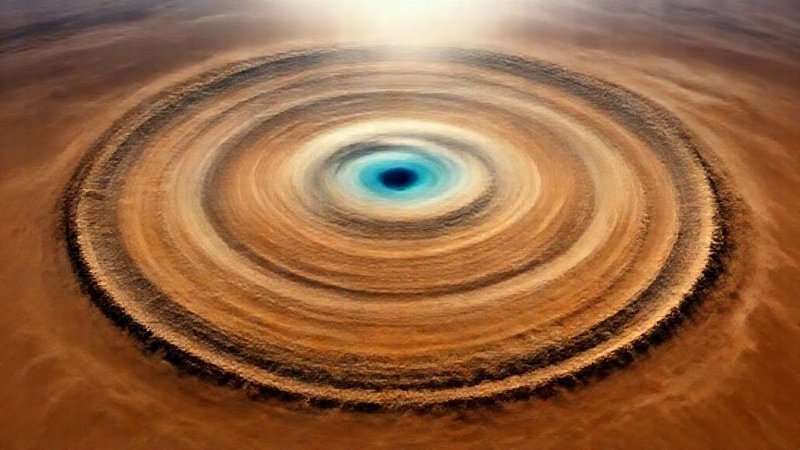
Here, where breath is held before the majesty of the Mauritanian desert, we find ourselves standing not over a mere rock formation, but before a profound wound in the planet’s body, spanning over forty kilometers in diameter. The “Richat Structure” is not just a stunning visual from space; it is a geological document inscribed in the language of stone and time—a language demanding we first understand that the Earth beneath our feet is not as solid as we imagine, but rather a living entity that breathes and transforms over eons. When one examines those symmetrically aligned central circles, the immediate thought might be the impact scar of a violent meteor strike—the hypothesis that prevailed in scientific circles for decades. Yet, remarkably, field studies have revealed a notable absence of “shocked quartz” or any evidence of the extreme temperatures left by meteorites. If the heavens were not the agent, what occurred in the depths of the subterranean inferno? Perhaps the depths hold more secrets than we can fathom.
A Living Document: Layers of Time and Unanswered Questions
The most accepted scientific explanation today takes us on a vertical journey into the Earth’s interior, specifically to approximately one hundred million years ago. Imagine a colossal mass of alkaline magma ascending from the depths, attempting to penetrate the Earth’s crust but failing to erupt as a conventional volcano. This immense pressure caused the overlying sedimentary layers to bulge upwards, forming a massive “dome.” Over epochs, due to tectonic fracturing and internal collapse, this dome began to fold inward upon itself, leaving behind this strange annular structure. Yet, the true marvel lies in the “stratigraphic dissection” of this formation. The layers you observe are not merely colors; they are a precise chronological record. The outer rings consist of hard quartzite rocks dating back to the Precambrian era, while the deep fissures and valleys between the rings are the result of the erosion of softer sedimentary rocks. This contrast in hardness is what allowed relen
As you view these aerial images now, a chill may run down your spine despite the desert heat; the Eye does not merely observe us, it seems to invite us to unearth its secrets. The questions that remain are profound:
As you view these aerial images now, a chill may run down your spine despite the desert heat; the Eye does not merely observe us, it seems to invite us to unearth its secrets. The questions that remain are profound:
- Can geology provide conclusive evidence to settle this debate?
- Will the truth remain buried beneath layers of salts and sedimentary rock?
With every step taken toward the center, we discover that the Earth does not surrender its secrets easily; every answer found merely opens dozens of closed doors, prompting the question: What will we find when we stop looking at the surface and begin to delve into the depths of the geological truth concealed by this Eye?
Frequently Asked Questions
Generated by AI Content Architect
About The Author