NASA Radar Reveals ‘Ghost Rivers’ and Lost Civilizations Buried Beneath the Sahara
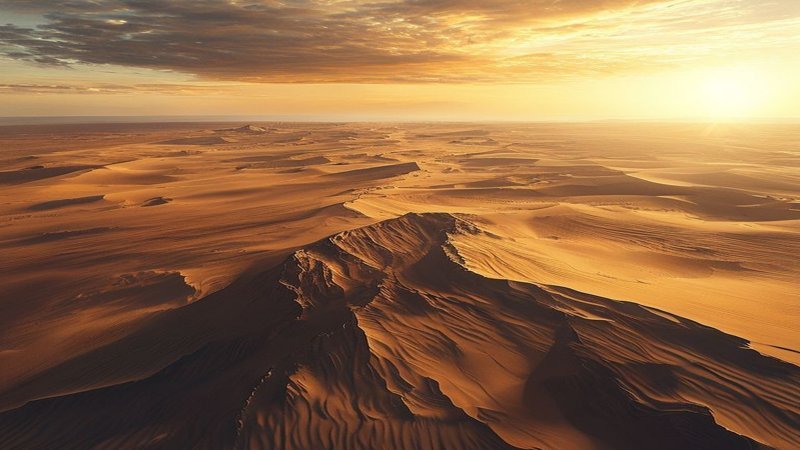
Beneath these deadly sand waves that you see now lies the largest river system the African continent has ever known in its forgotten history. You are not merely observing an arid desert; you are standing atop a mass grave of civilizations and cities submerged beneath an endless sea of yellow. Can you imagine that this scorching inferno was once a verdant paradise, teeming with life and crisscrossed by flowing rivers?
The Great Sand Sea (GSS), covering over seventy-two thousand square kilometers between Egypt and Libya, presents an image of absolute desolation. However, modern science decided to peer beyond the veil. In the 1980s, NASA initiated a groundbreaking experiment using sophisticated radar carried aboard a space shuttle, known as Spaceborne Imaging Radar (SIR). The mission achieved astonishing results because the dry sand in this region possesses a peculiar property: it is entirely transparent to radar waves. These waves were able to penetrate the sand layers several meters down into the earth’s subsurface, revealing the truth that time had buried. Researchers were confronted with stunning maps of deep valleys and vast, ancient rivers flowing through the heart of the desert, proving that the GSS was anything but historically vacant.
The Discovery of the ‘Ghost Rivers’
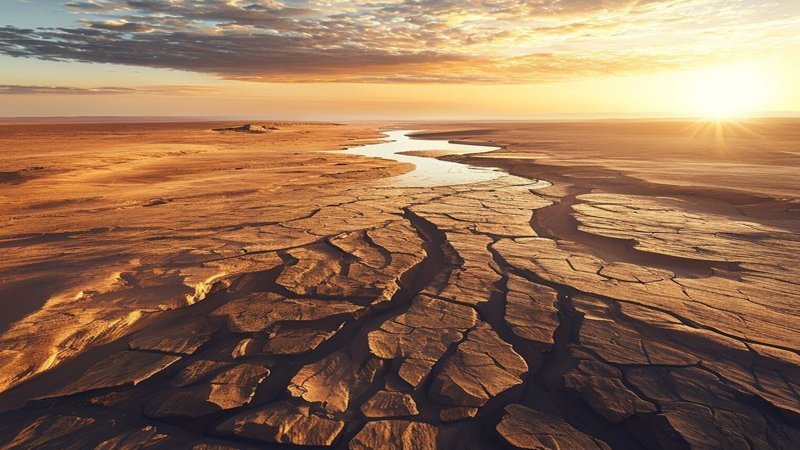
The radar surveys provided detailed geophysical data, mapping entire hidden hydrographic networks. Scientists dubbed these vanished waterways the ‘Ghost Rivers.’ These were not merely transient streams; they were colossal systems that once supported rich ecosystems. Evidence shows these integrated systems fed immense freshwater lakes that covered expansive areas of the Great Sand Sea. Consider the magnitude of these findings:
The True Crucible of Civilization
Subsequent radar surveys and exploratory missions uncovered mysterious stone formations and structures beneath the sands. In the Gilf Kebir area, near the boundaries of the Great Sand Sea, scientists found artifacts dating back to deep antiquity. Crucially, they discovered immense stone circles, structurally similar to the famous Stonehenge observatory in England. These circles, located at Nabta Playa, represent the oldest known astronomical observatory in human history, dating back over seven thousand years. This advanced knowledge suggests a highly organized society, prompting a fundamental shift in our understanding of human settlement.
The long-held belief was that Egyptian civilization originated exclusively along the banks of the Nile.
New evidence suggests the Western Desert and the Great Sand Sea were the true crucible of this civilization.
When the climate shifted approximately five thousand years ago, these populations migrated, carrying their sciences and arts toward the Nile Valley.
These discoveries force us to redraw ancient maps and acknowledge the existence of a highly sophisticated society that predates the Pharaonic dynasties. For a comparison of other ancient sites that challenge accepted history, read about Göbekli Tepe: The 12,000-Year-Old Enigma That Rewrites Human History.
Buried Architecture and Cosmic Evidence
The existence of these ancient societies is supported not just by hydrographic data, but by physical evidence of human construction. Recent radar surveys have shown the foundations of circular and rectangular buildings in areas completely isolated within the Sand Sea. Some of these installations are entirely covered by sand layers reaching twenty meters in thickness, explaining their centuries of obscurity. This period corresponds to the ‘Green Sahara’ phenomenon—climatic cycles where the desert resembled the contemporary savannas, supporting megafauna like giraffes and crocodiles.
The evidence is also preserved in stunning rock carvings, such as those found in the Cave of Swimmers, depicting people swimming in deep water in what is now an arid wasteland. Furthermore, the radar surveys did not stop at revealing rivers; they also exposed strange geological formations known as Libyan Desert Glass. This extremely rare, natural glass is hypothesized to be the result of a massive meteorite impact millions of years ago. To learn more about this strange artifact and its connection to Tutankhamun’s jewelry, check out Libyan Desert Glass Mystery: Tutankhamun’s Scarab and Cosmic Catastrophe.
Frequently Asked Questions
What specifically did NASA’s Spaceborne Imaging Radar (SIR) discover in the Sahara?
The SIR mission discovered vast, desiccated river channels and extensive ancient lake beds buried several meters beneath the sands of the Great Sand Sea (GSS). Scientists dubbed these features ‘Ghost Rivers,’ some of which rivaled the modern Nile in width.
Why was NASA’s radar effective in penetrating the sand?
The dry sand in the Great Sand Sea possesses a unique property that makes it highly transparent to radar waves. This allowed the Spaceborne Imaging Radar to penetrate deep beneath the surface and map geological and hydrological features that were previously invisible.
What is Nabta Playa and why is it historically significant?
Nabta Playa is an archaeological site near the Great Sand Sea where researchers found immense stone circles. It is considered the oldest known astronomical observatory in human history, dating back over seven thousand years, suggesting the inhabitants possessed advanced knowledge of celestial movements.
How does the ‘Ghost Rivers’ discovery change our understanding of early Egyptian civilization?
The evidence suggests that the fertile Western Desert and the Great Sand Sea were the true crucible of sophisticated civilization. As the climate aridified (around 5,000 years ago), these populations migrated eastward, carrying their culture and knowledge, thereby forming the foundation of the Nile Valley civilization.