Ancient Bridge Secrets: Roman Arches, Lost Concrete, and Their Enduring Genius

Ancient Bridge Secrets: Roman Arches, Lost Concrete, and Their Enduring Genius
Envision a bridge of colossal, unyielding stone spanning a deep chasm for two millennia, constructed without a single iron fixture or a grain of modern cement. This structure is not merely a passageway; it is a defiant assertion against the ravages of time and a stark challenge to the laws of gravity as we understand them today. Have you ever considered how our ancestors managed to tame harsh nature using rudimentary tools to create architectural marvels that endure, even as our contemporary bridges collapse after mere decades?
Navigate Content
The Immortal Logic of the Roman Arch
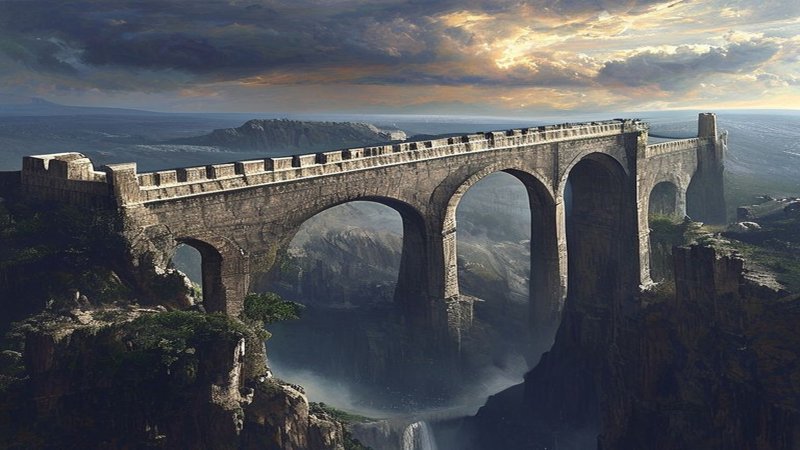
We now stand before the magnificent apotheosis of human intellect. Gazing upon the Alcántara Bridge in Spain, built by the Romans during Emperor Trajan’s reign nearly nineteen hundred years ago, one is struck by a sense of insignificance relative to its immense stone mass. Its resilience lies in the engineering genius of the Roman arch. This technique relies not just on material strength but on the precise distribution of forces. The reciprocal pressure transforms the downward pulling force of gravity into a lateral thrust directed toward the robust abutments. The stone situated at the apex of the arch is the keystone. Without it, the entire structure collapses. With it, the bridge grows stronger as the load above increases. Imagine: the very weight that might be expected to destroy the structure is what solidifies it in place. This mastery hints at other lost Roman technologies, such as the mysterious unbreakable Roman glass.
Living Chemistry: The Secret of Self-Healing Concrete
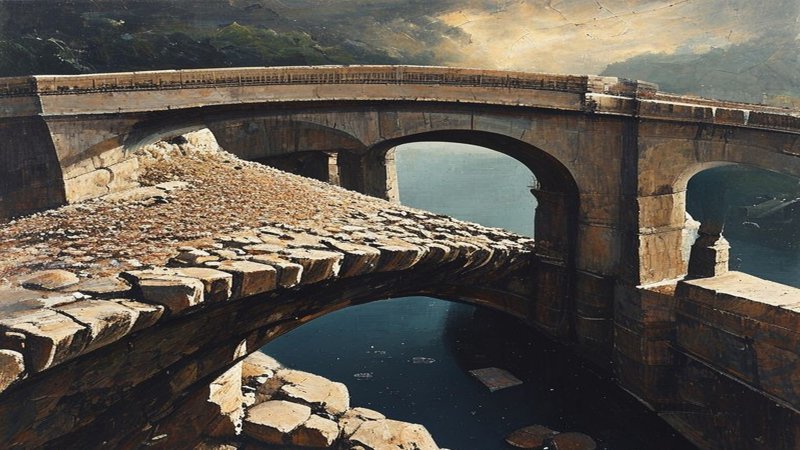
The materials utilized by the ancients were a marvel in themselves. The Romans did not rely exclusively on stone, but also developed a remarkable form of concrete. They mixed volcanic ash with lime and salt water. This proprietary mixture paradoxically increased in strength over centuries, particularly when exposed to water. One is observing not inert material, but a living chemistry that interacts with the environment, becoming part of the planet’s geology. Ancient bridges were not built for temporary utility; they were built for perpetuity. This long-term planning perspective is fundamentally lacking in the contemporary world, which prioritizes quick and inexpensive solutions.
Resilience Over Rigidity: The Inca Grass Bridges
Let us now shift to another region where genius manifests in a completely different form. High in the Andes Mountains, where the Inca Empire reigned, the engineers lacked the stone and techniques of the Romans. Instead, they harnessed nature itself. The Q’eswachaka Bridge is the last remaining hand-woven grass fiber bridge in existence. The secret here lies not in material rigidity, but in communal strength and regenerative capacity. The bridge offers powerful lessons in ancient engineering principles:
- Material: Massive cables woven from local ichu grasses.
- Method: Braided by hand to achieve the thickness of a human thigh.
- Maintenance: Replaced annually in a ceremonial ritual involving the entire community, demonstrating resilience stronger than rigidity.
The Inca mastery of their environment suggests advanced knowledge, echoed by mysteries surrounding the Andes Tunnels Enigma.
Dancing with Disaster: Seismic Flexibility in Chinese Design
To the Far East, we find a Chinese marvel that has withstood fourteen earthquakes and countless devastating floods: the Zhaozhou Bridge, built during the Sui Dynasty more than fourteen hundred years ago. Its designer, Li Chun, introduced the world’s first open-spandrel arch bridge. These smaller openings above the main arch are not merely decorative. They represent technical genius, achieving two primary goals:
- Weight Reduction: Significantly reducing the bridge’s overall mass.
- Water Passage: Allowing floodwaters to pass through, preventing destructive collision with the structure.
For its construction, the Chinese incorporated iron joints to connect the stones, permitting the bridge to flex slightly during seismic activity without fracturing. This is, effectively, dancing with the earth rather than resisting it, contrasting sharply with some historical accounts of Ancient China’s forged history.
The Philosophy of Perpetuity: Craftsmanship and Cohesive Strength
Consider the challenges faced by these builders. They lacked hydraulic cranes or computer-aided design software. They possessed only ropes, pulleys, and an innate understanding of mathematics. Astonishingly, the precision of the stone cutting is so fine that on some ancient bridges, one cannot insert a razor blade between two blocks. This mastery speaks to the philosophy of work at that time; construction was viewed as an act of worship and reverence for the cosmos. The unique materials employed sometimes included unimaginable components. In China, a sticky rice mixture was used in the mortar to bind stones; the amylopectin in the rice provided phenomenal cohesive strength. In other regions, egg whites and animal blood were incorporated to enhance the chemical bonding of the materials. This commitment to perpetuity ensured structures lasted long after their builders were gone.
Frequently Asked Questions
Generated by AI Content Architect
About The Author