Junk DNA: The 98% Unknown Code That May Hide Human Superpowers

0
image_1-144


Junk DNA: The 98% Unknown Code That May Hide Human Superpowers
Envision your body as containing a sealed chamber, the key to which has been lost for millennia. Deep within your cells resides a silent genetic code, once dismissed by science as mere “junk,” yet potentially holding the secret blueprint for enhanced human capabilities.


The 98% Mystery: The Central Control Panel

When you look in the mirror, you observe the culmination of a billion-year evolutionary journey. However, what you see is only the superficial layer of an exquisitely complex biological machine. Inside every cell, DNA is composed of three billion chemical base pairs—the very language in which life is written. The greatest shock scientists encountered upon decoding the human genome was that only two percent of this immense sequence is responsible for building proteins. The remaining 98 percent was simply dubbed “junk DNA.” It was regarded as evolutionary waste or the defunct remnants of our distant past.

Is it plausible that nature, with its astonishing efficiency, would retain such a massive volume of data without purpose? Modern science is slowly but surely revising this opinion. We are now discovering that this ‘dark region’ is, in fact, the central control panel. It dictates when, how, and where your genes operate. It is the hidden engine that may confer abilities exceeding the typical limits of human biology, much like the secrets hidden in the ocean’s ninety-nine percent darkness.

The 98% Mystery: The Central Control Panel


Unlocking the Mansion: Biological Outliers

Consider possessing a magnificent mansion with hundreds of rooms, yet only inhabiting two. The rest of the structure is sealed, lights extinguished, and doors bolted with rusty locks. Within this hidden segment of your genome exist the keys that might grant you extraordinary physical attributes. These are not mere fantastical tales, but biological possibilities buried deep within your structure.

Scientists involved in the massive ENCODE project discovered that this alleged junk is teeming with activity, functioning as an orchestral conductor guiding genes to play the symphony of life. A minor change in this guidance can yield extraordinary results. Consider individuals with a mutation in the LRP5 gene. They demonstrate:

  • Bone density: Their bones are so dense that surgeons struggle to penetrate them with drills.
  • Fracture immunity: They never suffer fractures, even in severe accidents.

This resilience did not emerge from a new gene, but from a modification in the control mechanism within that unknown genomic segment.


The Ghost Genes and Epigenetic Control

Furthermore, we have “jumping genes,” or transposons: mysterious DNA sequences capable of excising and pasting themselves into new locations. They wander ghost-like inside your cells. For a long time, they were dismissed as mere genetic parasites. However, research now indicates they play a crucial role in brain development and evolution. These active transposons, particularly in neurons, create vast diversity in neural connectivity, fostering uniqueness and creativity. These elements may be responsible for sudden genius or the exceptional skills exhibited by certain individuals.

Your genome is not a static text but an ongoing, creative process. This introduces the field of epigenetics, which reveals that your lifestyle, diet, and even your emotions can place chemical markers on your DNA. These markers do not alter the sequence itself, but they modify how the code is read. You possess the ability to switch specific genes on or off, acting as the engineer capable of redesigning your internal structure. This capacity to influence our internal structure links closely to the potential of finding hidden cures and biological advancements.
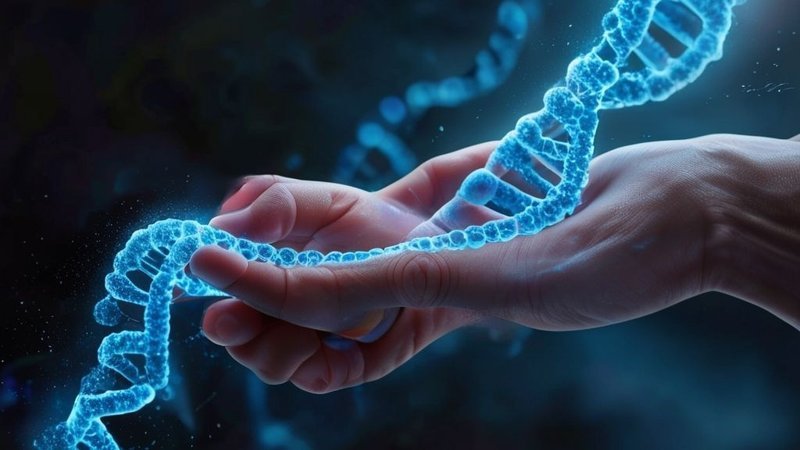
The Ghost Genes and Epigenetic Control


We Are Hybrids: The Ancient Viral Secret

An even more profound secret is concealed within your heritage: eight percent of your DNA is not originally human; it is viral. Over millions of years, our ancestors endured fierce viral attacks. Some viruses integrated their genetic code into the reproductive cells of our forebears, thus transmitting these viral sequences through the generations. We carry within us the remnants of ancient pandemics.

Astonishingly, we have co-opted these viruses for our benefit. Without a specific viral protein called syncytin, the placenta could not form in the mother’s womb, and none of us would be born. We are hybrid organisms, a blend of mammalian cells and ancient viral debris. This hidden viral segment may hold the keys to extraordinary immunity against future diseases, or perhaps the capacity to reshape our bodies in ways we cannot yet imagine.


The Superhuman Frontier and CRISPR’s Warning

Examining biological outliers reveals the potential locked within the 98% segment. Consider these examples of genetic lottery winners:

  • Myostatin Mutation: This gene normally limits muscle growth. Its deactivation can lead to exponential muscle growth without significant effort.
  • DEC2 Gene: Individuals with this gene require only four hours of sleep daily to feel fully refreshed.

These are the superhumans living among us today, humans who, by genetic chance, have activated a portion of that hidden treasure.

Science now stands at the precipice. Gene-editing technologies like CRISPR are beginning to grant us the ability to manipulate these secrets. Yet, the core issue remains our incomplete understanding of the hidden segment’s full language. Tampering with this intricate system is akin to attempting to repair an atomic clock with a hammer; a minor error could result in catastrophic outcomes or new diseases unknown to humankind. This unknown part of your genome is the final frontier of human evolution—the raw material from which the next stage of our species may emerge.

The Superhuman Frontier and CRISPR’s Warning


Frequently Asked Questions

What is ‘junk DNA’ and how much of the human genome does it comprise?
Junk DNA is the term scientists initially used to describe the 98% of the human genome that does not code for proteins. Modern research, however, reveals that this segment is a crucial control panel.
If it doesn’t code for proteins, what is the function of the 98% of non-coding DNA?
This non-coding DNA acts as the central control mechanism. Projects like ENCODE show it dictates when, how, and where the 2% of protein-coding genes are turned on or off, functioning as an orchestral conductor for biological processes.
Are ‘jumping genes’ (transposons) dangerous or beneficial?
While once dismissed as genetic parasites, transposons are now understood to be crucial for human evolution and development. They are highly active in neurons, generating diversity in neural connectivity that fosters uniqueness and creativity.
How much of human DNA is viral, and is this dangerous?
Approximately eight percent of human DNA is viral, integrated from ancient viruses that infected our ancestors. This is not dangerous; in fact, we rely on it. A specific viral protein called syncytin is essential for the formation of the placenta.

Generated by AI Content Architect

About The Author

Leave a Reply

Your email address will not be published. Required fields are marked *