Deep Sea Secrets: Ninety-Nine Percent Darkness and Shocking Marine Life
Deep Sea Secrets: Ninety-Nine Percent Darkness and Shocking Marine Life
Ninety-nine percent of our planet exists in absolute, crushing darkness—the abyssal depths of the ocean. Descending beyond the reach of sunlight introduces us to ecosystems governed by extreme pressure, bioluminescence, and creatures that defy conventional biology. This realm is a cosmic laboratory on Earth, challenging everything we thought we knew about life’s potential.
Navigate Content
The Midnight Zone: Light’s Sudden End
At 1,000 meters, sunlight vanishes entirely, plunging you into the midnight zone. Here, the atmospheric pressure is astronomical. Yet, life thrives. We encounter startling adaptations, such as the Barreleye fish, which has evolved a completely transparent, dome-shaped head allowing it to see the silhouettes of prey swimming above using its internal, glowing green eyes. This biological architecture shows evolution prioritizing survival in scarcity.
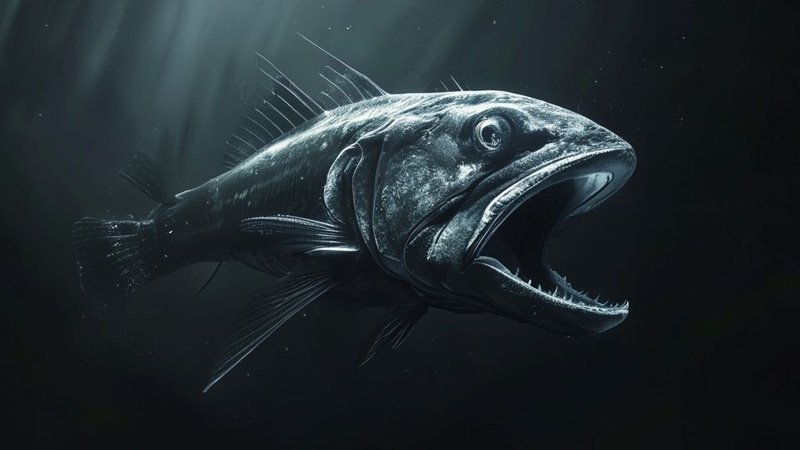
Monsters of the Deep: Colossal and Camouflaged
As the descent continues, the bizarre nature of deep-sea life becomes more apparent:
- The Siphonophore: A colony of thousands of zooids functioning as one, sometimes stretching 50 meters long, using eerie bioluminescence to hunt.
- The Black Seadevil: This predator must consume anything it finds, capable of swallowing prey ten times its size, stretching its stomach into a translucent balloon.
- The Giant Squid: Living in isolation, this behemoth battles sperm whales and possesses eyes the size of dinner plates engineered only to detect faint light flickers.
Life Independent of the Sun: Chemosynthesis and Resilience
At hydrothermal vents, life completely ignores solar energy. Water erupts at 400 degrees Celsius, yet giant tube worms flourish. They rely on chemosynthesis, where bacteria convert toxic chemicals into energy. Scientists suggest this environment, utterly independent of the sun, may mirror where life on Earth first originated. This resilience hints at possibilities beyond our planet, perhaps on icy moons like Europa or Enceladus.
The Hadal Zone: Surviving Crushing Pressure
The deepest parts, like the Mariana Trench (11,000 meters), house creatures like the Snailfish (Pseudoliparis swirei). This transparent, gelatinous organism withstands pressure equivalent to an elephant on a grain of rice. Its survival relies on specialized biochemistry: proteins configured to resist cellular collapse under immense force. Furthermore, transparency, seen also in the Glass Octopus, becomes the ultimate camouflage when light is non-existent.
Echoes of Deep Time and Unsolved Mysteries
The deep sea acts as a time capsule. The Frilled Shark, a ‘living fossil,’ retains a form unchanged for eighty million years, sporting 300 razor-sharp teeth. Despite these known inhabitants, scientists estimate we have explored less than five percent of the ocean floor. Unexplained phenomena, like the massive ‘Blooper’ sound recorded across the Pacific, leave open the unsettling question: what unknown, perhaps gigantic, life forms inhabit the vast, unexplored layers beneath us?
Frequently Asked Questions
Generated by AI Content Architect
About The Author