Puma Punku Enigma: Ancient Engineering That Defied Modern Technology
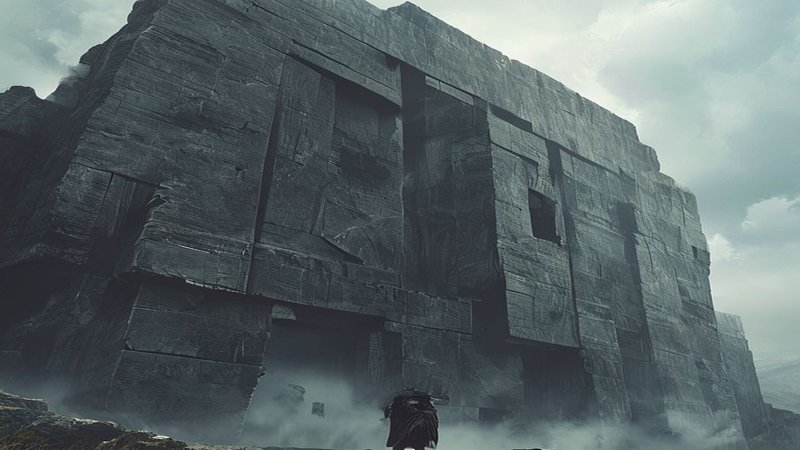
Imagine standing before an unyielding stone wall—not just any wall, but a massive block of volcanic andesite, harder than iron. You then discover this stone has been cut with such sharp right angles that merely touching it could cause injury. We are not referring to a modern workshop utilizing lasers; rather, these are the ruins of the Puma Punku complex in the Bolivian highlands, where the very laws of history and physics appear to have been rewritten. Here, at an altitude exceeding 3,800 meters above sea level, where oxygen is scarce and breathing is labored, lies an architectural marvel that defies everything we have learned about ancient eras from history books.
Gazing upon these colossal stones, you feel the coldness and immense strength of the rock. However, you are astonished by the regularity of the perfectly carved holes, featuring a constant depth, uniform to within a millimeter along their entire length. You are witnessing not merely an ancient structure, but advanced mechanical engineering manifested in solid stone. These blocks, some weighing over 130 tons, were not carved using stone or copper chisels, as some suggest. Try striking a piece of granite with copper yourself; you will find the copper deforms while the stone remains intact. How, then, did the builders of Tiwanaku manage to manipulate this stone as if it were soft butter in their hands?
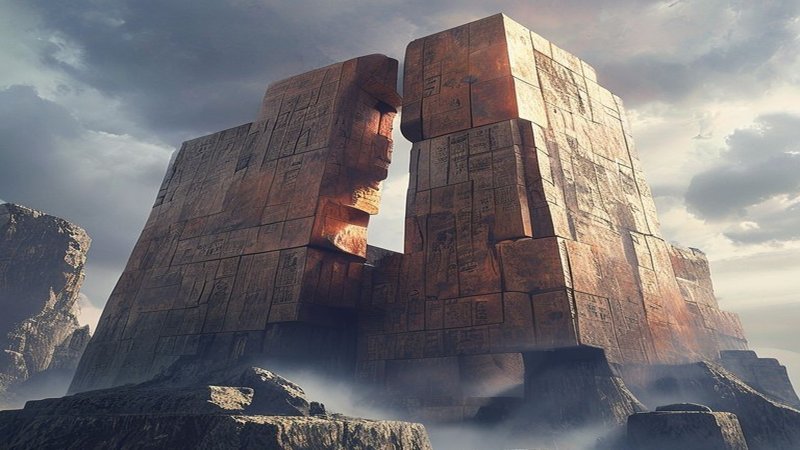
Look closely at the pieces scientists refer to as ‘H-blocks.’ These elements are so identical, so perfectly symmetrical, they suggest they were manufactured using a single mold or precision-programmed cutting machinery. If you place one block atop another, the corners align with such precision that not even a thin sheet of paper could pass between them. This level of mastery demands extremely accurate measurement tools and cutting implements far harder than andesite—a reality that forces us to confront a staggering question regarding the technology possessed by these people millennia ago. Can you conceive of the effort and intellect required to quarry a 450-ton block several kilometers away, then transport, lift, and place it with such exactitude? This site stands as a true engineering enigma.
Unearthing Lost Technologies and Advanced Metallurgy
The scene at Puma Punku is not just a scattering of stones; it is a complex artistic tableau narrating the story of a civilization that understood the secrets of spatial geometry beyond imagination. You will observe extremely precise cavities shaped like the English letters ‘T’ and ‘I.’ These recesses were intended for pouring molten metal to join the stones together. We are discussing metal joining technology from an era when it is assumed humans relied solely on ropes and wooden pegs. Touching these metallic inserts reveals that you are confronting minds capable of smelting and alloying metals to create durable compounds resistant to time and earthquakes.
You are undoubtedly wondering now: where are the tools used to achieve this miracle? This is the dark gap in the narrative. Excavators have failed to uncover a single trace of advanced machinery or engineering schematics. All that remains are these silent stones screaming of genius. The precision evident in the stone edges is not accidental; it is the product of profound knowledge in mathematics and trigonometry. The perfectly ninety-degree angles and mirror-smooth surfaces lead one to question whether these builders utilized an energy source unknown to us today, or if human history contains lost chapters of civilizations that reached peaks of development only to vanish without a trace. These ancient secrets of metallurgy and construction remain a profound puzzle.
Celestial Connections and Cataclysmic Theories
Envision the silence enveloping this place at night, under the stars adorning the pristine Andean sky. Tiwanaku is said to have been a spiritual and astronomical center, with some structures aligning with celestial movements and the sun with unparalleled accuracy. This connection between Earth and sky imbues Puma Punku with an aura of sanctity and mystery. Walking among these ruins, you feel as though you are traversing a crash site of an ancient spacecraft or an abandoned factory from an undocumented era. The stones here are not mere building materials; they are a memory engraved with extraordinary intelligence.
The journey into the depths of Puma Punku compels a re-evaluation of how our past is written. You are not viewing a structure decaying, but one designed for eternity, only overcome by violent natural catastrophes that tossed these colossal blocks around as if they were toys. The force required to shatter blocks of such magnitude and hardness suggests a cataclysmic event fundamentally altered the region, leaving us grappling to understand what occurred. This site truly represents an unsolved mystery of monumental proportions.
Challenging Conventional History and Modern Science
Investigating the secrets of Puma Punku leads one to ponder the capabilities of the human mind when unshackled from constraints. Is it possible that our ancestors discovered methods for cutting rock using sonic frequencies or concentrated heat? Conventional science attempts to simplify the matter, but the evidence visible to the eye rejects superficial explanations. The internal edges of some pieces display parallel longitudinal grooves that could only be produced by a rapidly rotating drill head—a feat inconsistent with the Neolithic or Bronze Age attributed to the site.
You are now experiencing a legitimate sense of perplexity, one shared by every seeker of truth. Puma Punku is more than an archaeological site; it is a challenge hurled at the arrogance of modern science, which presumes to have reached the zenith of knowledge. These stones tell us that the past held secrets we may have forgotten. The engineering techniques used to carve granite and andesite with such smoothness remain one of history’s greatest unsolved mysteries. Every stone here recounts a story of defying gravity, defying hardness, and defying time itself. The existence of advanced lost civilizations here and elsewhere pushes the boundaries of our accepted historical narratives.
Frequently Asked Questions
What makes Puma Punku’s architecture so mysterious?
The architecture features impossibly precise cuts in volcanic andesite, perfectly uniform holes, and ‘H-blocks’ with millimeter-level symmetry, all without any evidence of the tools required by ancient humans to achieve such feats.
What materials were the Puma Punku structures built from, and why is this significant?
The structures were built primarily from volcanic andesite and granite, stones harder than iron. Their manipulation to such precise forms defies the capabilities of known ancient tools like copper or stone chisels, suggesting a highly advanced, unknown technology was employed.
How did the builders of Puma Punku join the massive stones?
The builders utilized precise ‘T’ and ‘I’ shaped cavities in the stones, into which molten metal was poured to create durable joints. This indicates advanced metallurgy and metal-working technology far beyond what is commonly attributed to the era.
What theories exist regarding the tools or methods used at Puma Punku?
While no traditional tools have been found, theories suggest the builders might have used unknown energy sources, sonic frequencies, concentrated heat, or rapidly rotating drill heads. The precision observed challenges conventional archaeological explanations of Neolithic or Bronze Age technology.
What ultimately happened to Puma Punku?
The site shows clear signs of violent natural catastrophes that tossed colossal blocks around as if they were toys. This suggests a cataclysmic event fundamentally altered the region, despite the structures originally appearing to have been designed for eternity with advanced knowledge of soil mechanics and load distribution.