
The Beetle’s Brain: Microscopic Bio-Computer Surpassing Human Technology

The Beetle’s Brain: Microscopic Bio-Computer Surpassing Human Technology
We often dismiss the beetle as a simple crawler, yet beneath its minuscule shell resides an evolutionary masterpiece: a bio-computer that dwarfs the capabilities of our most powerful silicon chips in terms of efficiency and complexity. This article explores how hundreds of thousands of neurons, packed into a space the size of a grain of sand, execute feats of navigation, chemical engineering, and memory storage that challenge our understanding of scale and intelligence.
Navigate Content
The Microscopic Processor: A Feat of Scale
The beetle’s central nervous system is a testament to optimized engineering. While massive human-made processors require enormous power and cooling, this brain functions on minimal energy derived from simple sugars. It is partitioned into specialized centers, with a significant portion dedicated to visual processing via massive optical lobes, allowing it to translate light fluctuations into immediate, life-saving decisions concerning descent angles and trajectory tracking. This level of parallel processing efficiency inspires modern attempts to create neuromorphic computing.
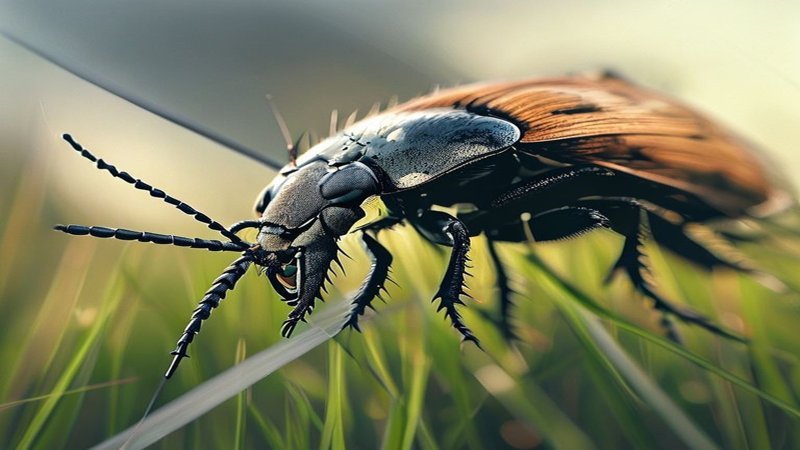
Celestial Navigation: The Global Positioning System of the Dung Beetle
Perhaps the most stunning capability lies within the central complex—the beetle’s GPS. The dung beetle, for example, utilizes celestial cues that humans struggle to perceive. It reads the light band emitted by the Milky Way, transforming faint starlight from millions of light-years away into a definitive, straight roadmap across the desert. This isn’t mere instinct; it’s the neural translation of astronomical data into critical navigation commands.
Learning, Memory, and Chemical Warfare
The brain houses structures called mushroom bodies, crucial centers for spatial memory and learning. While we might lose track of mundane objects, the beetle retains detailed maps of resource locations and complex terrain to navigate back to its burrow. Furthermore, its defensive capabilities showcase incredible neural timing:
- The bombardier beetle requires synchronized electrical and chemical signals.
- It mixes two chemicals internally to produce a superheated, precisely aimed blast.
- This defense necessitates instantaneous calculations of distance, speed, and wind, proving the brain acts as an expert munitions engineer.

Sensory Language and Social Intelligence
The beetle’s sensory input far exceeds human perception. In dense environments, its antennae transmit complex electrical impulses to olfactory lobes, where thousands of chemical molecules are sorted to decode the ‘language’ of the air—distinguishing mates, predators, and food sources. For social species, specialized neural circuits manage group dynamics, balancing individual needs with the welfare of the colony, a miniature political operation executed with flawless efficiency over millennia.
The Architecture of Speed: Maximizing Neural Density
The physical structure of the beetle’s brain is engineered for supreme velocity. To achieve lightning-fast reactions, the spaces between neurons are minimized, creating exceptional neural density. Connections are kept as short-range as possible to reduce signal latency. This compact, high-speed architecture is what scientists seek to emulate when designing next-generation, energy-efficient artificial intelligence systems.

Frequently Asked Questions
Generated by AI Content Architect
About The Author