Göbekli Tepe: The 12,000-Year-Old Enigma That Rewrites Human History

Göbekli Tepe: The 12,000-Year-Old Enigma That Rewrites Human History
Envision yourself standing in the heart of an arid plateau in southeastern Turkey, where winds whisper secrets buried beneath the earth for millennia. You are now confronted with a truth that has shaken the foundations of archaeology and compelled historians to revise their ancient texts. Göbeklitepe is not merely a collection of stones; it is the inaugural cry of human civilization, echoing twelve millennia ago. Before humanity discovered agriculture, domesticated animals, or developed writing, something was constructed that, by conventional understanding, should not have existed. Massive structures, weighing tens of tons, were meticulously arranged to observe the stars in the Neolithic sky. One gazes upon the dawn of history, where earth meets sky in the greatest architectural enigma known to humankind.
Navigate Content
-
The Dawn of Civilization: A Staggering Discovery
-
Neolithic Architects: Mastery of Geometry and Scale
-
Celestial Harmony: An Ancient Astronomical Observatory
-
Beyond Hunter-Gatherers: Social Organization and Purpose
-
The Vulture Stone: A Cosmic Catastrophe Warning?
-
An Enduring Enigma: Questions Etched in Stone
-
FAQ
The Dawn of Civilization: A Staggering Discovery
In 1994, German archaeologist Klaus Schmidt stumbled upon what he initially believed to be a natural rock formation in southeastern Turkey. Once excavations began, however, he discovered that the earth concealed a veritable forest of T-shaped stone pillars. These were not random stones but astonishing artistic carvings bearing intricate depictions of predatory animals and complex astronomical symbols. The true shock was not merely the scale of the construction but its age. Radiocarbon dating revealed that this site dates back to 9600 BCE, making it seven thousand years older than the Pyramids of Giza and six thousand years older than Stonehenge in Britain. Here, one witnesses an engineering marvel created by humans who were supposedly simple hunter-gatherers living in rudimentary caves. This profound discovery fundamentally challenges our understanding of early human development. For more on this groundbreaking site, read about the Göbeklitepe Enigma: 12,000-Year-Old Temple Rewrites Human History.

Neolithic Architects: Mastery of Geometry and Scale
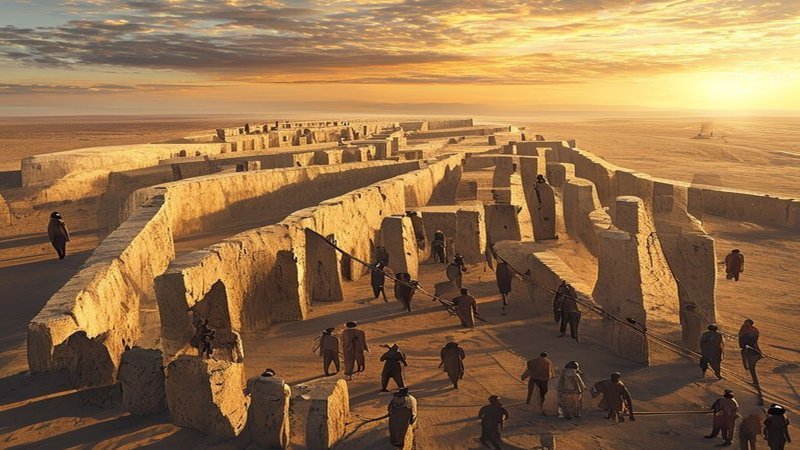
Observe closely the arrangement of these circular temples. Researchers at Tel Aviv University uncovered a startling secret within the site’s architectural planning: using analytical algorithms, they found that the geometric centers of three enormous enclosures form an almost perfectly equilateral triangle. This discovery challenges everything known about our ancient ancestors. Drawing an equilateral triangle requires deep geometric knowledge and the ability to accurately measure long distances. How did Neolithic humans plan a project of this magnitude before the invention of the ruler and compass? This implies a formidable engineering intellect that managed hundreds of workers, precisely locating points in space to achieve this cosmic harmony in construction. Such precision points to an enduring genius previously attributed to much later civilizations.
Celestial Harmony: An Ancient Astronomical Observatory
The mystery deepens when you raise your gaze skyward. The colossal pillars at Göbeklitepe are not randomly distributed; they are precisely oriented astronomical observatories directed towards specific celestial bodies. Many archaeoastronomers believe the site was designed to track Sirius, the brightest star in the night sky. In that distant era, this star appeared on the horizon at specific times linked to nature’s cycles. Other hypotheses suggest a connection to the Cygnus constellation, located in the heart of the Milky Way. Imagine these early humans observing celestial movements for years, then deciding to immortalize this motion in stones, each weighing twenty tons. One feels the grandeur of those who not only sought to survive but aspired to comprehend the secrets of the cosmos, much like the celestial observations possibly encoded in the Nazca Lines.
Beyond Hunter-Gatherers: Social Organization and Purpose
Consider the immense physical and mental effort required to transport these megaliths. Workers had to quarry massive blocks of limestone from nearby sites using simple stone tools like flint. Then, they had to drag these blocks over long distances and raise them to be set into deep pits. This undertaking demanded a formidable social organization, which we previously did not believe existed in that era. You are not witnessing an individual effort, but a communal project that united thousands of people under a single concept. This concept was likely religion or spirituality. Göbeklitepe overturned the historical paradigm that agriculture led to human settlement and subsequent temple construction. The truth here is that the temple gathered people, compelling them to innovate to provide food for those involved in the construction, which later led to the discovery of agriculture.
The Vulture Stone: A Cosmic Catastrophe Warning?
The carvings on the pillars are not mere decoration. Look at Pillar 43, known as the Vulture Stone. You will find images of birds, reptiles, and circular symbols. Researcher Graham Hancock and his team proposed that these carvings are, in fact, a star map depicting the sky at the time of a major cosmic catastrophe. They believe the site records the moment a comet impacted Earth twelve thousand eight hundred years ago, an event known as the Younger Dryas impact hypothesis, which caused a sudden global freeze. The vulture in the carving might represent the Sagittarius constellation, and the scorpion another celestial body. Was Göbeklitepe a time capsule left by our ancestors to warn us of dangers originating from the heavens? A sense of awe and apprehension resides within the details of these stones, echoing other ancient mysteries like the Libyan Desert Glass Mystery.
An Enduring Enigma: Questions Etched in Stone
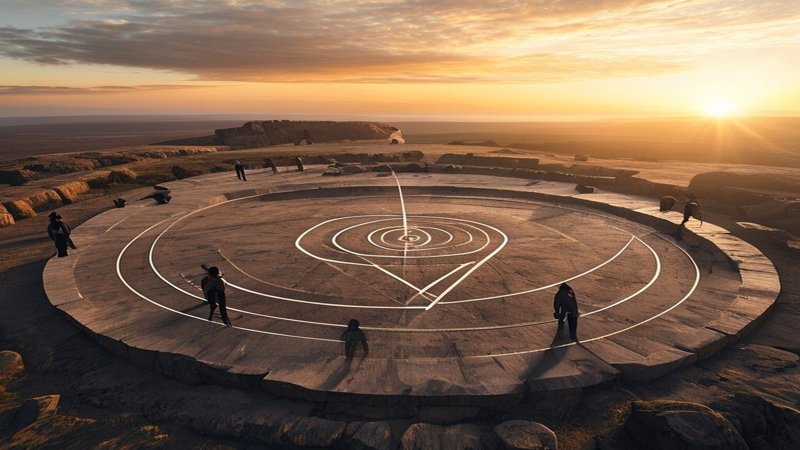
Reflect on the precision of the angles and distances. Upon entering the heart of Enclosure D, you find two monumental central pillars rising majestically. These pillars likely represent colossal, faceless anthropomorphic figures with arms wrapped around their waists. Standing between them instills a feeling of your own insignificance compared to the grandeur of the design. These ancient engineers understood the principles of leverage, balance, and pressure millennia before the laws of physics were formally established. The silence that envelops the site today is punctuated by endless questions.
- From where did this sudden knowledge originate?
- Is it the product of a gradual evolution missing from our records?
- Or a gift from a more advanced civilization that vanished into the mists of time?
The relationship between Göbeklitepe and mathematics is evident in the proportional relationships between the enclosures. There is a mathematical harmony akin to a visual symphony. This place was not built overnight; its construction spanned successive generations, who transmitted engineering and astronomical knowledge across millennia. The enduring mystery of its construction and purpose aligns with other ancient secrets, such as those found at Mount Kailash.
Frequently Asked Questions
Generated by AI Content Architect
About The Author