Rome’s Secret Internet: How a Hidden Network Sustained an Empire for 1000 Years

0
image_1-9


Rome’s Secret Internet: How a Hidden Network Sustained an Empire for 1000 Years
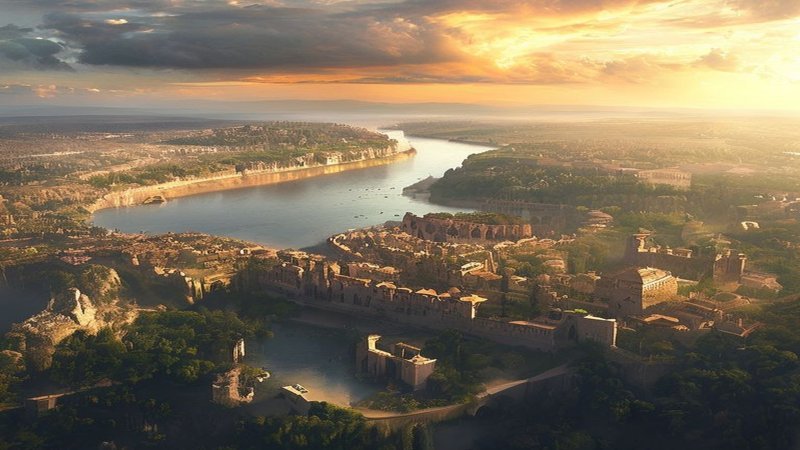
Imagine a vast empire stretching from the banks of the Tigris River in the east to the forests of Britain in the west, governed by a single central mind located in the heart of Rome. How could an imperial decree issued in Italy reach a soldier stationed at the world’s frontiers before the blood of battle had cooled? The secret lay not merely in the power of swords, but in a hidden network, an ultra-complex communication system that made Rome the first true information society in human history. You now stand before the greatest logistical puzzle of the ancient world, a system that surpassed all predecessors in its speed and encryption, remaining a mystery that has perplexed historians for centuries.


The Roman ‘Internet’: Stone-Crafted Data Cables

Today, you live in an age of fiber optics and satellites, where information travels in the blink of an eye. But cast your mind back two millennia. Imagine the silence that enveloped continents, the isolation that crippled great kingdoms. At that time, Rome was building something entirely different. Roman roads were not merely passages for armies; they were, quite literally, stone-crafted data cables. When you walk on the Appian Way, you are not just treading on paved stones, you are touching the backbone of an ancient internet. Roman engineers designed these roads with five layers of different materials to ensure uninterrupted traffic flow regardless of weather conditions. This stability was crucial for the operation of the imperial postal system, known as the Cursus Publicus. This grand logistical undertaking was essential for Rome’s control, a feat of organization that made them the first true information society in human history, tackling a monumental logistical puzzle.

The Roman 'Internet': Stone-Crafted Data Cables


The Speed of Empire: The *Cursus Publicus* and Ancient Relays

This system was not available to the public; it was exclusively for the transmission of sensitive state information. Imagine precisely spaced horse-relay stations every twelve miles. At each station, a young rider and fresh horses awaited, ready to depart the moment the dispatch arrived. Here, you confront the concept of relay, which we use today in computing. The message never stopped. When the first rider tired, they handed the message to the second, and so the movement continued day and night. Messages covered a distance of one hundred and fifty miles per day. This figure might seem small to you now, but in that era, it represented the speed of light. The Emperor in Rome knew what was happening on the Germanic frontiers before the Germans themselves realized their movements had been observed. This ancient relay system mirrored complex modern concepts, foreshadowing the intricate workings of systems like killer algorithms.


Secrets and Signals: Roman Encryption and Optical Telegraphy

But speed wasn’t everything; knowledge is power, and its protection was a matter of life or death. You are now entering the world of Roman encryption. You might have heard of Caesar’s cipher, that simple method of shifting letters. But the reality was far more profound. The Romans employed multi-layered encryption systems to protect their messages from spies. They would write sensitive messages on wooden tablets covered in wax, then erase the wax and write a trivial message directly onto the wood, then re-apply the wax and write another deceptive message. If the tablet fell into enemy hands, they would see only empty words about grain trade or weather conditions, while the real military orders remained hidden just beneath the surface. This type of concealment required exceptional skill from the recipient, who knew exactly where to look for the truth. This was a sophisticated form of dark psychology applied to state secrets.

Now, lift your gaze from the roads and tablets to the mountaintops. There, Rome operated an astonishing optical system based on light. Can you imagine a series of towers stretching for hundreds of miles, each visible from the next? This was the ancient optical telegraph. The Romans used a system of torches and smoke to transmit pre-defined messages. These were not just simple signals like danger or no danger; they constituted a sophisticated visual language. Through a specific arrangement of torches, complex details about the enemy army’s size and direction of movement could be conveyed. On clear nights, a message could travel from the borders of Scotland to the walls of London in mere minutes. This system made it impossible for any enemy to surprise the Empire, for Rome’s eye was always open, and its optical tongue outpaced the hooves of horses.

Secrets and Signals: Roman Encryption and Optical Telegraphy


The *Frumentarii*: Rome’s Hidden Intelligence Network

You now wonder, who managed this colossal network? Here emerges the dark and mysterious side of the story. The Frumentarii – these were not mere postal carriers, but Rome’s central intelligence agency. They operated covertly, disguised as merchants or ordinary travelers, gathering information from markets, taverns, and palaces, then transmitting it via that sophisticated network directly to the Emperor. Their role was to ensure the network operated efficiently and to purge it of any leaks. These men represented the software that managed the Empire’s stone hardware. Thanks to them, Rome ruled not merely by military force, but by real-time knowledge of everything happening in the corners of the known world. Their methods underscore the powerful grip of internalized social control and strategic surveillance.


Information Superiority: Rome’s Enduring Legacy and Fatal Flaw

Consider with me the psychological pressure Rome’s enemies must have felt. Imagine you are a rebellious tribal leader, planning an attack in complete secrecy, only to be surprised by Rome’s legions awaiting you at dawn in the very place you chose for your ambush. This terror did not come from nowhere, but from their realization that Rome possessed communication capabilities that seemed supernatural in their eyes. It was information superiority that allowed Rome to endure for over a thousand years. The Romans understood, before anyone else, that controlling distances meant controlling people. For this reason, the budget for road maintenance and the postal system sometimes exceeded the budget for arming armies. Information was the most valuable currency, and the network that carried it was the most precious treasure.

But what happens when this network begins to erode? In the final centuries of the Empire’s lifespan, roads began to crumble, and budgets allocated to postal stations diminished. Here lies the great historical lesson. With the collapse of the communication system, the capacity for central administration fell. When messages ceased, the extremities became detached from the body, and each province became an isolated island.

Information Superiority: Rome's Enduring Legacy and Fatal Flaw


Frequently Asked Questions

What was the *Cursus Publicus*?
The *Cursus Publicus* was the Roman imperial postal system, an exclusive network designed for the rapid transmission of sensitive state information and imperial decrees. It was not accessible to the general public.
How fast could messages travel using the *Cursus Publicus*?
Using a system of horse-relay stations spaced every twelve miles, messages could travel approximately one hundred and fifty miles per day. This was an astonishing speed for ancient times, equivalent to the ‘speed of light’ for information transfer.
What methods of encryption did the Romans use?
Beyond simple methods like Caesar’s cipher, Romans employed multi-layered encryption. One sophisticated technique involved writing sensitive messages directly onto a wooden tablet, then covering it with wax and writing a trivial, deceptive message on the wax surface. The true message remained hidden beneath.
How did the Roman optical telegraph work?
The Romans used a system of interconnected towers on mountaintops, visible from one another. They transmitted pre-defined messages using specific arrangements of torches and smoke signals, forming a sophisticated visual language capable of conveying complex details about enemy movements over vast distances in minutes.
Who were the *Frumentarii*?
The *Frumentarii* were Rome’s central intelligence agency, operating covertly as merchants or travelers. They gathered information from across the empire and transmitted it through the communication network directly to the Emperor, ensuring the network’s efficiency and security.

Generated by AI Content Architect

About The Author

Leave a Reply

Your email address will not be published. Required fields are marked *