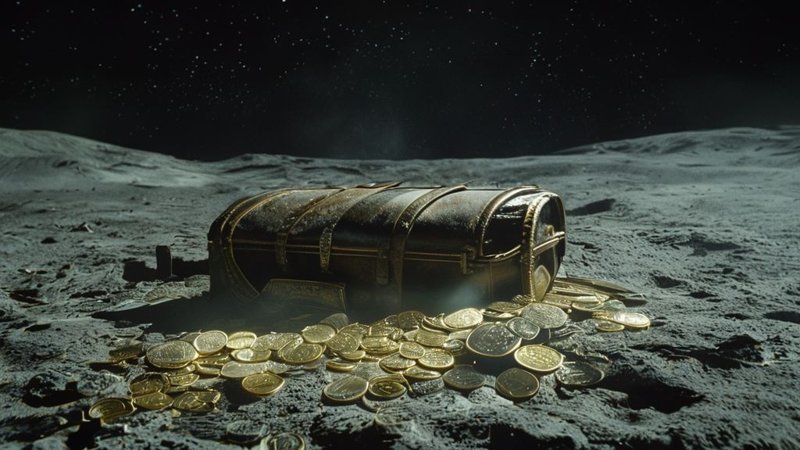
Why Humanity Stopped Going to the Moon: Uncovering the Truth Behind Apollo’s End
Imagine standing now on the edge of a cosmic abyss, silently observing the last human footprint sink into lunar dust, before the light of ambition suddenly extinguished, plunging the world into a silence that lasted five decades. Have you ever wondered why we abandoned the greatest achievement in the history of our species, while the stars whispered promises of more? The truth behind the sudden halt of the Apollo program is not merely a technical story; it is an epic tale of political greed, economic collapse, and the fear of the unknown that resides in the depths of space.
You now feel that strange quietness enveloping the lunar surface, where rovers lie abandoned like the ruins of a forgotten civilization. In December 1972, astronaut Eugene Cernan took his final steps away from the camera, unaware that the moon’s door would close behind him for fifty full years. In that moment, the lunar module’s ascent engine ignited, carrying the last two men into orbit, leaving behind an absolute silence and rigid American flags unmoving in the absence of air. This end was dramatic, but it was not unexpected for those in the corridors of power in Washington.
A Cold War Victory, Not a Scientific Pursuit
The dream began with an inspiring speech from John F. Kennedy in 1961, where he promised the world that America would land a man on the moon before the end of the decade. They indeed did so, and in 1969, hundreds of millions held their breath before blurry screens. However, you must realize that this achievement was not primarily scientific; rather, it was a weapon in a brutal Cold War. Once Neil Armstrong planted the flag, the symbolic battle ended. The United States had secured its geopolitical victory, and interest began to wane as soon as the political objective was met. This strategic maneuver highlights the machiavellian principles at play in global power dynamics.
The Astronomical Cost & Terrestrial Wars
Consider the figures that were devouring the state budget; they paint a picture of financial horror. At the peak of the Apollo program, NASA consumed approximately four percent of the total US federal budget. This figure means that each trip to the moon cost billions of dollars in today’s estimates. Imagine 400,000 workers, thousands of companies, and budgets exceeding those of entire nations, all serving one goal: sending three men in a small metal box 380,000 kilometers away. Over time, the American public grew bored. Lunar landings became routine events, and dissenting voices grew louder, questioning: ‘Why are we spending all this money in the sky while our cities are ablaze with protests and bogged down in the quagmire of the Vietnam War?’
The Vietnam War was the black hole that swallowed the funding. In those years, the financial and military bleeding in Southeast Asia demanded every available dollar. In his Oval Office, President Richard Nixon viewed the Apollo program as a legacy of his Democratic predecessors, not as a path to the future. Declassified official documents later revealed secret memos between Nixon’s advisors. In one such document, Caspar Weinberger, who later became Secretary of Defense, wrote a letter warning that the continuation of the Apollo program would lead to a financial catastrophe. The administration was advised to cut funding and scale back lunar ambitions in favor of a cheaper, more immediately beneficial program: the Space Shuttle.
Hidden Dangers and Strategic Retreat
But were the issues solely material? Consider the technical risks inherent in every mission. You are watching the Saturn V rocket, that three-million-kilogram behemoth, violently shaking upon launch. Every launch was a gamble with human lives. NASA understood that luck would not last forever. After the Apollo 13 disaster, which nearly ended in tragedy in deep space, leaders realized that losing a crew live on air before the world would deliver a devastating blow to America’s technical reputation. The fear of failure resided in the hearts of engineers as much as it did in the hearts of politicians.
From a geopolitical perspective, the withdrawal from the moon was a calculated strategic retreat. Washington realized that the Soviet Union had lost the lunar race early after the explosion of their colossal N1 rocket. With the absence of a fierce competitor, there was no longer a political justification to continue these costly missions. The focus shifted from ‘exploration’ to ‘low Earth orbit dominance.’ The new goal was to build space stations and shuttles capable of carrying spy and communication satellites—tools far more useful in global conflict than collecting lifeless lunar rocks.
You now feel a sense of bitterness as you realize that science was not the primary driver. Official documents clearly indicated that the moon had been ‘politically consumed.’ There was no sustainable plan for human presence. There was no consideration of mining or building bases at that stage. It was akin to building a lavish palace in the desert merely to impress neighbors with one’s capability, then abandoning it to the winds and sands because one cannot pay the electricity bill. This was the challenge faced by global agencies: the absence of a long-term economic vision.
The Unseen Hostility of the Lunar Environment
There were also hidden technical obstacles not widely discussed by the media.
Cosmic radiation and solar winds posed an imminent threat to the health of astronauts outside Earth’s atmosphere. In the 1970s, we lacked sufficient technology to protect humans for extended periods on the lunar surface.
Moreover, lunar dust—that microscopic powder, sharp as glass fibers—penetrated spacesuits, damaged lungs, and corrupted machinery.
Scientists discovered that staying on the moon was not just a short trip but a struggle for survival against a completely hostile environment. The dangers highlighted the challenges of operating beyond Earth’s magnetic shield.
Beyond Conspiracy: The Human Factor
When you scrutinize history, you will find that the halt was not due to aliens expelling us, as conspiracy theories claim, but due to human weakness in the face of budgets and volatile policies. Humanity lost that audacious spirit that drove it to seek beyond the horizon, replacing it with quick profit-and-loss calculations. The withdrawal from the moon left a geopolitical vacuum, where the sky above…
Frequently Asked Questions
When did the last Apollo mission to the Moon take place?
The last Apollo mission, Apollo 17, took place in December 1972, with astronaut Eugene Cernan being the last person to walk on the lunar surface for 50 years.
What was the primary motivation behind the Apollo moon landing program?
The primary motivation for the Apollo program was not scientific exploration but rather a geopolitical victory in the Cold War against the Soviet Union, fulfilling President Kennedy’s promise.
What economic factors contributed to the end of the Apollo program?
The Apollo program was incredibly expensive, consuming approximately four percent of the US federal budget at its peak. Public boredom, the immense cost, and the financial demands of the Vietnam War led to a cut in funding and eventual cancellation.
Were there technical challenges that influenced the decision to stop lunar missions?
Yes, significant technical risks included the danger of rocket launches (exemplified by Apollo 13), and the hostile lunar environment itself, with threats from cosmic radiation, solar winds, and abrasive lunar dust that damaged equipment and posed health risks to astronauts.
Was the halt to moon missions due to hidden factors like alien intervention, as some conspiracy theories suggest?
According to historical documents and analysis, the halt was not due to alien intervention or other conspiracy theories. Instead, it was a result of human factors, including political decisions, budgetary constraints, shifting geopolitical priorities, and unforeseen technical challenges.