Whales in the Desert: Wadi Al-Hitan’s 40-Million-Year-Old Evolutionary Shock
Whales in the Desert: Wadi Al-Hitan’s 40-Million-Year-Old Evolutionary Shock
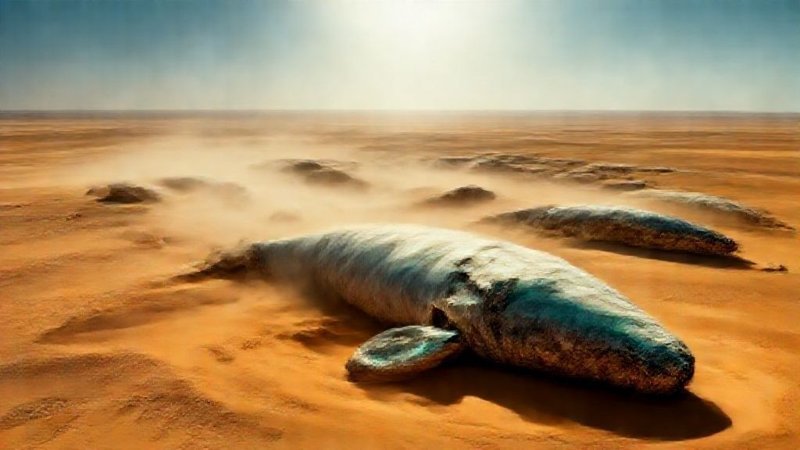
The sun-scorched expanse of the desert often suggests absolute finality and desiccation, yet beneath the sands of Egypt’s Wadi Al-Hitan, colossal secrets lie buried. This is not merely a geological curiosity; it is the submerged graveyard of giants—massive, fully formed whale skeletons emerging from the arid earth. These forty-million-year-old marine behemoths offer irrefutable proof that the landscape beneath our feet was once the floor of the vast Tethys Sea, and they carry an astonishing evolutionary secret: vestiges of legs.
Navigate Content
The Desert’s Marine Ghosts: Discovery and Significance
Discovered in 1905 and declared a UNESCO World Heritage site in 2005, Wadi Al-Hitan reveals a history dramatically different from today’s desolate environment. The primary inhabitants found here date back approximately 40 million years. These ancient whales are pivotal because they document a critical juncture in Earth’s biological history. The presence of these fossils confirms that tectonic shifts and geological forces utterly transformed the world, turning warm, life-filled oceans into barren sand. This site acts as a chapter of Earth’s history etched in stone, challenging our perception of stable geography. For more context on impossible ancient environments, see Unearthing the Impossible: Tropical Forests Discovered Beneath Antarctic Ice.
Basilosaurus: The King with Feet
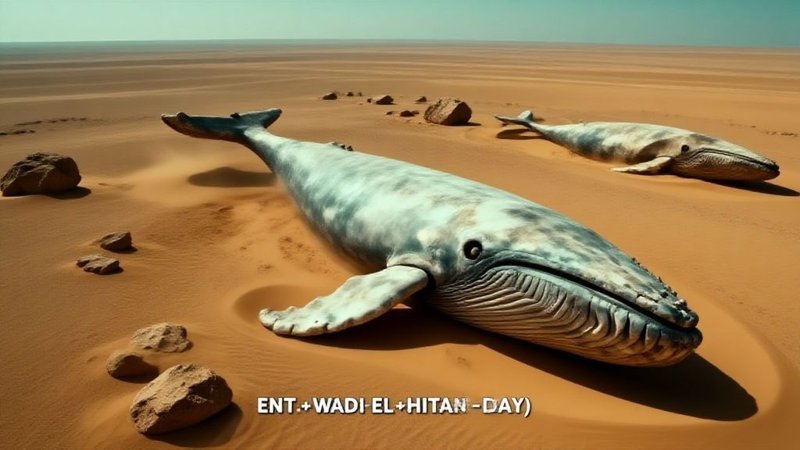
The most dramatic resident of this valley is the *Basilosaurus*, often called the ‘King of Lizards,’ despite being a marine mammal that reached eighteen meters in length. Its serpentine body and terrifying, sharp teeth speak of a formidable apex predator. However, the true shock is found at the posterior end of its skeleton. Here, protruding from the earth, are:
- Pelvic Bones: Clear evidence of hips.
- Vestigial Hind Limbs: Complete legs, featuring knees, ankles, and toes, yet far too small to support the immense body.
This anatomical anomaly provides the strongest evidence that whale ancestors were once quadrupeds that walked on land before migrating permanently to the sea.
Dorudon and the Missing Links of Evolution
Alongside the massive *Basilosaurus*, scientists find *Dorudon*, a creature roughly five meters long that more closely resembles modern whales. Crucially, *Dorudon* also possesses these small, non-functional hind limbs. These two species are not just fossils; they are the tangible ‘missing link’ sought by science. They illustrate the physical processes of adaptation:
- The forelimbs mutating into steering fins.
- Nostrils migrating to the top of the head for easier breathing.
- Legs gradually shrinking until they vanished entirely in later lineages.
This valley showcases a creature actively rebelling against its terrestrial nature to conquer the deep oceans.
Decoding the Vanishing Ocean
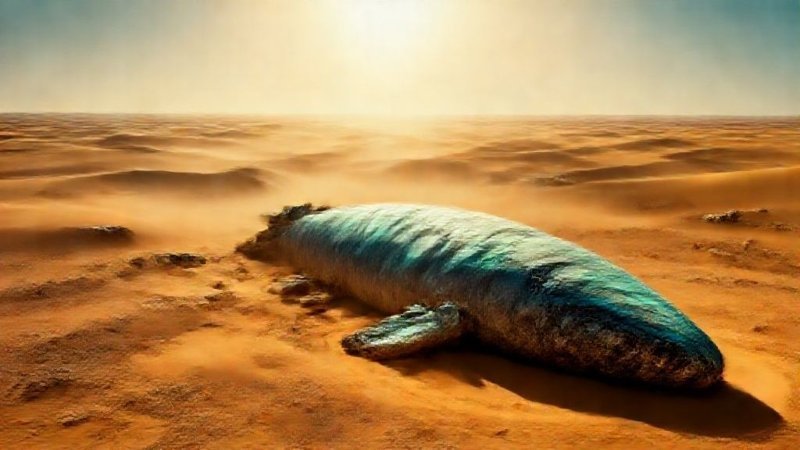
The existence of these giants raises the most profound question emanating from the dunes: What forces caused the great Tethys Sea to vanish so completely? The transformation from a teeming oceanic basin to the arid expanse of the Egyptian desert is a staggering display of climatic and geological volatility. These buried structures serve as a silent warning about the immense power of planetary cycles. Every protruding bone is a key to unlocking the mechanisms behind such massive environmental shifts, detailing the fate of an ocean that once governed much of the ancient world. If you are interested in other mysteries of ancient, powerful forces, explore The Great Attractor Enigma.
Frequently Asked Questions
Generated by AI Content Architect
About The Author