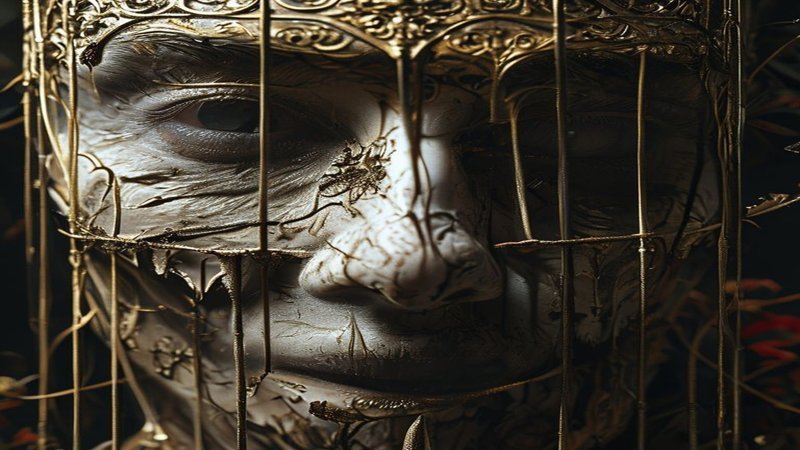
Unconditional Love: The Hidden Dangers of Absolute Acceptance and Emotional Control
You now stand in the middle of a room with no walls, yet you feel suffocated, as if trapped in an underground cell. The air around you is saturated with the scent of roses, but your lungs refuse to inhale it. The person standing before you smiles overtly, opens their arms, and tells you in sweet words that they love you just as you are, unconditionally, boundlessly, and without judgment. At that moment, you believe you have found paradise, but in truth, you have taken your first steps into the most dangerous prison humanity has ever known. A prison with no bars, whose guard is compassion, and whose fence is absolute acceptance, slowly absorbing your identity until you completely vanish.
Unconditional love, in its essence, is a sublime idea, but when cast into a distorted reality, it transforms into a terrifying tool of control. Imagine living with someone who accepts you at your worst, forgives your missteps before you utter them, and erases your mistakes before you apologize for them. It sounds ideal, doesn’t it? But look deeply into those eyes watching you. In the science of body language, there is a gaze called the “soft possessive gaze.” It is a steady, calm gaze, with the head tilted slightly to the side, accompanied by a smile that never quite reaches the eyes. This gaze tells you, “I own you because I am the only one who tolerates you.” Here begins the hidden cost of absolute acceptance. For more on how minds can be controlled, read about Unmasking Subconscious Manipulation.
The Shackle of Gratitude and Subtle Brainwashing
When the other person decides to love you unconditionally, they grant themselves divine authority over your very being. They place you in the position of the helpless, always in need of forgiveness. Every time you make a mistake and are met with absolute acceptance, you feel diminished by their artificial generosity. This feeling of gratitude is the first shackle.
Gratitude in toxic relationships is not a feeling of comfort; rather, it is a heavy debt that grows every day.
You are indebted to them for your existence, for their patience, and for not abandoning you when they should have.
Thus, love transforms into a mechanism for brainwashing, gradually convincing you that without this absolute acceptance, you are worthless in the eyes of the outside world.
Taming Rituals and the Stifling of Growth
Observe the movements of their hands when they speak of their sacrifices for you. The hands that always extend to touch your shoulder or stroke your head with excessive tenderness are, in reality, performing taming rituals. In the dark psychology, constant touch is used to foster dependency. They tell your body before your mind that you are under their protection, and here, protection is the other side of confinement. You stop growing because growth requires friction, and it requires mistakes followed by correction or consequence. But in the prison of absolute acceptance, there is no correction. There is only a continuous descent into complete dependence. You become like a child in a womb that does not want to cast it into life, feeding it with its blood to keep it small, weak, and eternally subservient. This mirrors the struggle against Internalized Social Control.
Silent Emotional Blackmail and the Rejection of Change
Think of the times you tried to rebel. Did you encounter anger? No, anger is easy to confront. What you found was sad silence and a look filled with disappointment. This is what we call, in body language, “silent emotional blackmail.” They do not scream at you; instead, they slowly withdraw, leaving you in a void of solitude until you crawl back, begging for forgiveness. Unconditional acceptance here becomes a double-edged sword. They accept you as you are, but they reject any attempt you make to change that reality. They want you as you were at that moment when you were broken, so they can remain the sole restorer of your soul. This can feel akin to betrayal, a theme explored in Brain Chemistry of Betrayal.
The Erosion of Self and Pathological Altruism
The hidden cost is the loss of your moral compass and sense of self. When there are no boundaries, there is no definition of self. The self is defined by what it rejects just as much as by what it accepts. In this prison, you reject nothing because everything is accepted. You lose the ability to say no, because you fear breaking that sacred covenant of unconditional love. You fear proving them wrong in their estimation of you, so you continue to play the role of the grateful victim. Look in the mirror, do you see your eyes? Do you see that sparkle that once burned with defiance? It has extinguished, replaced by a quiet brokenness, which is what we observe in the body language of the emotionally imprisoned: shoulders slightly hunched forward, and a low voice emanating from the throat, not from the chest. This type of disguised control relies on a strategy of emotional engulfment. They inundate you with attention until you drown, and when you start gasping for air, they tell you that this air is polluted, and that their lungs are the sole source of pure oxygen. Have you noticed how they interfere in the minutest details of your life under the guise of concern for you?
“I accept your recklessness, so I will manage your finances.”
“I accept your forgetfulness, so I will hold your keys.”
Every act that appears to be a service is, in reality, another nail in the coffin of your independence. Hidden control does not come with whips, but with sincere promises and cold kisses on the forehead. Society applauds this type of relationship. They look at both of you and say, “What a loyal partner, they tolerate everything.” But they do not see the internal bleeding you suffer from. You live in a state of perpetual dread that this partner might one day wake up and decide their conditions have begun to surface. This fear makes you exercise harsh self-censorship. You imprison yourself before they imprison you. You stop dreaming, you stop aspiring, and you stop expressing your anger, because anger contradicts the idealized image they have painted for you within the framework of their unconditional love. In the darker chambers of psychology, this behavior is known as “pathological altruism.” They give not for the sake of giving, but for the feeling of moral superiority. They need your weakness to prove their strength. They need your l
Frequently Asked Questions
What is the core danger of ‘unconditional love’ as described in the article?
The article suggests that in a distorted reality, ‘unconditional love’ transforms into a dangerous emotional prison, eroding one’s sense of self and leading to complete dependence rather than true freedom and growth.
How does absolute acceptance become a tool of control in such relationships?
Absolute acceptance, particularly when artificial, can diminish the recipient by placing them in a position of constant need for forgiveness. This fosters a feeling of heavy gratitude, which becomes a debt, making the recipient feel worthless without the other person’s ‘unconditional’ validation.
What psychological tactics are used in this ’emotional prison’?
Tactics include the ‘soft possessive gaze’ to assert ownership, constant physical touch as ‘taming rituals’ to foster dependency, ‘silent emotional blackmail’ through sad silence and disappointment, and emotional engulfment where concern masks intrusive control over personal details.
How does this type of relationship erode one’s sense of self and moral compass?
When there are no boundaries or consequences, the individual loses the ability to define themselves by what they reject, as everything is accepted. This leads to an inability to say no, self-censorship, loss of dreams and aspirations, and the extinguishing of their inner sparkle and defiance.
What is ‘pathological altruism’ in this context?
‘Pathological altruism’ refers to a behavior where the ‘giver’ provides not out of genuine selflessness, but for a feeling of moral superiority. They need the other person’s weakness to validate their own strength and maintain control under the guise of compassion.