The Wood Wide Web: Discover the Forest’s Secret Internet & How Trees Communicate

The Wood Wide Web: Discover the Forest’s Secret Internet & How Trees Communicate
Imagine walking through a silent forest where the earth beneath your feet is screaming coded messages your ears cannot hear. You believe the trees are merely mute timbers competing for light, when in reality, they manage the greatest social communication network the planet has ever known. Are you prepared to see the forest through unprecedented eyes and uncover the secret the soil has hidden for millions of years?
Navigate Content
The Invisible Internet: Unveiling the Wood Wide Web
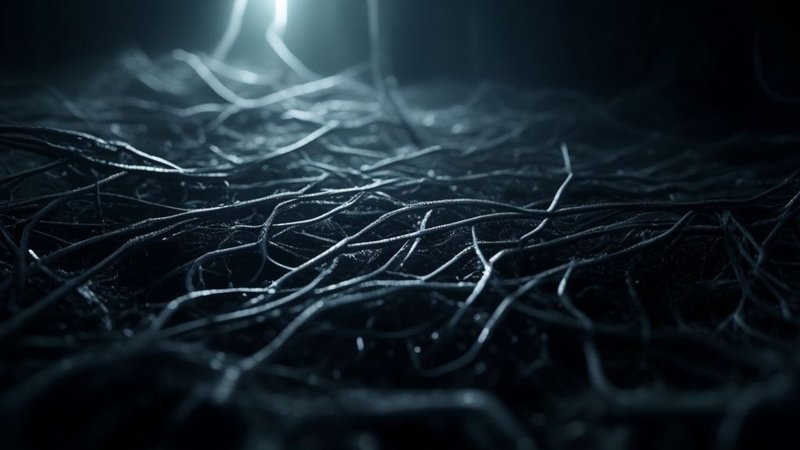
You now stand among the towering trees, perceiving each one as a separate entity struggling for survival. This is the grand deception your vision presents. The truth lies beneath, where a world of fine threads extends, connecting the forest roots in a complex network we now call the Wood Wide Web. This network is not merely intertwined roots; it is an astonishing collaboration between the plant kingdom and the fungal kingdom. In every cubic centimeter of soil under your shoe lie kilometers of microscopic fungal filaments known as mycelium. These filaments act as biological fiber optic cables, transmitting data and nourishment between trees at incredible speeds. Fungi cannot produce sugar because they lack green leaves for photosynthesis, and while trees possess sugar, they struggle to absorb phosphorus and nitrogen from the deep soil. This is where the grand deal is struck. The tree provides the fungi with the sugar it produced from sunlight, and in return, the fungi supply the tree with minerals and water gathered from vast distances.
Warning Signals and Collective Defense
But it does not end with simple trade exchanges. You are now witnessing an intelligent, mutually caring community. When insects attack a single tree at one end of the forest, it does not perish silently. That tree immediately begins pumping chemical signals through the fungal network to reach its neighboring trees. These messages literally warn, “An enemy is approaching.” Upon receiving this signal, the adjacent trees begin producing toxic chemicals in their leaves, making them bitter and unpalatable to insects before they even arrive. The afflicted tree has sacrificed its energy to warn others, and the others have prepared for battle thanks to this woody internet. It is a complex chemical language that makes the forest function as one body, not a collection of competing individuals. This concept of shared awareness echoes the fascinating ideas explored in Collective Consciousness: The Shared Realm of Dreams and Nightmares.
The Mother Tree: Forest’s Pulsating Heart
Consider what happens when a massive tree falls in the forest. You assume it is finished, but it is actually initiating an astonishing act of legacy. Before the tree fully dies, it dumps its remaining stores of carbon and nitrogen into the fungal network to send to the young saplings growing beneath its canopy. These young trees receive insufficient sunlight due to the dense overhead canopy and would starve without this vital aid from the Mother Tree. Yes, there is a Mother Tree. It is the oldest and largest tree in the forest, possessing the widest underground communication network. Studies have proven that the Mother Tree can recognize its offspring—the saplings grown from its own seeds. It distinguishes them from strangers and sends them larger quantities of food and resources. The Mother Tree functions as a pulsating heart, distributing life and equity within this green society. To learn more about this incredible entity, explore The Mother Tree: Earth’s Secret Controller of Fate and Human Consciousness.
Beyond Roots: The Forest as a Giant Brain
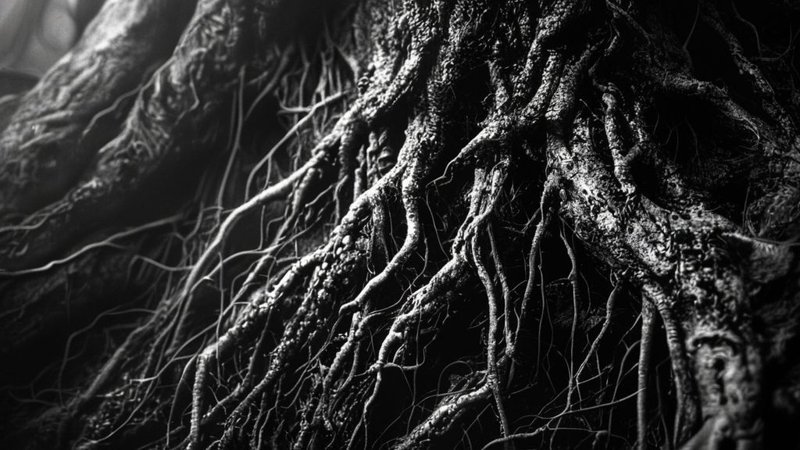
Look closely at a cross-section of the soil. You will find that the roots are not merely wooden extremities searching for water, but astonishingly resemble the neurons in your brain. These plant nerve endings connect to the fungal filaments, forming electrical and chemical circuits pulsating with information. This similarity between the human brain and the forest network is not mere coincidence but a cosmic design for efficiency and intelligence. The forest possesses a collective memory. It knows past drought seasons and knows how to store resources for difficult times. If a tree falls ill, its neighbors send it sugar and nutrients via the fungal network to keep it alive. They understand that the death of one tree leaves a gap in the canopy that could expose the entire forest to strong winds or alter the humidity levels they all require.
The Wood Wide Web’s Shadows: Hackers and Betrayals
But do not assume this world is perfect and free of conflict. Just as there are hackers on the human internet, there are infiltrators on the Wood Wide Web. There are plant species, such as the Ghost Orchid, that possess no green leaves and do not photosynthesize at all. These plants live as pirates, hacking into the fungal network to steal the sugar that trees share amongst themselves without offering anything in return. Furthermore, some trees, like the Black Walnut, use the network to deploy chemical toxins to eliminate competing plants trying to grow nearby. It is a world rife with politics, alliances, and silent betrayals.

Lessons from Earth’s Oldest Network
Reflect on the pressure you feel in your daily life. You seek connection in a digital world, whereas the forest has been doing this for 450 million years. This network is what allowed life on land to flourish and persist despite every major extinction event the planet has endured. The next time you enter the forest, do not walk with arrogance. You are walking atop a giant brain processing data and silently protecting its members. Feel those pulses moving beneath your feet. Imagine the luminous threads carrying messages of distress and welcome between the roots. This astonishing system teaches us a lesson in survival. Strength lies not in total independence, but in
- interconnectedness
- and cooperation.
A tree attempting to live alone, disconnected from the network, will perish at the first drought or attack by harmful fungi. However, a tree belonging to the network is shielded by the wisdom of millions of its peers. We humans are only just beginning to understand this language. We are starting to realize that the forest is not merely a timber reserve but a single, extended organism. When we cut down a single tree, we are not just severing a trunk; we are breaking a link in a complex communication chain. Felling the Mother Tree could lead to the collapse of the nutritional support system for thousands of small saplings that depend on it.
Frequently Asked Questions
Generated by AI Content Architect
About The Author