The Secret of Lost Gold: How Japanese Treasures Reshaped the Global Economy
The Secret of Lost Gold: How Japanese Treasures Reshaped the Global Economy
Imagine standing now in the heart of a dense tropical forest in the Philippines. Directly beneath your feet, dozens of meters deep, lie layers of reinforced concrete and deadly booby traps protecting a secret that could alter the global economy as you know it today. You are not merely looking at a fleeting legend but at the largest organized plunder in human history. This is the story of lost gold, washed by the blood of millions and buried by the secrets of great powers. In the early 1940s, the continent of Asia teemed with ancient gold and bloody conflicts. Imperial Japan extended its influence in every direction, seeking resources and sovereignty. Behind this declared military expansion lay a highly secret plan named ‘Golden Lily.’ The objective of this plan was not only to occupy land but to strip Southeast Asia of every ounce of gold, every precious stone, and every ancient artifact accumulated over thousands of years.
Navigate Content
The Golden Lily Operation: A War Machine Fueled by Plunder
Consider the scale of the tragedy that unfolded. Japan recognized that its war machine required an inexhaustible financial fuel. Consequently, Emperor Hirohito formed a secret organization led by his brother, Prince Chichibu. This organization did not comprise ordinary soldiers but included accounting experts, archaeologists, and intelligence officers. Their mission was clear: to scour every bank, every temple, and every royal palace in the occupied territories. From Malaysia to Indonesia, from Thailand to Burma, military convoys transported treasures beyond imagination. These were not mere ordinary war spoils but the wealth of entire nations forcibly seized. Can you picture the sheer size of the trucks groaning under the weight of pure gold ingots, melted down and re-stamped with the Imperial emblem? The scale of this operation, dubbed the ‘Golden Lily‘ plan, revealed a chilling efficiency in systematic plunder, creating a secret that would impact global finance for decades.
The Philippines: A Giant Repository for Imperial Riches
When Singapore fell to the Japanese in 1942, it marked a pivotal moment. The vaults of British and Dutch banks fell into the hands of General Tomoyuki Yamashita, famously known as the ‘Tiger of Malaya.’ However, as the war intensified and Allied superiority grew in the Pacific, Japan faced a major logistical challenge. It became impossible to transport all these tons of gold by sea to Tokyo because American submarines were tracking and sinking every Japanese vessel. At this juncture, the High Command made a decision that was both historic and terrifying. It was decided to transform the Philippines into a giant secret repository for these treasures. One must realize that the Philippines, with its strategic location and thousands of islands, was the ideal place to hide until the storm passed.
Buried Secrets and Deadly Deception
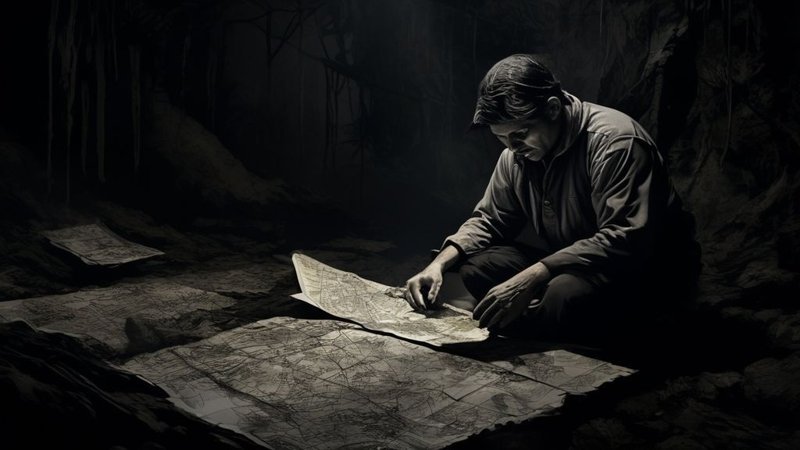
Japanese engineers began digging hundreds of tunnels in the mountains and forests under the direct supervision of senior princes and generals. Thousands of Allied prisoners of war and local laborers were used for the arduous work. These unfortunate individuals, unknowingly, dug their own graves. The plan involved burying the treasures in fortified chambers and then detonating the entrances with the workers still inside, ensuring no secret would escape. Can you feel the chilling nature of this situation as you imagine thousands of lives extinguished beneath tons of gold to keep this secret concealed? The maps drawn for the burial sites were encrypted in a language understood only by a select few close to the Imperial family. The symbols indicated the depth of the gold, specific angles, and carefully placed explosive booby traps.
The Cold War’s Golden Shadow: American Involvement and Japan’s Revival
By 1945, the balance of power clearly shifted in favor of the United States. General Yamashita realized that defeat was inevitable. However, the gold did not simply disappear; it transformed from Japanese spoils into an international leverage point. Declassified documents later indicate that American intelligence discovered some of these sites before the war’s end. This is where the most enigmatic phase of our modern history begins. Instead of returning these funds to their rightful owners in the plundered Asian nations, it appears that secret agreements were made behind closed doors. It is said that the gold was used to finance what became known as the ‘Black Eagle Fund,’ a highly secret fund utilized by the United States to finance anti-communist operations during the Cold War. Consider this carefully. How could Japan, devastated by atomic bombs and utterly bankrupt after the war, achieve such a miraculous economic leap in just a few years? Many historians and researchers believe that a significant portion of Yamashita’s gold was re-injected into the Japanese economy under American supervision to ensure Japan remained a strong ally against the Soviet Union. You are now discovering that the gold stolen from the temples of Thailand and the impoverished people of the Philippines contributed to building the skyscrapers and technology factories that serve the world today.
The Enduring Legacy: Rogelio Roxas, Marcos, and Unresolved Justice
But secrets do not die easily. In the 1970s, the story emerged of Rogelio Roxas, a Filipino treasure hunter who claimed to have discovered a solid gold Buddha statue, weighing a full ton, in one of the tunnels dug by the Japanese. Roxas’s story is not mere fiction. He was abducted and tortured by men belonging to former Philippine President Ferdinand Marcos, who was rumored to have seized billions of dollars of this buried gold. Courts in Hawaii witnessed years of legal deliberations on this case, concluding with rulings acknowledging the treasure’s existence and its theft by Marcos. This demonstrates that colonial ambitions did not end with the departure of armies but persisted in the form of dictatorial regimes supported by major powers. The gold that should have built schools and hospitals in Southeast Asia ultimately ended up in secret bank accounts in Switzerland or in the vaults of global intelligence agencies. Why have all these riches not been recovered to date? The answer lies in legal and political complexities.
Frequently Asked Questions
Generated by AI Content Architect
About The Author