The Hobbit Enigma: Homo floresiensis, Island Dwarfism, and Human Evolutionary Failure
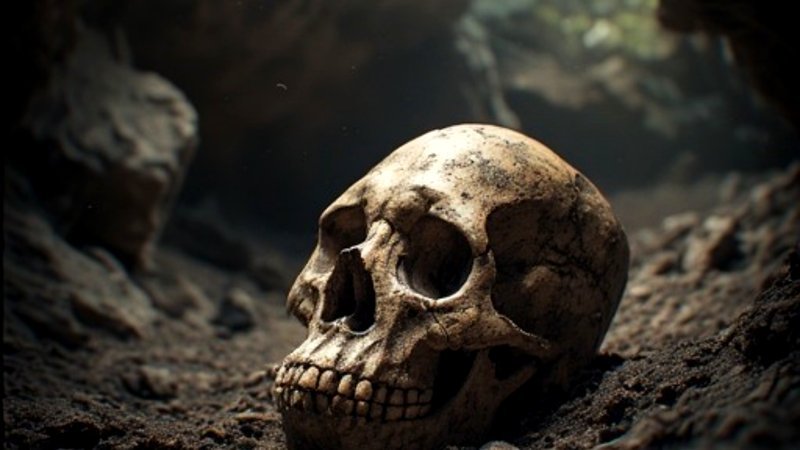
The Hobbit Enigma: Homo floresiensis, Island Dwarfism, and Human Evolutionary Failure
The assumption that bigger and stronger means better survival is profoundly challenged by the discovery of *Homo floresiensis* on the Indonesian island of Flores. This small-statured hominin, barely a meter tall with a grapefruit-sized brain, thrived for over 100,000 years. This article delves into the biological nightmare this discovery represents—a potential roadmap for human collapse where smallness was the ultimate evolutionary advantage.
Navigate Content
The Biological Nightmare: Meeting the Hobbit
In 2003, scientists unearthed a skeleton that upended human evolutionary timelines: an adult female standing under a meter tall with unique, non-pathological anatomy. This was not a case of microcephaly; it was a distinct, successful species. This creature thrived by embracing scarcity, demonstrating that nature’s law of survival isn’t always about brute strength. While we pride ourselves on our size and caloric demands, the Flores human proves that massive size can be a fatal burden when resources dwindle. We must question if our large physique is actually our greatest constraint.

Island Dwarfism: Nature’s Efficiency Protocol
The secret to the Hobbit’s longevity lies in a powerful ecological principle: Foster’s Rule, or island dwarfism. When large species are confined to isolated environments with limited calories, evolution favors reduction in size.
- Large bodies starve; small bodies persist.
- The Flores human adapted by shrinking over millennia to cope with famine conditions.
- Their specialized anatomy—short limbs, prominent brow ridges, and large feet—was perfect engineering for forest survival, prioritizing agility over plains running.
This adaptation allowed them to hunt dwarf elephants and control fire with minimal energy expenditure.
Efficiency Over Mass: Redefining Intelligence
The narrative that brain size equals superior intelligence is directly confronted by *H. floresiensis*. Despite a brain weighing only one-third of ours, detailed cranial studies suggest astonishing neural complexity, implying neural efficiency trumps sheer brain mass. This raises a controversial possibility: modern humans may be inefficient consumers—biological tumors draining the planet—whereas the Flores human represented perfect balance and existential intelligence. They adapted to the environment; we adapt the environment to us. For further reading on forgotten geniuses who built complex systems, consider the work of Al-Jazari.

The Shadow of Extinction: Who Killed the Hobbits?
The Hobbit lineage lasted for an incredible duration, outlasting many other larger human species. Their demise around 18,000 years ago coincides precisely with the arrival of *Homo sapiens*. Were we the cause? The text posits difficult questions: Did we outcompete them for food? Did we introduce diseases they couldn’t fight? Or were we simply the dominant, violent force that erased a competing human experiment? The echoes of this encounter may survive in local folklore, such as the legends of the “Ebu Gogo”, suggesting a direct, ancient coexistence between two distinct human species.
Frequently Asked Questions
Generated by AI Content Architect
About The Author