The Big Rip: Dark Energy’s Terrifying Secret and the Universe’s Explosive End
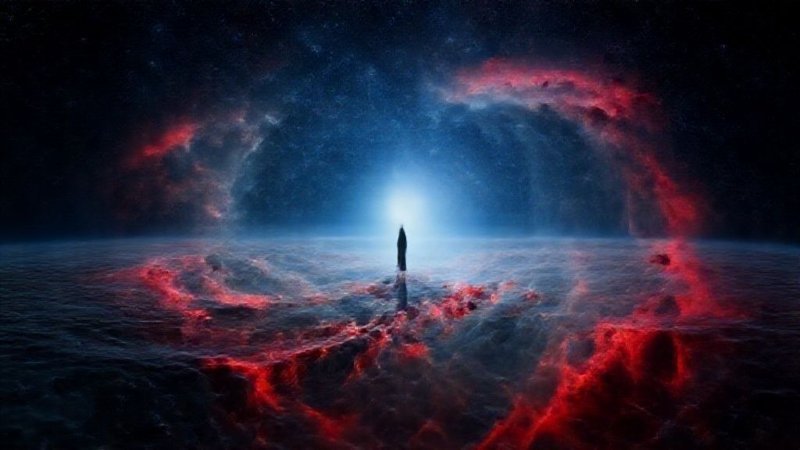
Here, where the boundaries between reality and imagination fade, everything we know seems to be but a fleeting chapter in a cosmic narrative whose ending has yet to be written. Gazing at the night sky on a clear evening, one observes stars twinkling with apparent serenity; however, the underlying truth behind this stillness is terrifying to the limits of human comprehension. The universe you perceive as your stable home is currently engaged in a frantic race toward the void—a race not aimed at reaching a finish line, but at dismantling the finish line itself.
Have you ever questioned: What if the Big Bang, which occurred approximately thirteen billion eight hundred million years ago, was merely the initial spark for a catastrophic event awaiting us in the unknown? We inhabit an environment expanding at an almost unimaginable rate, and this expansion is not constant; it is “accelerating.” It is precisely as if you were driving a car toward a precipice, and instead of pressing the brakes, you find an unseen foot forcefully depressing the accelerator pedal. This mysterious force, which scientists have termed “dark energy,” is the specter haunting the persistence of matter. It constitutes about sixty-eight percent of the universe’s total composition, yet we neither see it, nor touch it, nor grasp its essence; we only observe its destructive effects as it pushes galaxies away from us at speeds approaching the velocity of light. The universe’s frantic race toward the void itself signals a profound and terrifying cosmic truth.
The Big Rip: When Spacetime Tears Apart
Consider for a moment that the distances between stars may stretch so far that their light will never reach us, and the sky, currently crowded with celestial bodies, will someday become a stage for absolute, unending blackness. Yet, the true horror lies not just in spatial vastness, but in the “Big Rip” scenario. This terrifying physical hypothesis suggests that dark energy will not merely confine itself to driving galaxies apart, but its power will intensify to the point where it begins to tear apart the very fabric of “spacetime.”
At that inevitable moment, gravity will fail, and the nuclear forces holding the remnants of your own atoms together will yield. It will commence with the disintegration of galactic clusters, followed by planets separating from their stars. In the final seconds, atoms and molecules will be shredded, until existence dissolves into isolated particles adrift in eternal nothingness. Can matter truly end this way? Are we merely an anomaly in a universe inclined toward self-destruction?
Beyond the Big Bang: The Annihilation Equation
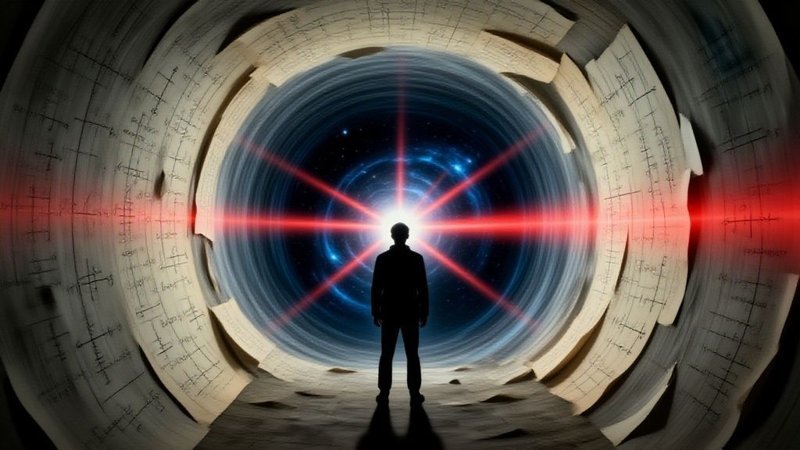
This existential query leads us into a dark tunnel of cosmology, where the laws we studied in school unravel and become meaningless scrawls on torn paper. Understanding what lies beyond the Big Bang demands the courage to look into the eyes of “annihilation.” How can an unseen force be the surgical instrument destined to sever the connections of the cosmos? And what subtle signals is space currently broadcasting that inform us our time is rapidly expiring?
As you absorb these words, galaxies are receding beyond our visual horizon forever, and gaps are silently widening in the fabric of reality. To comprehend this material disintegration, we must delve into the depths of the forces driving existence and unveil the eternal conflict between matter, which seeks persistence, and the void, which craves expansion. But before we reach the tragic conclusion, more urgent questions await answers within the mysteries of missing gravity—are you prepared to learn what happens when time breaks? The idea of an ultimate self-destruction truly challenges our understanding of reality.
Hubble’s Cosmic Warning: The Redshift Revelation
Reflect upon the surrounding void; it is not mere absolute silence, but the stage for the greatest escape in the history of existence. While you imagined the stars fixed in place like lamps suspended from the ceiling of creation, the truth concealed a far more turbulent countenance. The time you fear breaking is merely a thread in a continually stretching tapestry, a fabric that began expanding from that moment no one dares call the absolute beginning. Have you ever wondered: What fills the distances between us and the remote?
In the early twentieth century, specifically in 1929, the scientist Edwin Hubble cast a stone into the stagnation of scientific certainty. He discovered that distant galaxies were not merely moving away from us, but were fleeing at a speed that increased proportionally with their distance. This is what we term “redshift”; imagine the light emanating from those celestial bodies stretching like a taut musical string, shifting its color from sharp blue toward deep crimson, as if the cosmos were screaming a warning of irrevocable recession. This is not merely the motion of objects within space, but the continuous birth of space itself between objects—void begetting void in an endless sequence.
Dark Energy’s Vicious Cycle: The Universe’s Hidden Fuel
But what is driving this existence toward self-destruction through expansion? Here enters the “hidden fuel” of the stage: dark energy. It is neither matter we observe, nor light we detect, but an enigmatic negative pressure permeating the empty spaces. Imagine the universe as a colossal balloon, yet it is not being inflated by external air; rather, it possesses a terrifying quality: the more it expands and the larger its surface area becomes, the greater the amount of dark energy contained within it, granting it even greater power to expand. This is a vicious cycle of merciless acceleration, where gravity—the force that gathers the scattered—has become a mere impotent specter against the tyranny of this expansion.
For many years, scientists debated the ultimate fate of this cosmic madness. Would the universe collapse upon itself in a “Big Crunch,” returning all matter to a singularity? Or would it expand until it cooled and perished in a “Big Freeze,” where the last stars extinguish in icy silence? However, a third, more brutal scenario looms on the horizon of mathematical equations. When the equation of state parameter, symbolized by the scientists as “w,” surpasses the value of negative one, we enter the zone of true danger, where dark energy’s power becomes even more extreme and capable of tearing apart everything.
Frequently Asked Questions
What is dark energy and how much of the universe does it comprise?
Dark energy is a mysterious force scientists believe is responsible for the accelerating expansion of the universe. It constitutes about sixty-eight percent of the universe’s total composition, though its essence remains unknown.
What is the ‘Big Rip’ scenario?
The ‘Big Rip’ is a terrifying physical hypothesis suggesting that dark energy will intensify to the point where it tears apart the very fabric of spacetime. This would lead to the disintegration of galactic clusters, planets, and ultimately, atoms and molecules, dissolving existence into isolated particles.
How did Edwin Hubble contribute to our understanding of the universe’s expansion?
In 1929, Edwin Hubble discovered that distant galaxies are moving away from us at a speed proportional to their distance, a phenomenon known as ‘redshift’. This indicated that the universe is not static, but continuously expanding, with space itself being created between objects.
What are the debated ultimate fates of the universe?
Scientists have debated several ultimate fates: the ‘Big Crunch,’ where the universe collapses back into a singularity; the ‘Big Freeze,’ where it expands until it cools and all stars extinguish; and the ‘Big Rip,’ driven by intensifying dark energy, which would tear everything apart.
How does dark energy cause the universe to expand in an accelerating fashion?
Dark energy acts as an enigmatic negative pressure permeating empty spaces. The more the universe expands, the greater the amount of dark energy contained within it, which in turn grants it even greater power to expand further, creating a vicious cycle of merciless acceleration.