Sumerian Banking: How Ancient Mesopotamia Invented the ‘Cloud’ 5,000 Years Ago
From this juncture, where the threads of time interweave and the boundaries between myth and reality dissipate, we embark on an unparalleled journey; a voyage that transports us back thousands of years to a time when the Earth was still pristine, and words were born only to vanish into the air, before humanity decided to permanently confine truth within strictures. Have you ever paused while swiping your smartphone screen, tracking stock market indices or executing a bank transfer with a fingertip, to wonder: Who laid the foundational cornerstone for this digital frenzy? Who first dared to transform “value” from a mere mental concept or a tangible commodity into an abstract symbol to be preserved eternally?
Imagine yourself now, enveloped by the dust of a blazing sun overlooking the banks of the Tigris and Euphrates, where the great city of Sumer rose from the alluvial soil to challenge the heavens with its grandeur. We are now in the heart of Mesopotamia, more than five millennia ago. The era is ancient, yet the surrounding din is intensely familiar: it is the clamor of commerce, the shouts of vendors, and the ceaseless movement of caravans. Amidst this congestion, a fundamental question powerfully emerges: How did these people manage vast commercial empires, exchanging thousands of tons of barley, livestock, and textiles, without their entitlements being lost to the wind? How did E-nāṣir or Ur-Namma know that hundreds of minas of silver were owed to them, when they possessed no computer, no paper, not even a ballpoint pen?
We are not discussing simple bartering between neighbors here, but rather “global trade” by the standards of that epoch, connecting the Iranian highlands to the Gulf seas and the Syrian deserts. Herein lies the miracle we are about to unveil; the Sumerians did not merely invent the wheel or the plow; they engineered something far greater: they invented humanity’s “external memory.” Can you feel the texture of wet clay between your fingers? That clay was history’s first “Cloud.”
Clay Tablets: Humanity’s First Servers
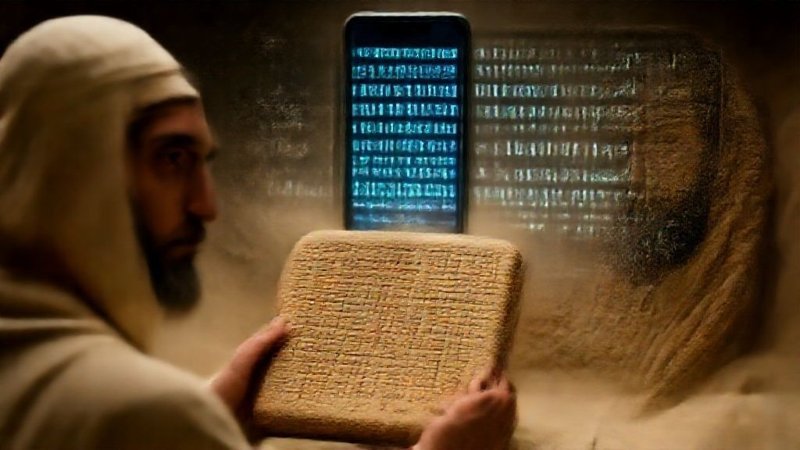
Those small clay tablets, which might appear to you today as silent artifacts in museums, were the monumental “Servers” upon which the minutest details of the ancient economy were stored. What you are about to discover on this journey will fundamentally alter your perception of progress. While we believe we are living at the zenith of the digital age, we will find that the Sumerians established:
Accounting algorithms
Auditing systems
And even rudimentary forms of “digital signatures” at the dawn of history.
But how did these complex cuneiform symbols transform into an uncompromising financial system intolerant of error? And what compelled a priest in an ancient temple to spend his day counting and recording goat heads on clay instead of praying? A secret lies buried beneath the sands of Ur and Warka—a secret concerning how numbers evolved from simple tools of enumeration into the language that governs the world. The excitement lies not in knowing what they did, but how they did it with a precision that alarms contemporary accountants. As we prepare to delve into the depths of these tablets, always remember that every number you see on your screen today has a senior ancestor buried in a clay tablet awaiting decipherment. Are you ready to see how this all began? Let us now contemplate that pivotal moment: the moment the reed stylus touched the clay surface, to grasp the true genesis of the world’s engine: money.
From Barter to Organized Accounting
Picture yourself now standing on the banks of the Tigris and Euphrates, more than five thousand years ago, where the earth was still virgin, and breaths mingled with the scent of damp silt. There, amidst the roar of the great rivers, humanity was not only battling nature but engaged in another kind of struggle: a struggle against oblivion and the loss of rights. At that moment the reed touched the clay surface, the objective was not to inscribe a love poem or a war epic, but something far more vital and urgent: it concerned survival, property, and the accounting of debits and credits.
Centuries before this moment, our ancestors lived under a simple system of barter: you give me a sheep, and I give you a sack of grain. The world was small, and human memory sufficed for the limited transactions of the tribe. However, with the explosion of the agricultural revolution in Mesopotamia, the unexpected occurred. Crops overflowed, herds multiplied, and small villages transformed into bustling cities. Here, memory fell prey to abundance. How could one recall how many seahs of barley he lent his neighbor three seasons ago? How could the temple tally the offerings of thousands of citizens without violating the rights of the deity or the enslaved?
Necessity was the womb from which accounting was born.
The First Financial Safes and Signatures
Numbers did not begin as abstract symbols; they began as tangible objects. Do you perceive those small clay pieces of varying geometric shapes? They were known as “clay tokens.” A small cone represented a quantity of grain; a clay sphere represented a head of sheep. The Sumerian merchant held these tokens in his hand, feeling the physical weight of his wealth before it was transmuted into figures on a surface. Yet, the question that persistently troubled the merchant’s inner sanctum was: How do we ensure no one tampers with these tokens?
From this necessity emerged the concept of “hollow clay spheres,” constituting the first financial safe in history. The first accountant would place the tokens inside a sphere of soft clay, then seal it securely. Since trust was a rare currency even at the dawn of civilization, the “cylinder seal” appeared. Every person of consequence possessed a unique seal, upon which they engraved their personal symbols, rolling it over the clay to leave an unforgeable signature. These seals narrated tales of power and ownership, shouting down anyone attempting fraud: “This is mine, this is my signature, and this is my witness.” At the heart of this imposing scene stood the very foundation of trust and verifiable transactions that continues to echo in our digital age.
Frequently Asked Questions
Who invented the first banking system?
The Sumerians in ancient Mesopotamia developed what can be considered the first banking system over five millennia ago, driven by the need to manage complex trade and track entitlements within their vast commercial empires.
How did Sumerians manage their economy without modern technology?
Sumerians used small clay tablets as their primary record-keeping tool, essentially acting as ancient ‘servers.’ They developed sophisticated accounting algorithms, auditing systems, and early forms of ‘digital signatures’ using cylinder seals to ensure accuracy and prevent fraud.
What were ‘clay tokens’ and ‘hollow clay spheres’?
‘Clay tokens’ were small, geometrically shaped pieces of clay used to represent quantities of goods (e.g., a cone for grain, a sphere for sheep). ‘Hollow clay spheres’ were the first financial safes, where these tokens were placed and sealed with unique cylinder seals to secure transactions and verify ownership.
What role did the agricultural revolution play in the birth of accounting?
The agricultural revolution in Mesopotamia led to an explosion of crops and herds, transforming small villages into bustling cities. This abundance overwhelmed human memory, making simple barter insufficient and creating an urgent necessity for organized accounting to track complex transactions, property, and rights.