Siberian Zombie Viruses: Ancient Threats Emerging from Melting Permafrost
Siberian Zombie Viruses: Ancient Threats Emerging from Melting Permafrost
Imagine a stillness spanning millennia, a silence broken only by the howl of polar winds sweeping across vast expanses of absolute white. There, where you might think time has ceased, in those regions we call “the ends of the Earth,” something begins to stir. These are not mere cracks in the ice; they are ruptures in the very fabric of history. These fissures, whose hum you can hear beneath your feet, are not merely the result of rising temperatures, but a cry of emergence for entities we believed had vanished alongside mammoths and saber-toothed tigers. This is the true beginning of our story, where the curtain unveils content that no human in our modern era has ever faced, a genesis that brings us face-to-face with a past that was supposed to remain buried forever.
Navigate Content
The Permafrost Bio-Bank: Nature’s Ancient Vault
Deep within the permafrost, lies a giant bio-bank, nature’s secret vault that has preserved its mysteries for over thirty thousand years. This soil is not merely frozen mud; it is a biological time capsule, remarkably preserving the genetic material of microorganisms, viruses, and bacteria that roamed the Earth before humanity knew writing or built its first civilizations. And now, with the retreating ice cover, this capsule begins to leak. Can you feel the chilling implications of this idea? To breathe air that might carry the very breath of ancient epochs? You now stand on the verge of a profound discovery, where the ground beneath our feet transforms from a guardian of safety into a source of an enigmatic biological threat for which we do not yet have a complete explanation.
Awakening Microbes: A Challenge to Modern Immunity
What is happening beneath this fractured ice transcends mere physical melting; it is an awakening of microscopic armies that had been in a state of deep slumber, a forced “biological dormancy” imposed by the harshness of the deep freeze. But what happens when these microbes awaken in a world that no longer resembles their own? Our immune systems, which have evolved over ages to confront modern threats, might find themselves utterly powerless against “ancient strangers” they have never encountered before. We are talking here about biosecurity challenges that extend beyond laboratories and reach the heart of global public health. Are we on the verge of confronting forgotten pandemics? Or do these organisms carry within their genetic codes secrets that could change our understanding of life itself?
Zombie Viruses: Fact or Fiction?
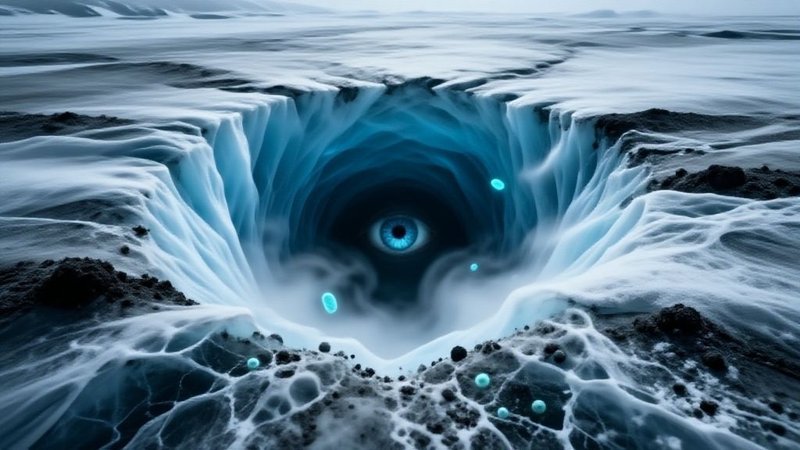
Consider the black fissures appearing in the blue ice; they resemble eyes opening after a long slumber. Every melting drop of water flowing into the oceans carries with it countless possibilities. Scientists today speak with a tone of concern about “zombie viruses,” those entities that have regained their infectious capacity after centuries of freezing. Think about it: how can a minuscule entity, imprisoned in an icy tomb for thirty or fifty thousand years, rise again and seek a host? This question is not just a scientific hypothesis; it is a reality now crystallizing in laboratories examining polar ice samples, where researchers are discovering that life does not truly die at the poles, but rather awaits the opportune moment for its return.

Pandora’s Box: Broader Repercussions and the Unknown Enemy
But is the problem limited merely to ancient microbes? The environmental and biological repercussions of this melting open doors to even more terrifying questions. As the ice melts, it releases massive quantities of trapped greenhouse gases, accelerating the rate of melting in a vicious cycle that appears to have no end. Amidst this transformation, the major dilemma emerges: how will we be able to protect our biosecurity in the face of an enemy about which we know nothing, an enemy that has been dormant since the last ice age? The challenge facing humanity now is not merely to maintain temperatures, but to prepare for what will emerge from these icy tombs. As the cracks continue to widen and the waters continue to flow, the lingering question in the air, refusing to close, remains: what have scientists actually found in those deep samples that made them reconsider every biosecurity protocol we know? The answer lies in the details of what has been extracted from the depths of Siberia and Alaska, which will make us wonder if we have opened a Pandora’s Box that can never be closed.
Permafrost: Earth’s Deep Archive and Viral Resuscitation
Here, in these perpetually cold regions, we are not merely talking about accumulated layers of ice, but about “permafrost“; that dark geological archive that has held the Earth’s breath captive for thousands of years. Imagine land that has not seen the light of day for over fifty thousand years, where temperatures drop to levels that freeze time itself, transforming microorganisms into prisoners in crystalline cells. This soil is not merely frozen mud; it is a biological “time capsule,” preserving within its depths the remains of extinct creatures, along with strains of microbes that modern humanity has never encountered. What causes concern in the corridors of secret laboratories is not the death of these organisms, but their astonishing ability to “return to life,” or what is scientifically known as “Resuscitation.” Microbes, including ancient viruses, bacteria, and fungi, do not die in this environment; rather, they enter a state of deep dormancy, where their vital processes slow down almost to zero, awaiting the moment of liberation. Sense with me that moment when the ice melts, and these organisms begin to restore their metabolic activity, as if awakening from a millennia-long coma, carrying genetic codes dating back to prehistoric eras. Scientists have categorized these dormant microbes into terrifying groups, including:
- Giant viruses that surpass some bacteria in size and complexity, such as the Pithovirus discovered deep in Siberia, which remained dormant for over thirty thousand years.
- Ancient bacteria strains unknown to modern medicine.
- Potentially unknown fungi species with unique properties.
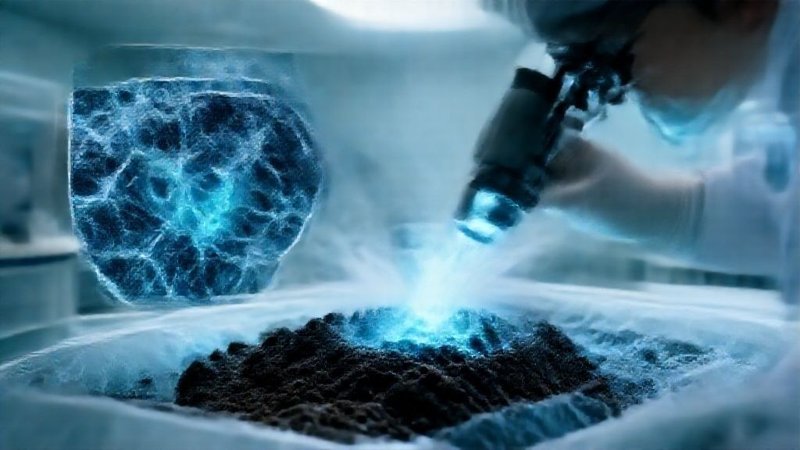
When scientists revived the Pithovirus in a suitable laboratory environment, it immediately began to attack and proliferate, as if those thousands of years were merely a short nap. This raises the question: is the matter confined solely to viruses? The answer lies in those bacteria and fungi that also await their awakening, hinting at a wider spectrum of dormant threats.
Frequently Asked Questions
Generated by AI Content Architect
About The Author