Orichalcum: Legendary Atlantis Metal Discovered, Stuns Scientists & Rewrites History

Orichalcum: Legendary Atlantis Metal Discovered, Stuns Scientists & Rewrites History
Imagine diving into the crystal-clear depths of the Mediterranean Sea off the coast of Sicily, where the secrets of bygone civilizations have lain dormant beneath the seabed sands for thousands of years. There, in 2015, divers discovered the wreck of a merchant vessel dating back 2,600 years. Yet, it carried neither gold nor ordinary pottery. Instead, it bore luminous metal ingots, combining the luster of gold with the reddish hue of copper—a metal that historians for centuries believed to be a mere myth, a product of Plato’s imagination. It is Orichalcum, said to have covered the walls of Poseidon’s temple in the lost continent of Atlantis. This discovery compels a re-evaluation of all we understand about the history of human technology.
Navigate Content
The Astonishing Composition of Orichalcum
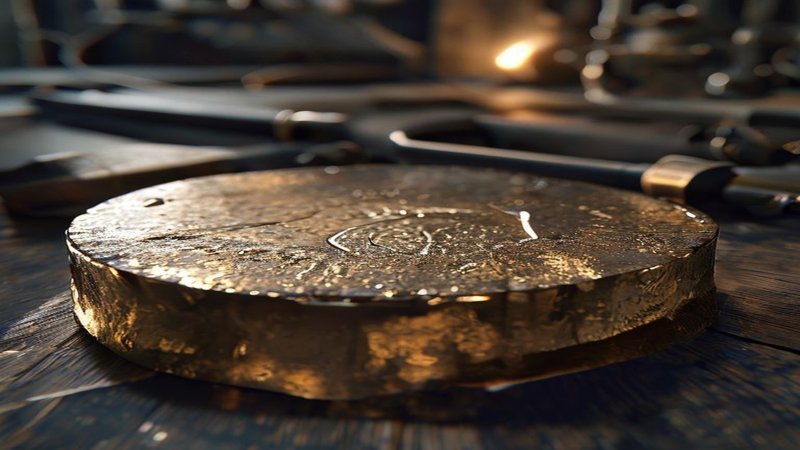
You are now confronted with tangible, irrefutable evidence that your ancestors possessed industrial capabilities that vastly surpass what is taught in conventional history textbooks. These forty-seven ingots recovered from the deep are not just pieces of metal; they are time capsules narrating a story of exceptional human ingenuity. When scientists subjected these pieces to meticulous chemical analysis in contemporary laboratories, they were astonished by the findings. They discovered a sophisticated alloy consisting of eighty percent copper and twenty percent zinc, along with trace, yet deliberate, amounts of lead, iron, and nickel. This blend is not a mere coincidence; it is the product of a complex chemical smelting process demanding precise temperatures and meticulous control over elemental ratios. This raises a crucial question for you: How did ancient artisans attain such a degree of purity and sophistication millennia before the advent of modern furnaces? This finding challenges conventional views and forces a re-evaluation of history, much like the Göbeklitepe Enigma.
Plato’s Prophecy and Ancient Industrial Might
In his renowned dialogues, Plato described Orichalcum as being second only to gold in terms of value and aesthetic appeal. He stated that the inner walls of Atlantis’s citadel were encased in this metal, which shone with a mysterious, fiery luminescence. For centuries, scholars dismissed this account as literary embellishment, crafted to enhance the myth of the sunken city. Yet today, observing the ingots recovered from the wreck, one realizes Plato was describing a palpable reality, not a mere fantasy. The brilliance emanating from this metal signifies a technological leap in metallurgy, indicating that ancient societies were not confined to a state of primitive simplicity, as some perceive. Rather, they possessed sophisticated industrial centers and extensive trade networks spanning continents to procure the raw materials necessary for the production of this rare metal. The discovery of Orichalcum in a sunken ship, destined for the port of Gela in Sicily, substantiates that this metal was a luxurious commodity, traded among the ruling elites and engineers of the ancient world. This prompts a reconsideration of the concept of linear historical progression. We habitually assume that humanity progresses in a linear fashion, from ignorance to enlightenment, from primitivism to advancement. However, this shipwreck narrates a fundamentally different account. It suggests that monumental technological advancements occurred in the past, their origins and outcomes subsequently lost to the ravages of natural disasters or major conflicts. While we live in an era widely considered the zenith of technological achievement, you are now discovering that we may be re-inventing tools and materials that were entirely familiar to engineers of ancient civilizations.
The Unfathomable Metallurgy of Antiquity
Reflect momentarily on the industrial processes prerequisite to producing a single Orichalcum ingot.
- Geological expertise is required to identify copper and zinc ore deposits, followed by the capability to extract them from deep within the earth.
- The more arduous stage, smelting, follows. Zinc, notably, is a highly challenging metal, as it vaporizes at temperatures below copper’s melting point.
- This implies that ancient metallurgists had to devise sealed furnaces and sophisticated distillation techniques to fuse these two metals without significant loss of either.
Such industrial chemistry necessitates meticulous temperature regulation and a profound comprehension of the properties of the constituent elements. When you hold this ingot, you are not merely grasping a piece of metal; you are holding a chemical engineering doctorate, inscribed by the flames of antiquity millennia ago. This level of advanced engineering opens up many unsolved mysteries.
Atlantis, Lost Civilizations, and a New History
This discovery directly connects us to the legend of Atlantis and compels us to question the identity of the people who disseminated such technology across the Mediterranean basin. Was Atlantis merely an island, or did it signify an advanced global civilization possessing technological prowess far exceeding that of its contemporaries? The utilization of Orichalcum in adorning temples and monumental structures suggests a substantial economic surplus and industrial capacity capable of producing vast quantities of this challenging metal. Such advancement does not spontaneously emerge; rather, it necessitates centuries of accumulated knowledge and scientific experimentation. This implies that entire chapters of human history remain undiscovered, lying beneath tons of sediment in the depths of our oceans. Delving deeper into the psychological and sociological analysis of these societies reveals that possession of a metal like Orichalcum conferred a sense of superiority and dominance. Envision a city whose walls shimmer under sunlight with a majestic, golden-red hue. This visual spectacle was designed to inspire awe in visitors and underscore the technological might of the city. The wreck discovered off Sicily represents the crucial link between legend and reality. It proves that Orichalcum was not merely a symbol of wealth but a technological instrument employed in commerce, construction, and potentially in the fabrication of intricate mechanical devices, of which only corroded fragments persist. You are now witnessing a revolution in our understanding of antiquity, pointing to lost civilizations and their profound secrets.
Frequently Asked Questions
Generated by AI Content Architect
About The Author