Nazca Lines: Unraveling the Mystery of Ancient Peru’s Sky-Visible Geoglyphs
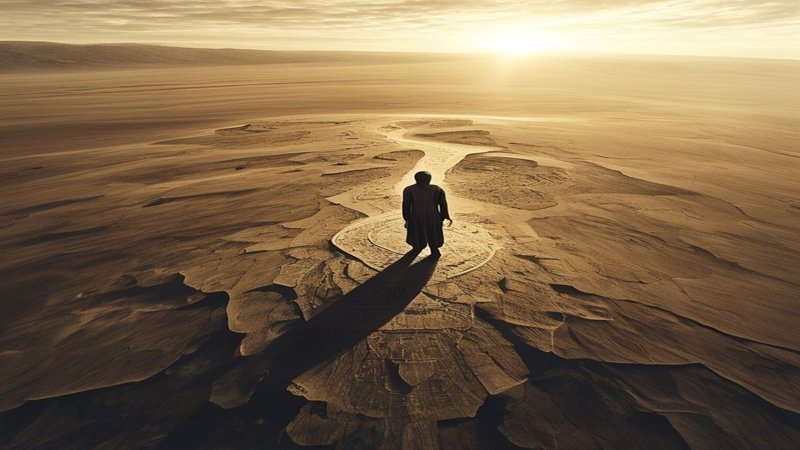
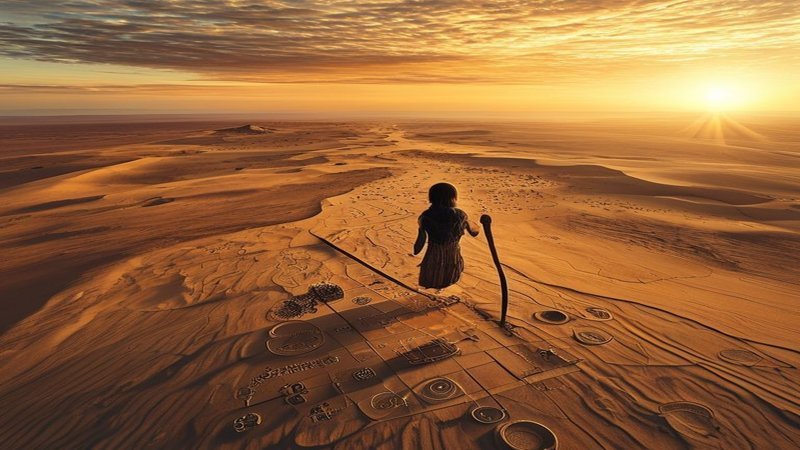
Imagine standing in the heart of an endless void where the earth is utterly silent and the wind dares not cross. Here, in the arid Peruvian desert, lies a mathematical marvel that defies human logic and pulsates with unsolved mysteries spanning thousands of years. You are not merely looking at scratches in the soil; you are before the greatest artistic and engineering canvas in human history, visible in its full clarity only from an aircraft soaring high in the sky.
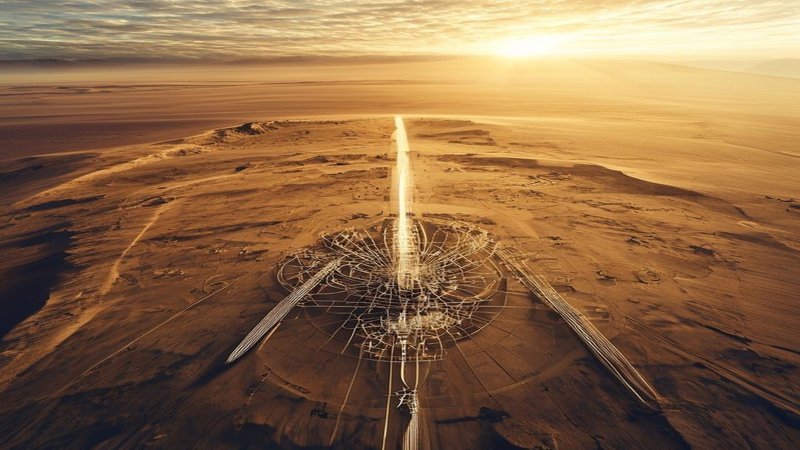
Have you ever wondered how ancient people managed to create an artwork whose full details they themselves could not see? You are now confronted with the Nazca Lines, geometric formations extending over 450 square kilometers of arid plateaus. These are not random lines; they are an embodiment of extreme precision, surpassing all we know about the capabilities of ancient civilizations. Look closely beneath your feet, for you are treading upon history written in the language of monumental engineering.
The story began in 1927 when archaeologist Toribio Mejía Xesspe walked across the plateaus and noticed strange paths beneath his feet. But the true discovery exploded onto the world stage in 1939 when scientist Paul Kosok flew over the area, encountering a breathtaking sight. Giant birds, animals, and geometric shapes appeared as if drawn by a giant using the earth as a canvas. It was a moment that forever changed our understanding of ancient history.
Maria Reiche: Dedication to Precision
The impossible task fell to a woman who dedicated her life to this enigma: the German mathematician Maria Reiche, nicknamed the “Lady of the Lines.” Maria spent over forty years alone in this harsh desert, armed with a broom and mathematical tools. With her genius, Maria proved that these lines were not the product of chance but the result of immense mathematical planning. She believed that these ancient engineers used extremely precise units of measurement and scaled up small drawings to enormous sizes using a complex system of ropes and stakes.
Ancient Engineering and Biological Wonders
Let us delve into the engineering details that will make you question everything you’ve learned about evolution. The straight lines in Nazca extend for several kilometers without deviating by even a single centimeter. How did they achieve this without modern surveying instruments? The secret lies in the soil itself. The desert consists of an upper layer of dark gravel saturated with iron oxide, beneath which lies a layer of light-colored sand. The Nazca people meticulously removed the dark layer to expose the lighter color below, creating a visual contrast that has endured for thousands of years thanks to the lack of rain and wind in that region.
Consider the spider figure, which is 46 meters long. It is not just a drawing; it is an accurate depiction of a very rare spider species that lives in the distant Amazon rainforests. How did the desert inhabitants know the exact form and precise anatomical details of this spider, to the extent of placing its reproductive organ correctly on the tip of its leg? This question opens a door of bewilderment that cannot be closed. Was there a connection between the peoples of the mountains, forests, and desert that we have not yet found traces of? This level of ancient ingenuity parallels other South American mysteries, such as the Andes Tunnels Enigma.
As for the hummingbird, extending 93 meters in length, it represents the pinnacle of creativity in aerodynamic design. Its lines curve at perfect mathematical angles, adhering to the laws of spatial geometry. You now realize that we are not talking about primitive art but an open-air engineering laboratory. Consider the physical and mental effort required to move thousands of tons of dark rocks simply to create this visual contrast, which only birds or, as they believed, gods could see.
Deciphering the Purpose: From Astronomy to Extraterrestrials
Here we arrive at the most controversial hypothesis: the purpose of these lines. Were they a giant astronomical calendar, as Maria Reiche believed? Maria found that some lines pointed with extreme precision to the sunrise and sunset points during the summer and winter solstices. For them, the desert was a map of the stars, reflecting the celestial order on Earth. However, this explanation was insufficient to account for the presence of the massive animal figures.
Science introduced another hypothesis concerning water, the most precious element in one of the Earth’s driest regions. Scientists now believe these lines were ritual paths trodden by people praying for rain. Furthermore, some lines even follow underground water courses. The Nazca people developed an astonishing system of underground aqueducts called puquios, which are still functional today. Their engineering served both survival and spirituality simultaneously.
Yet, we cannot ignore the theory that sparks imagination: “Ancient Astronauts.” In 1968, Erich von Däniken proposed the idea that these lines were runways for landing spacecraft. He cited the image of a man wearing what appears to be a space helmet and possessing strange hands, known as the “Astronaut,” carved on a mountainside. Despite the appeal of this idea, science tells us that the soil is too fragile to withstand the landing of any heavy object. The intriguing possibility of contact with advanced intelligence is a theme explored in discussions like NASA’s Secret: Did Early Space Race Aim to Contact Extraterrestrials? Nevertheless, the question remains: why did they draw images that could not be seen from the ground?
The Enduring Enigma: Cosmic Constants and Future Discoveries
The mathematical dimension in Nazca transcends mere shapes. There is a golden ratio in some formations, similar to that found in ancient Greek architecture. How did a people isolated from the ancient world arrive at these cosmic constants? Is it the innate engineering intuition residing in the human mind, or was there a lost civilization that taught them these secrets and vanished into the sands of time? You are now faced with material evidence that our ancestors possessed a cosmic vision extending beyond their simple daily needs.
In recent years, scientists have utilized drones and artificial intelligence to discover over 140 new figures that were previously unseen. This implies that we have only uncovered the tip of the iceberg. Each new discovery confirms that Nazca was a complex cultural and intellectual achievement that continues to challenge our understanding of ancient capabilities.
Frequently Asked Questions
What are the Nazca Lines and where are they located?
The Nazca Lines are massive geoglyphs – intricate designs and figures – etched into the desert floor of the Nazca region in Peru. They span over 450 square kilometers and are most clearly visible from an aerial perspective.
How were the Nazca Lines created by ancient people?
The Nazca people created the lines by carefully removing the dark, iron-oxide-rich top layer of gravel to expose the lighter-colored sand beneath. The extremely dry climate and minimal wind in the region have preserved these contrasts for thousands of years.
Who was Maria Reiche and what was her contribution to studying the Nazca Lines?
Maria Reiche was a German mathematician and archaeologist who dedicated over 40 years to researching, measuring, and preserving the Nazca Lines. She played a crucial role in mapping the figures and theorized they served as an astronomical calendar due to their precise alignments.
What are the leading theories regarding the purpose of the Nazca Lines?
Several theories exist for their purpose:
Astronomical Calendar: Alignments with celestial events for agricultural or ceremonial timing.
Water Rituals: Paths for ceremonial processions linked to prayers for rain and even marking underground water sources (puquios).
Ancient Astronauts: A controversial theory proposing they were landing strips or signals for extraterrestrial visitors.
Are there any new discoveries related to the Nazca Lines?
Yes, modern technology like drones and artificial intelligence has led to the discovery of over 140 new figures in recent years, demonstrating that the full extent of the Nazca Lines’ complexity is still being uncovered.