Libyan Desert Glass Mystery: Tutankhamun’s Scarab and Cosmic Catastrophe

Libyan Desert Glass Mystery: Tutankhamun’s Scarab and Cosmic Catastrophe
Navigate Content
The Scarab of Tutankhamun and the Geological Enigma
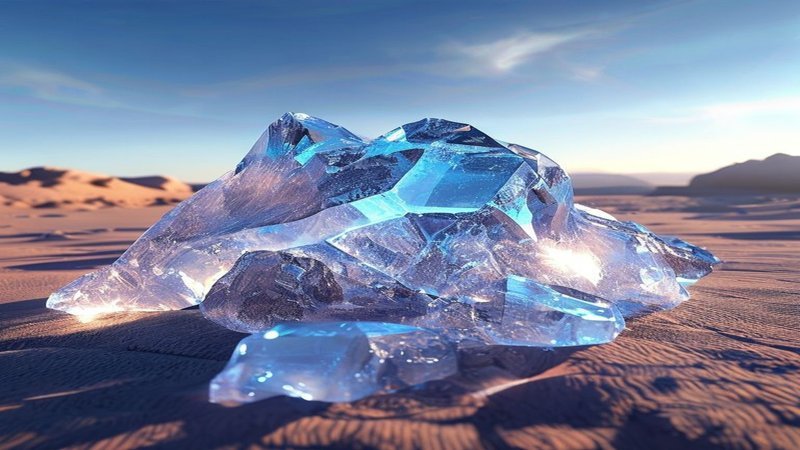
The global significance of this naturally occurring glass exploded into the public consciousness with Howard Carter’s 1922 discovery of Tutankhamun’s tomb. At the heart of the young Pharaoh’s pectoral rested a scarab made of translucent yellow material. Analysis confirmed it was Libyan Desert Glass, a substance composed of 98% pure silica. This discovery established a direct link between this ancient material and Egyptian royalty, yet it failed to answer the crucial question: how was it created in a desert setting devoid of the necessary volcanic activity?
The Inferno Required: Meteorites vs. Airbursts
Transforming sand into glass requires instantaneous heat exceeding 1,700°C, an energy signature typically associated only with catastrophic cosmic events. Scientists debate two primary theories:
- Meteorite Impact: A massive object strikes the Earth, melting the surface sand. The main counter-argument is the absence of a clear impact crater in the vast dispersion area.
- Cosmic Airburst: A large meteor explodes high in the atmosphere, sending a thermal wave and pressure shock down onto the desert floor. This process bears a striking resemblance to man-made nuclear fusion, such as the creation of Trinitite in New Mexico.
This event witnessed an absolute inferno, liquefying sand over tens of square kilometers. If you are interested in other cataclysmic cosmic events, consider reading about Spacetime’s Unheard Scream: The Terrifying Reality of Gravitational Waves & Cosmic Collisions.
Physical Evidence: The Fingerprints of Space
The glass itself holds secrets sealed within tiny bubbles trapped millions of years ago. Chemical analysis of these internal gases has provided compelling, non-terrestrial clues:
- Iridium Isotopes: The presence of iridium, an element rare on the Earth’s surface but common in meteorites, strongly supports a cosmic origin.
- Reidite Mineral: The discovery of reidite, a mineral formed only under extreme pressure, confirms that violent, high-pressure cosmic collisions must have occurred.
These physical testimonies suggest the event was a cataclysm that instantaneously reshaped the environment, validated by zircon crystals found within the glass subjected to pressures reaching thirty gigapascals.

Alternative Theories: Lost Technology and Ancient Weapons
Beyond conventional cosmology, some historians and researchers speculate about lost terrestrial capabilities. They point to ancient texts describing celestial weapons capable of boiling sand, suggesting the heating might not have been entirely natural. While sounding like fiction, the material evidence of unnatural fusion leads to bold questions:
- Could highly advanced, extinct civilizations have possessed the technology to replicate these fusion events?
- Are the glass fragments remnants of an ancient conflict or an experiment using technology we no longer comprehend?
The question of unnatural heating leaves a chilling alternative to cosmic impact, forcing us to re-evaluate the complexity of human and planetary history.
Frequently Asked Questions
About The Author