Damascus Steel: Ancient Nanotechnology, Lost Secrets, and Unsolved History
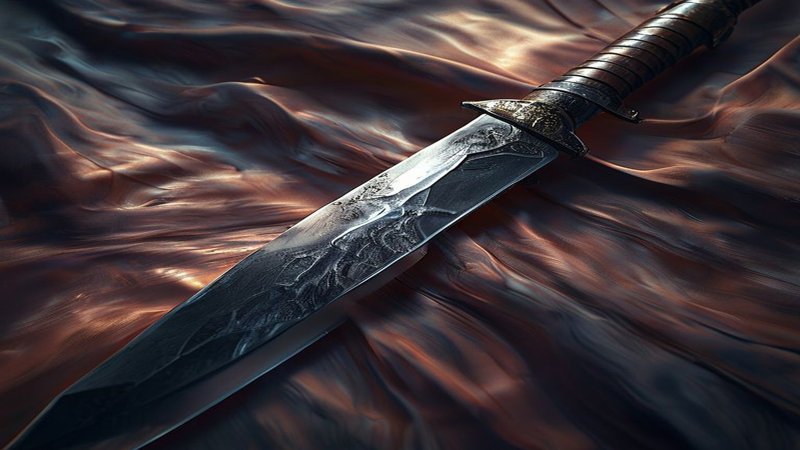
Imagine a blade slicing through a falling silk scarf with the pull of gravity. A sword splitting a steel helmet without losing its edge or breaking. You are now contemplating the greatest material enigma in human history. Look at your hand now. Imagine holding the hilt of a thousand-year-old sword. This blade is not merely a piece of cast metal. It is a mysterious microscopic roadmap. Its surface is covered with undulations resembling flowing river water or sand sculpted by the wind. You are now touching what European laboratories struggled to achieve for centuries. This is Damascus steel. The secret buried with its makers beneath the sands of time. Have you ever wondered how a simple blacksmith in a narrow alley in Damascus could surpass 18th-century physics? The answer lies not in the strength of the hammer, but in a world unseen by the naked eye – the nanoworld.
The story began when Crusaders confronted Arab swords on the battlefields. They were astonished by this metal’s ability to bend until its tip touched the hilt, then return perfectly straight. They saw heavy European armor shredded by this blade as if it were paper. The steel they knew bore no resemblance to this. Their steel was brittle, breaking under violent impacts, or quickly rusting under humidity. The swords they faced, however, possessed a unique spirit: terrifyingly hard and astonishingly flexible. They called it ‘Damascus steel,’ after the city that exported these masterpieces to the world. But the truth was far deeper than a mere city’s name.
Nanotechnology Revealed: A Thousand-Year-Old Secret
You now live in the era of the electron microscope. In 2006, a team of scientists at Dresden University of Technology in Germany decided to examine an ancient Damascus blade. What they found there completely upended the scales of scientific history. They discovered tiny carbon nanotubes within the sword’s structure. Do you grasp the significance of this? We are talking about nanotechnology, which modern science only recognized in the late 20th century. These Arab blacksmiths were manipulating atoms a thousand years before the word ‘nano’ was even coined. They were integrating fine carbon fibers into the steel matrix. This integration is what granted the sword its legendary strength. The carbon nanotubes acted as microscopic structural supports, protecting the sword from breaking and giving it an eternally sharp edge.
The Blacksmith’s Secret: Wootz Steel and Catalytic Impurities
But how did they achieve this? They did not possess sterile laboratories or laser devices. Their tools were fire, water, sand, and patience. The secret began with a raw material called ‘wootz.’ It arrived from India in the form of small ingots. But Damascus was the workshop that transformed this raw material into a miracle. The secret was not in the metal alone, but in its ‘impurities.’ Yes, the impurities everyone tries to eliminate were the key to their genius. Elements like
vanadium
chromium
manganese
were present in minute quantities. These elements catalyzed the growth of carbon nanotubes during the repeated heating and cooling processes. Close your eyes and imagine the scene. The blacksmith sits before his glowing forge. He heats the sword until its color resembles a ripe cherry. Then he removes it to hammer it with a measured rhythm. He isn’t merely striking metal; he is rearranging atoms. He cools the sword in secret liquids. Some said it was blood, others rare vegetable oils. But science tells us the secret was in the cooling rate. They had to maintain a specific temperature that allowed carbon to form into long, strong threads. If the temperature rose by just one degree, the magic would shatter. If it cooled too quickly, the blade would become brittle as pottery.
The Unsolved Mystery: Why Damascus Steel Production Ceased
You are now witnessing a struggle between science and legend. In the 19th century, Britain’s greatest scientists, including Michael Faraday, attempted to replicate this steel. Faraday, who transformed the world with electricity, failed utterly before the secret of the Damascus sword. He spent years mixing metals and analyzing samples but could not achieve those magical undulations. Scientists at the time did not understand that the secret lay not only in the chemical elements but in how these elements combined under the pressure of the hammer and the heat of the furnace. Damascus steel was an advanced composite material, millennia ahead of its time. Have you ever felt the bitterness of lost knowledge? Around 1800, the production of Damascus swords abruptly ceased. The secret vanished. Those undulations disappeared from new swords. Why? This is the most enigmatic part of the story. Historians believe that the mines supplying the Arabs with ‘wootz’ ore were depleted. And since the secret depended on the trace impurities present specifically in that ore, blacksmiths were unable to reproduce the same effect using other raw materials. The chain of oral knowledge, passed from father to son, was broken. The secret drowned in the depths of history, leaving us with swords in museums that refuse to tell us their genesis.
Ancient Mastery Meets Modern Science
Consider this stunning paradox. Today, we use carbon fibers in fighter jets and Formula One race cars, considering them the pinnacle of human development. Yet, if you traveled back in time to the 10th century, you would find an Arab knight carrying this technology in his scabbard. He trusted his blade as you trust your computers. This sword was not merely a weapon; it was a technological identity card. It was proof that Arab civilization was not just one of texts and poetry, but one of open laboratories and astonishing material experiments. Look at the microscopic details. Carbon in ordinary steel exists as irregular clumps. But in Damascus steel, carbon transforms into ‘cementite.’ Cementite is a very hard but brittle material. And here the miracle appears: nanocarbon tubes encapsulate these hard particles. Imagine it like concrete construction. The cementite is the hard aggregate, and the carbon tubes are the reinforcing bars that hold the structure together. This combination provided the unparalleled strength and flexibility.
Frequently Asked Questions
What made Damascus steel legendary?
Damascus steel was renowned for its extraordinary properties: the ability to bend dramatically without breaking, its terrifying hardness, astonishing flexibility, and an eternally sharp edge. It could famously slice through silk mid-air or cut through heavy armor.
How was nanotechnology discovered in Damascus steel?
In 2006, a team of scientists at Dresden University of Technology used an electron microscope to examine an ancient Damascus blade. They discovered tiny carbon nanotubes integrated within the steel’s structure, revealing an ancient application of nanotechnology millennia before its modern recognition.
What role did ‘wootz’ steel play in Damascus blades?
‘Wootz’ was the raw material, imported from India, in the form of small ingots. Its unique composition, including trace impurities like vanadium, chromium, and manganese, was crucial. These elements acted as catalysts for the growth of carbon nanotubes during the specific heating and cooling processes employed by ancient blacksmiths.
Why did the production of Damascus steel cease around 1800?
Historians believe the primary reason was the depletion of the specific mines in India that supplied the unique ‘wootz’ ore. Since the secret of Damascus steel relied heavily on the trace impurities found exclusively in that ore, blacksmiths were unable to replicate the material with other raw materials, leading to the loss of the oral tradition and the disappearance of the technology.