Cosmic Particles Reveal Secret Voids in Khufu’s Great Pyramid
Cosmic Particles Reveal Secret Voids in Khufu’s Great Pyramid
Navigate Content
The Science of Seeing Through Stone: Muon Radiography
The breakthrough came via the ScanPyramids project, a collaboration launched in 2015 involving major international institutions. Since drilling or destructive entry was forbidden, scientists needed a non-invasive technique. The answer lay in muons: subatomic particles that constantly shower the Earth, generated when cosmic rays strike the upper atmosphere. These particles possess the unique property of penetrating hundreds of meters of dense material.
- Muons function like cosmic X-rays: they lose energy when passing through dense stone (limestone/granite).
- They pass through unimpeded in greater numbers when encountering a void or hidden space.
- Detectors, including nuclear emulsions and muon telescopes, collected data over several months to map density variations within the structure.
The Shock Discovery: The Big Void and the North Face Corridor
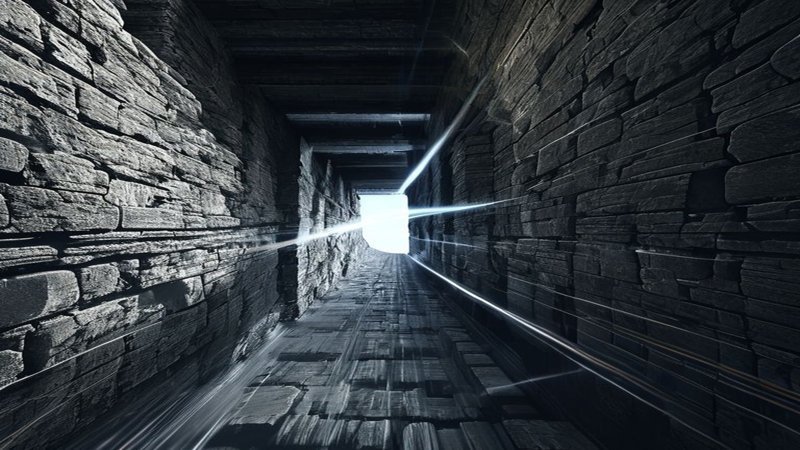
The initial analysis published in 2017 yielded an astonishing result: the detection of a void exceeding 30 meters in length, situated directly over the Grand Gallery. Dubbed the ‘Big Void,’ this feature had no precedent in known architectural plans. This discovery was followed in March 2023 by the identification of a smaller, yet precisely defined corridor behind the North Face’s Entrance Gable, measuring approximately nine meters long and two meters wide.
Advancements in digital processing and AI allowed scientists to not only locate these spaces but also to visually confirm one. A micro-endoscope (six millimeters in diameter) inserted through a pre-existing crack provided the first images of the corridor, revealing meticulously cut stones and a distinct inclined gable ceiling, devoid of inscriptions.
Hypothesis One: Structural Genius and Pressure Relief
The most widely accepted explanation for these internal voids stems from ancient Egyptian structural engineering prowess. The primary hypothesis suggests these are pressure-relief chambers.
Consider the colossal weight of the pyramid pressing down towards critical areas like the King’s Chamber. The voids, often employing gable roofs (seen in the newly discovered corridor), act as sophisticated load-distribution systems. They effectively redirect immense structural stress away from fragile lower passages and toward more robust adjacent stone blocks, protecting the integrity of the burial chambers below. This view cements the ancient engineers, like Hemiunu, as masters of material science.
Hypothesis Two: Theological and Funerary Intent
A less empirical, yet culturally significant, theory links these hidden spaces to ancient Egyptian spirituality and funerary rites. This perspective views the pyramid not just as a tomb, but as a mechanism for the Pharaoh’s afterlife journey.
- The voids may symbolize passages intended to facilitate the Pharaoh’s soul (the ‘Ba’) ascent to the Northern Sky, home to the circumpolar stars that never set.
- The Big Void might have served as a transitional space or potentially a functional area where lifting mechanisms used to place the massive ceiling blocks of the King’s Chamber were stored and subsequently abandoned.
Frequently Asked Questions
About The Author