Baghdad Battery: Did Ancient Iraqis Use Electricity 2,000 Years Ago?
Imagine if the light illuminating your room now was not a product of the 19th century, but a secret hidden within the sands of Iraq two millennia ago. Could the battery in your phone have had its rudimentary version designed in a forgotten workshop on the outskirts of ancient Baghdad? We are not speaking here of science fiction myths, but of a solid archaeological reality that has shaken the foundations of the scientific community and reshaped our understanding of human evolution.
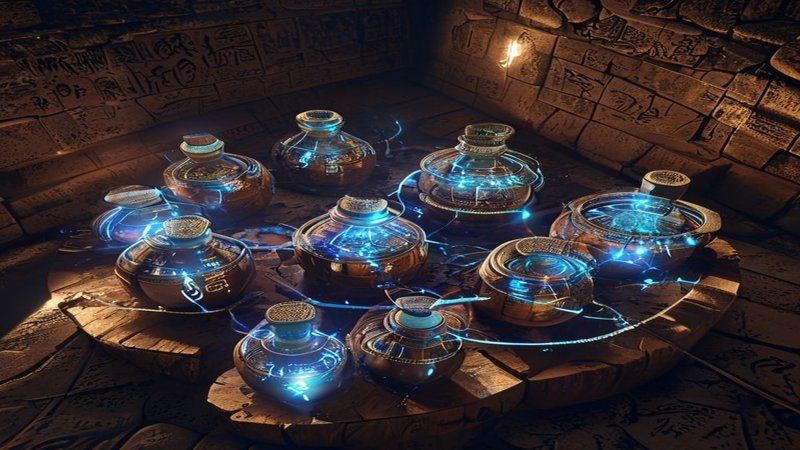
In 1936, in an area known as Khujut Rabou, near Baghdad, workers unearthed a peculiar pottery jar, no more than fifteen centimeters in length. This jar contained neither gold nor jewels, but rather held within its core a technical enigma that perplexed minds. Inside the pottery, excavators found a copper cylinder secured with a bitumen stopper, and within the cylinder’s heart, an iron rod displaying clear evidence of acidic corrosion. When the German archaeologist Wilhelm König examined this discovery, he realized that what he was observing was not merely a vessel for storing oils, but an integrated electrochemical system.
A Functioning Galvanic Cell, 1,700 Years Ahead of Time
Observe this precise engineering design carefully. Copper, iron, and bitumen are the fundamental components required to construct a simple galvanic cell. If this jar were filled with an acidic liquid, such as lemon juice or vinegar, an immediate chemical reaction would ensue between the two metals. This reaction liberates electrons and generates a continuous electric current. Modern experiments conducted by researchers in international museums have demonstrated that reconstructing this jar with remarkable accuracy can produce between half a volt and 1.1 volts of power. You might consider this amount negligible, but imagine if dozens of these jars were connected together in a single circuit. You would then possess sufficient energy to profoundly alter the trajectory of ancient civilization.
Lost Applications: Electroplating and Ancient Medicine
You might now be wondering about the motivation behind our Mesopotamian ancestors inventing such a device. Did they possess electric lamps to illuminate their darkened temples, free from the smoke of candles? Some theories suggest that this energy was utilized in electroplating processes. Consider the gold ornaments and jewelry discovered in royal tombs. Some are coated with an exceedingly thin layer of gold over silver—a process virtually impossible to achieve with such remarkable precision without the use of an electric current to immerse the metal and uniformly distribute the particles.
However, the enigma deepens when we consider the medical aspect. In ancient times, electro-acupuncture or the application of mild electrical impulses was a method for treating joint pain and alleviating inflammation. Did the physicians of Babylon and Parthia use these jars to soothe the suffering of their patients? The concept of pain management via electricity represents the pinnacle of modern medical advancement that we pride ourselves on today. To realize that this concept was practiced in the heart of the desert centuries ago challenges the linear progression commonly associated with human history. This suggests a pattern of lost technical expertise, similar to the ancient metallurgic feats detailed in Orichalcum: Legendary Atlantis Metal Discovered.
The Vanishing Act: Why the Technology Disappeared
Why, then, did this technology vanish? And why have we not found wires or lamps in excavations? The incomplete material record does not preclude its existence but suggests that the Earth still conceals many secrets within its depths. The answer may lie in the esoteric nature of specialized knowledge. In those eras, technical expertise was often exclusive to the priestly class or master artisans, who often shrouded their innovations in an aura of mystique and exclusivity to protect them. Potential reasons for the lack of corresponding artifacts include:
Specialized Secrecy: Knowledge was confined to exclusive guilds, preventing widespread application or documentation.
Perishable Conductors: The ‘wires’ used to connect the cells might have been made from organic fibers or textiles, which decayed long ago.
Material Recycling: Any precious or reusable metal components (like lead connectors) would likely have been melted down and reused throughout the subsequent ages of war and resource scarcity.
A Challenge to Historical Hubris
Imagine the profound cognitive challenge faced by an archaeologist attempting to interpret the existence of technology far ahead of its time. The case of the Baghdad Battery presents a fundamental question regarding contemporary human hubris. We often assume intellectual superiority over our predecessors, believing we are the sole masters of electrical phenomena. Yet, the stark reality is that ancient civilizations may have possessed a deeper understanding of the universe and its laws, employing simple yet effective methodologies. This jar dismantles the conventional stereotype of primitive ancient humans and replaces it with the image of a resourceful engineer adept at leveraging chemistry to serve their needs. Every time you touch your phone screen, remember that the genesis of this technological concept extends millennia into the past, originating in Mesopotamia. This artifact, much like the Göbeklitepe Enigma, demands that we redefine our collective identity as a lineage of innovators who never succumbed to the darkness of ignorance.
Frequently Asked Questions
What is the Baghdad Battery?
The Baghdad Battery is a term used to describe three artifacts found near Khujut Rabou, Iraq, dating back to the Parthian period (around 150 BC to AD 250). It consists of a small clay jar containing a copper cylinder, an iron rod, and a bitumen stopper, forming a rudimentary electrochemical system (a galvanic cell).
How did the Baghdad Battery allegedly produce electricity?
If the jar were filled with an electrolyte, such as vinegar, fermented grape juice, or lemon juice, the acidic liquid would react with the copper and iron components. This redox reaction would release electrons, generating a small but continuous electric current, demonstrating the principle of a basic battery.
What are the main theories about the battery’s use?
The two primary theories suggest the electricity generated was used for: 1) Electroplating, specifically applying thin layers of gold or other metals onto artifacts for decorative purposes; and 2) Medical applications, possibly a form of electro-acupuncture or mild electrical pain relief.
Why is the Baghdad Battery controversial among archaeologists?
The controversy arises because the artifact suggests ancient Mesopotamian civilizations possessed knowledge of electrochemistry 1,700 years before its formal discovery in Europe. While its function as a battery is demonstrable, definitive proof (like wires or electrical tools) of its electrical use has not been widely excavated, leading some skeptics to suggest it was merely a storage vessel for scrolls or spices.