Amazon’s Walking Trees: The Socratea Exorrhiza Mystery That Will Shock You

0
image_1-128


Amazon’s Walking Trees: The Socratea Exorrhiza Mystery That Will Shock You

Imagine waking in a dense jungle to find the tree that once shaded your tent has completely vanished. This isn’t just an old wives’ tale, but a geographical reality that terrifies anyone daring to venture deep into the Amazon. Can you believe there are giant arboreal beings that suddenly decide their original habitat is no longer sufficient, embarking on a slow, eerie crawling journey under the cover of darkness?


The Enigma of Socratea Exorrhiza: Trees That Walk

You now stand in the heart of Ecuador’s rainforests, where locals whisper stories that send shivers down your spine. They speak of walking palm trees, scientifically known as Socratea exorrhiza. You look at them and see trunks rising on roots resembling long, slender legs. These roots are not merely anchors in the ground but tools for walking in a world governed by the survival of the fittest. When these trees sense that the shade above has become too heavy, and sunlight begins to fade behind other forest giants, they make a crucial decision. They start growing new roots in the direction of light, while allowing their old roots to die and gradually decompose. You observe a process that takes many months but ultimately leads to a single outcome: the tree has effectively moved from one point to another. You might consider this movement simple, yet in the plant world, it is a kinetic miracle that defies the steadfastness of mountains and soil.

Look closely at the details of this arboreal entity. Prop roots protrude from the trunk one or two meters above the ground, giving it the appearance of a giant spider ready to pounce. When you touch its rough bark, you feel a strange coolness and an enigma that envelops the history of these ancient forests. Scientists say these trees can move up to twenty meters per year. Imagine the extent of change occurring in the forest while you sleep. Paths shift, and the landmarks you used to navigate might be gone the next morning. This continuous migration creates a dynamic environment, making the forest a living organism that breathes and moves collectively. You are not just a visitor in a static place but a guest in a kingdom governed by laws of slow motion, imperceptible to your limited vision.
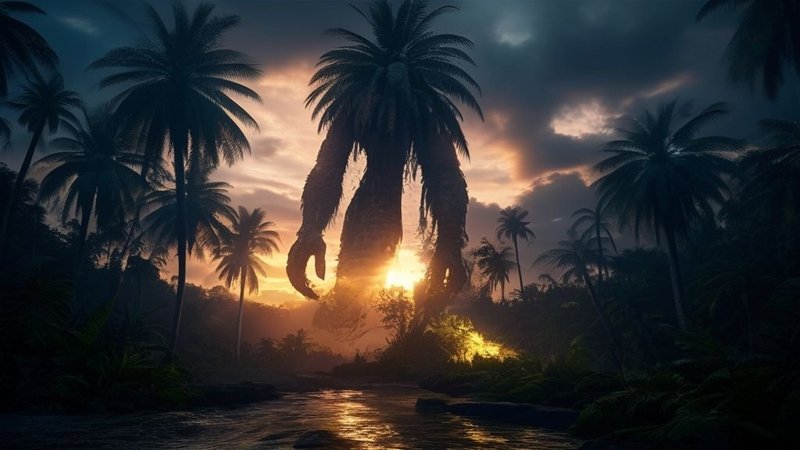
The Enigma of Socratea Exorrhiza: Trees That Walk


Beyond Biology: Folklore, Consciousness & Human Fear

But it’s not just about seeking light. Some in those regions believe these trees possess a unique consciousness. Latin American folklore abounds with tales of spirits inhabiting and guiding these trees. They say that if you sit in complete silence on a moonlit night, you might hear the creaking of wood as it stretches and the groaning of roots as they push through the damp soil. The scent there is strong, saturated with the smell of decaying earth and decomposing leaves that hide buried secrets. You feel the forest watching you with a thousand hidden eyes. Is it merely a biological phenomenon, or is there something deeper connecting these beings?

When we delve into the psychological analysis of our relationship with forests, we find that your fear of moving trees stems from an ancient instinct. Humans always seek stability in nature to feel secure. Rocks are steadfast, mountains are firm, and trees are the pillars that hold the forest sky. When these pillars begin to walk, your concept of reality starts to collapse. You fear chaos and getting lost in a place that refuses to stay still. This fear led ancient peoples to weave legends of enchanted forests where trees speak and move to protect their treasures or repel strangers. You now realize that scientific truth is no less strange than legend, and perhaps even more terrifying because it is a tangible reality you can measure with a ruler and a pen.


Ecological Dance: How Mobile Trees Sustain the Forest

Consider the ecological balance this movement creates. The forest is not merely a random collection of trees but a complex network of shared interests and silent conflicts. Mobile trees play a vital role in opening new spaces for smaller plants growing beneath them. When a large tree moves, it leaves behind a gap that allows light to reach the forest floor, stimulating new life to emerge. Here you witness a complete life cycle dependent on movement and migration. The ancient forest does not die because it knows how to renew itself and change its location to survive. This plant intelligence makes us reconsider our definition of life and consciousness. Is consciousness limited to beings with brains and nerves, or do wood, bark, and plant sap carry a form of perception we have yet to understand?

Ecological Dance: How Mobile Trees Sustain the Forest


The ‘Wood Wide Web’ & The Engineering of Movement

Let us shift your memory to recent research that revealed what is called the “wood wide web” or the forest’s internet. Beneath your feet, as you walk among these moving trees, are billions of tiny fungal threads connecting the roots of trees to each other. This network allows trees to exchange information, warnings, and even nutrients. When a tree is attacked by insects, it sends chemical signals through its roots to alert its neighbors. You now realize that a moving tree does not do so alone; its movement may be part of a larger strategic plan involving the entire forest. Could these walking trees be the scouts searching for new resources for the rest of the arboreal community? This concept completely changes your perspective on every tree you see in your garden or in distant forests.

Delving into the technical details of this phenomenon reveals an engineering marvel in root structure. These roots are not just tubes for absorbing water; they are natural hydraulic levers. The tree uses osmotic pressure to direct cell growth in a specific direction, creating enough propulsive force to shift its enormous weight over time. You are amazed by this silent power that requires no engines or fuel other than sunlight and raindrops. This grand design makes us wonder about the many other phenomena occurring around us that we fail to notice due to our excessive speed in life. We live in a time of seconds and minutes, while the forest lives in a time of decades and centuries. To understand the language of trees, you must slow your pulse, calm your breath, and observe with insight.


Frequently Asked Questions

Do trees truly walk in the Amazon rainforest?
Yes, scientifically known as *Socratea exorrhiza*, these palm trees are observed to slowly change their location over time, giving the impression of ‘walking’ by shifting their root system.
How do walking palm trees move?
They grow new roots in the direction of more favorable conditions (like sunlight), while allowing older roots on the opposite side to die and decompose. This differential growth enables the entire tree to gradually shift its position.
How fast can these walking trees move?
Scientists estimate that *Socratea exorrhiza* trees can move up to twenty meters per year, although this process is slow and imperceptible to the human eye over short periods.
What is the ‘wood wide web’ and how does it relate to moving trees?
The ‘wood wide web’ is an underground network of fungal threads connecting tree roots, allowing them to exchange information, warnings, and nutrients. It’s theorized that a moving tree’s actions might be part of a larger, coordinated strategy within this intricate forest network.
Why do these trees move?
The primary reason is to seek better light conditions when shaded by other forest giants. Their movement also plays a vital role in ecological balance by creating new spaces for other plants, and some folklore suggests a form of unique plant consciousness guiding their migration.

Generated by AI Content Architect

About The Author

Leave a Reply

Your email address will not be published. Required fields are marked *