
The Industrial Revolution in Alexandria: Why History Delayed the Steam Engine
The Industrial Revolution in Alexandria: Why History Delayed the Steam Engine
Navigate Content
The Mind of Heron and the Mouseion Workshop
To truly understand Heron, we must discard the image of the philosopher wearing a white robe, lost in contemplation of the cosmos. Heron was a highly skilled craftsman and an engineer who loved practical experimentation.
He lived at the heart of the Library of Alexandria, which was not merely a repository of books, but rather akin to a research and development center. For more context on the ancient city’s ultimate fate, read The True Story of the Library of Alexandria’s Fall.
- Combined mechanical workshops and chemical laboratories
- Exploration of inanimate objects moving on their own
- Practical applications recorded in his famous book Pneumatica
The Birth of the Aeolipile: The First Steam Engine
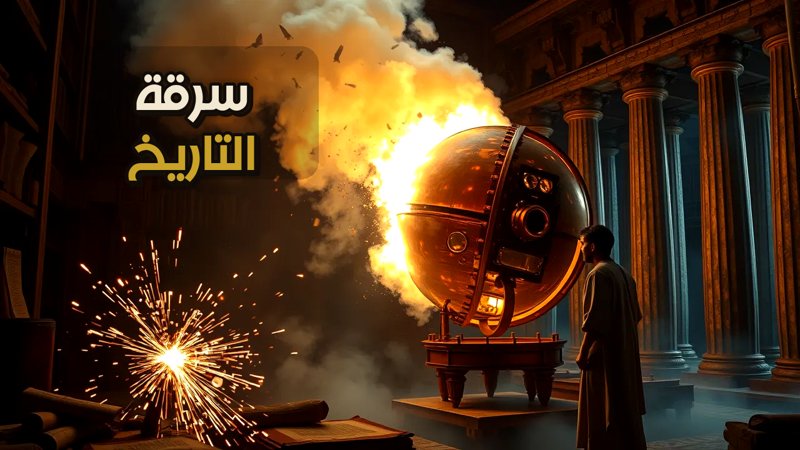
Inside his workshop, Heron suspended a metallic sphere above a boiling pot of water. As steam escaped from its bent pipes, the sphere spun at an extraordinary speed accompanied by a high-pitched whistling sound.
Those who witnessed the sphere spinning on its own stood in astonishment. There were no gears, no horses pulling it, and no hands touching it. It was simply a force generated by heating water that moved the metal.
The ‘Roman Trap’ and the Economic Barrier
This scene prompts a logical question: if this principle was understood and applied practically, why did no one connect this sphere to gears and wheels to propel transportation? The reality is that we face a phenomenon we might call the ‘Roman Trap’—a trap that delayed the industrial revolution by more than 1,700 years.
The issue was economics above all:
- Cheap Labor: The empire rested on the shoulders of slaves performing arduous tasks for free.
- No Financial Incentive: There was no motivation to spend vast sums developing complex engines requiring maintenance and coal.
- Alternative Civilizations: Other ancient empires also faced unique technological hurdles, much like the engineering feats seen in The Meroë Pyramids: Sudan’s Iron Empire That Defied Rome.
Technical and Societal Obstacles to Mechanization
Beyond economics, there were severe technical hurdles. To turn Heron’s ‘toy’ into a true engine capable of pulling tons, society needed boilers that could withstand immense steam pressure. Unfortunately, the metallurgy of the era relied heavily on copper and bronze, lacking the advanced steel production required to safely contain high-pressure steam.
Most importantly, society viewed science as philosophy or amusement rather than a tool for mass production and commercial industrial scaling.
Frequently Asked Questions
About The Author