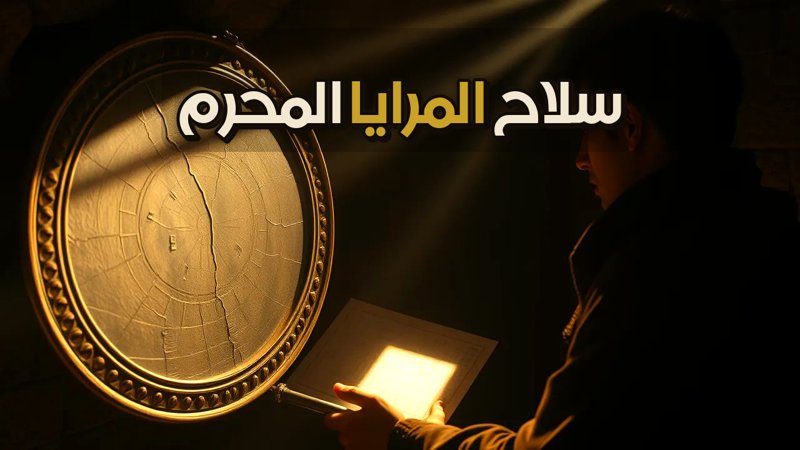
When we hear the term ‘magic mirror,’ our minds naturally wander to fantasy stories and legends. However, in the history of ancient warfare, reality was far more ingenious. This mirror was not merely an ornamental object; rather, it was a highly sophisticated military encryption and espionage device used by empires to transmit secret messages and detect enemy movements from afar.
The core concept is simply how science and physics were transformed by spies into a silent weapon. To decode this weapon, we follow a structured path starting from the optical illusion itself. In ancient times, the greatest challenge for any military commander was the ‘factor of time.’ Instead of resorting to superstition, the solution lay in applying the physics of light and reflection to overcome distance.
Spies at the time took advantage of the fact that scientific knowledge was not widespread among ordinary people, shrouding these mirrors in an aura of mystery and bizarre tales as a form of military camouflage. The bronze mirror, which looked completely ordinary, was cutting-edge technology by the standards of that era.
Transmitted encrypted signals without suspicion
Concealed military maps in plain sight
Fooled border guards with innocent appearances
Ancient China and the Ingenious ‘Makio’ Mirrors
The true beginning of this technology was in the Far East, specifically in the ancient Chinese Empire. There, the art of war blended with manufacturing genius to produce the first mirror capable of concealing details and revealing them at the right moment.
When artisans poured molten copper and tin alloy into molds, the back featuring thick, raised patterns cooled at a different rate than the thinner areas. This disparity created microscopic curvatures impossible for the naked eye to detect. When sunlight struck the face, it acted as a lens displaying the data hidden behind it.
Archimedes and the Siege of Syracuse
If we head west toward the Mediterranean basin, we see how the human mind evolved the use of mirrors from an information transmission tool into an offensive weapon. During the Roman siege of a Greek city in Sicily, Archimedes allegedly used polished bronze shields to direct sunrays toward the Roman fleet.
While modern experiments by institutions like MIT show that setting ships ablaze via light reflection is nearly impractical due to wave movement, the strategic use of mirrors was still profound: blinding archers and guiding catapult operators with pinpoint accuracy.
Frequently Asked Questions
What was a magic mirror used for in ancient times?
Magic mirrors were used as sophisticated military encryption and espionage devices to smuggle secret maps, alliance messages, and tactical data across enemy borders in plain sight.
How did ancient Chinese ‘Makio’ mirrors work?
During the metal casting process, differential cooling rates between thick raised patterns on the back and thinner areas on the front created microscopic, invisible curvatures on the polished face. When sunlight hit the mirror, it projected the hidden patterns onto a wall.
Did Archimedes really burn Roman ships with mirrors?
Modern scientific tests suggest that setting wood on fire via reflected sunlight at sea is highly improbable due to wave motion and cooling; however, the mirrors were likely used effectively to blind sailors, distract archers, and guide catapult targets.
Why didn’t border guards catch spies carrying these mirrors?
The mirrors looked completely ordinary—circular with smooth, shiny faces and familiar geometric patterns on the back—allowing them to pass inspection as innocent decorative items.