The Pyramid of Kukulcan: Ancient Acoustic Enigma and Lost Maya Technology
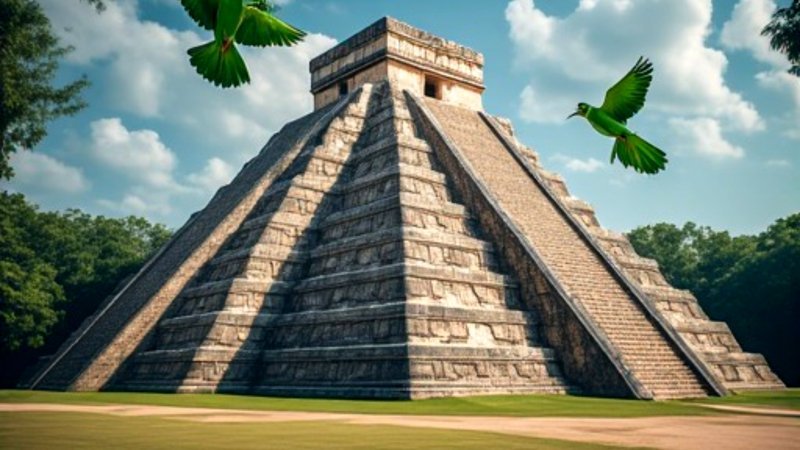
The cry of the Quetzal bird you hear when standing before the Pyramid of Kukulcan is not a natural echo. It is an acoustic code carved into the stone a thousand years ago. If you clap your hands now, the jungle will answer you with the sound of a sacred bird nearly extinct in that region. However, the terrifying aspect is not the sound itself, but the question archaeologists are reluctant to answer clearly: How did a civilization lacking metal tools manage to precisely tune acoustic wave frequencies with accuracy surpassing the most advanced digital laboratories today? You are now standing before the greatest acoustic enigma in human history—a mystery that transforms solid stone into a living musical instrument.
The Quetzal’s Call: An Engineered Miracle in Stone
You are looking at the pyramid of Chichen Itza, seeing merely a massive stone structure. In reality, you are observing a colossal data processor. The Maya engineers did not build this pyramid solely for worship; they designed a complete sensory experience. When you clap at the base of the staircase, sound waves strike the narrow, elevated stone steps. These steps function as frequency filters, rearranging and compressing the sound before sending it to your ears as the chirping of the green Quetzal bird. This bird represented a deity to them. Imagine the awe an ordinary person in those times must have felt: seeing the priest raise his hand, clap, and the god’s voice issuing forth from the heart of the stone. Do you grasp the magnitude of psychological control inherent in this design?
Contemporary scientists have attempted to simulate this effect using computer models. They discovered that the height, angle, and material used in the steps were calculated with astonishing precision. Even a deviation of a few centimeters would have turned the sound into unintelligible noise. This leads to an unavoidable question: How did they achieve this without modern acoustic measurement equipment? The conventional explanation cites architectural serendipity. But in my personal opinion, this explanation is an insult to your intelligence. Coincidence does not repeat with such perfection on all four faces of the pyramid, nor does it selectively choose the exact voice of a bird revered by the people.
Beyond Sound: Astronomical Alignment and Sensory Deception
You now sense that there is something deeper at play, and you are correct. The pyramid is more than just a loudspeaker; it is an astronomical clock. During the vernal and autumnal equinoxes, a phenomenon beyond imagination occurs. Sunlight strikes the pyramid’s corner, casting a serpentine shadow along the staircase, creating the illusion of a snake of light slithering toward the ground. But have you considered the accompanying sound? Reports indicate that the gathering of people and their specific vocalizations on that day create a vibrational resonance resembling the hissing of snakes. You are not facing a temple; you are facing an augmented reality simulation system constructed from limestone, shadow, and sound.
Defying Physics: The Great Ball Court and Raining Echoes
Let us move to the Great Ball Court at the same site. If you stand at one end and whisper a single word, a person at the opposite end will hear you with perfect clarity. The distance between you exceeds 150 meters. There are no curved, parabolic walls to focus the sound, as in modern domes; the walls are straight. This defies all known laws of acoustic physics regarding planar surfaces. You feel as if the walls are transmitting your voice through an invisible telephone wire. Most people overlook this detail, but here the dominant narrative collapses. How did the Maya know the properties of sound reflection on flat surfaces with such efficiency?
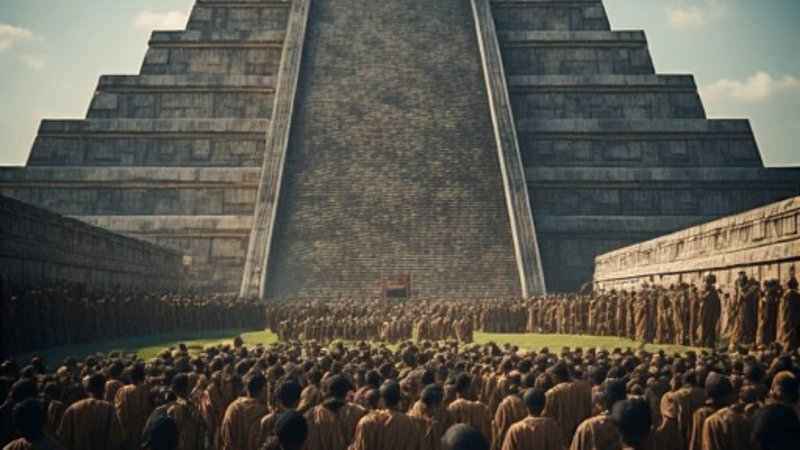
Imagine living in the year 900 AD, knowing nothing of physics, and entering the main plaza. You hear the sound of rain emanating from the top of the pyramid even on dry days. Yes, there is another acoustic phenomenon known as the “sound of raindrops.” When people walk on the gravel plaza, the echo returning from the pyramid mimics the sound of heavy rainfall. The Maya associated the pyramid with the rain god Chaac. You now realize that the subjugation of the populace was not achieved solely by the sword; it was achieved by controlling their senses. Sound was their most lethal tool.
Lost Knowledge: The Maya’s Vibrational Technology and Its Dark Side
In my humble view, we commit a profound error by labeling the Maya as a Stone Age civilization. We equate technology with electricity and silicon. The Maya possessed a different form of technology: an engineering paradigm based on manipulating natural frequencies. They did not need electronic amplification because they transformed architecture itself into a speaker system. They did not need screens because they used the sun and shadows to project moving images. This is where the tedious academic narrative unravels. They were not primitive; perhaps they understood the vibrational nature of the cosmos far better than we do today in our climate-controlled laboratories. Their architectural prowess challenges our understanding of ancient capabilities.
There is a dark aspect to this mastery. Acoustic frequencies can influence human mood and physiology. Some studies suggest that the frequencies generated by the pyramid may induce states of awe or submission in the human brain. You do not just hear the sound with your ears; you feel it in your bones. This is not just a temple; it is a mass control device—a silent psychological weapon. When we look at the pyramids today, we see them as silent. But they are, in fact, screaming secrets we are unwilling to hear. Scientists fear admitting that an ancient civilization surpassed us in understanding geometric subtleties. Acknowledging this would necessitate rewriting the entire history of humankind.
Frequently Asked Questions
What is the primary acoustic phenomenon observed at the Pyramid of Kukulcan?
When standing before the Pyramid of Kukulcan and clapping, the echo produced remarkably mimics the chirping sound of the sacred Quetzal bird. This is an engineered acoustic effect, not a natural one.
How did the Maya achieve such precise acoustic engineering without modern tools?
Archaeologists are still reluctant to provide a clear answer. The article suggests the Maya may have possessed a different form of technology based on manipulating natural frequencies, transforming architecture into complex sound systems with astonishing precision, surpassing even modern digital laboratories.
Are there other unexplained phenomena at Chichen Itza besides the Quetzal sound?
Yes, during equinoxes, a serpent-like shadow appears on the pyramid’s staircase, accompanied by vibrational resonances resembling a snake’s hiss. Additionally, at the Great Ball Court, a whisper can travel 150 meters across straight walls, defying acoustic physics. The pyramid also produces a ‘sound of raindrops’ when people walk on the gravel plaza.
What is the ‘dark aspect’ of the Maya’s acoustic mastery?
The text suggests that the acoustic frequencies generated by the pyramid could influence human mood and physiology, potentially inducing states of awe or submission. It posits that the pyramid might have functioned as a mass control device or a silent psychological weapon, controlling the populace through sensory manipulation.
Does this imply the Maya were more technologically advanced than conventionally believed?
The author argues that labeling the Maya as a ‘Stone Age civilization’ is an error. It’s proposed they had a sophisticated engineering paradigm focused on vibrational physics and natural frequencies, enabling them to create advanced sensory experiences and architectural marvels without relying on electricity or silicon-based technology.