The Ancient Secret of Whales with Legs: Egypt’s Desert Graveyard
The Ancient Secret of Whales with Legs: Egypt’s Desert Graveyard
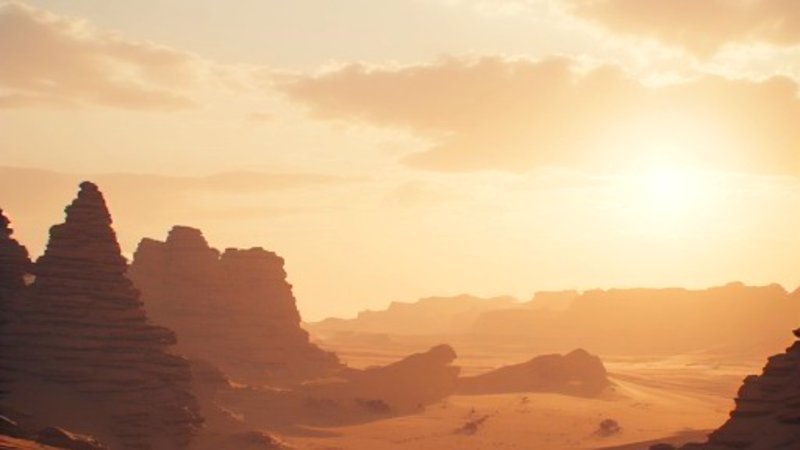
You are currently standing above the world’s largest graveyard. Yet, you see no human remains. Beneath your feet, in the heart of the arid Fayum Desert, lies an eighteen-meter-long behemoth. This creature does not belong to the sands. It possesses inexplicable bones—bones that defy everything you learned in your school science books. A secret is buried beneath these golden dunes, a secret concerning a small muscle, a knee joint, and an ankle that should never have existed in this location. If you believe the ground you walk on is stable, you are mistaken. If you think you know the story of whales, prepare to have your certainty completely shattered. One question will haunt your mind until the very last moment of our discussion: Why did a creature possessing powerful limbs decide to abandon the land and return to the absolute darkness of the ocean depths? The answer is not evolution. The answer is escape.
Navigate Content
The Desert’s Hidden Leviathan
The Fayum Desert, an seemingly barren expanse, harbors an astonishing truth. Here, in what is now a parched landscape, lies the fossilized remains of ancient marine giants—a testament to a world utterly unlike our own. These aren’t just any fossils; they are the skeletons of monstrous creatures like the *Basilosaurus*, an eighteen-meter-long leviathan that possessed a secret so profound it challenges our understanding of life itself. Its bones, especially the inexplicable presence of a small muscle, a knee joint, and an ankle, defy conventional scientific explanation, suggesting a past far more complex and violent than commonly accepted. This graveyard in the sand whispers a story of a creature that abandoned powerful limbs for the ocean’s depths, driven not by evolutionary ambition, but by a desperate need for escape. For more insights into surprising desert phenomena, read about The Zone of Silence: Physics-Defying Desert Where Signals Die.
Forty Million Years Ago: The Great Tethys Ocean
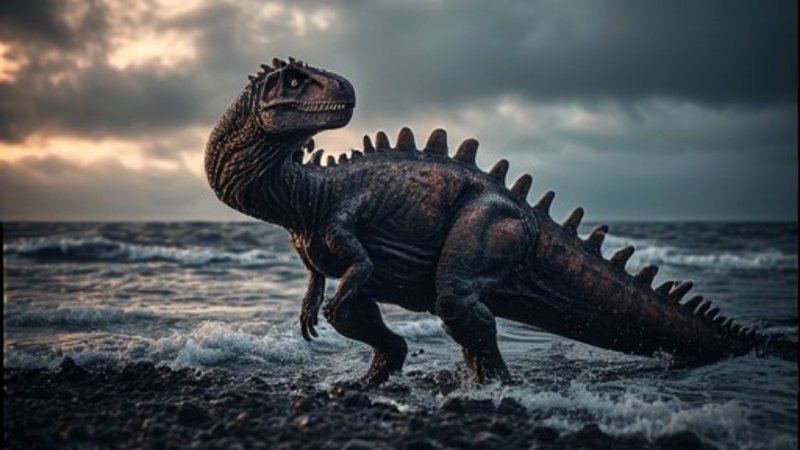
Look around you now. Sand surrounds you on all sides. Heat radiates from the fractured rocks. But forty million years ago, this place was a churning chaos. You would have drowned within seconds. This was the Great Tethys Ocean. Deep blue waters covered all of North Africa. The Sahara Desert did not exist. There were dense forests on the shores and terrifying marine life below. It was during this ancient epoch that an ‘illogical’ creature, the *Basilosaurus*, thrived. Far from the gentle giants we know today, this was an aquatic nightmare—its body long and serpentine, its head resembling a crocodile’s. Yet, the most startling discovery lies in its posterior: scientists have unearthed small hind limbs—yes, complete legs, replete with knees, ankles, and toes. This creature, a precursor to modern whales, carried the undeniable evidence of its terrestrial past. The mystery of ancient ocean predators continues to captivate, much like the debate around Is Megalodon Alive? Secrets of the Mariana Trench and Deep Sea Giants.
From Terrestrial Predators to Aquatic Refugees
The presence of legs on a creature destined for the deep ocean presents an enigma often simplified by mainstream science. While many reports cite these as merely vestigial evolutionary remnants, a deeper look reveals something far more dramatic. These limbs are forensic evidence of our planet’s greatest transformation. Whales, in fact, did not originate in the water. Their ancestors were small, terrestrial creatures akin to hungry, wild wolves, known as *Pakicetus*. These four-legged hunters lived beside rivers, breathing air and feeling the mud beneath their paws. The question then shifts: why abandon the land? Was the Earth so dangerous, or the ocean’s whispers deceptive? My personal view posits a story of fear, not success. Evolution isn’t always an ascent; sometimes, it’s an organized retreat. The ancient land was a bloody battlefield, teeming with predators and scarce resources. Early whales entered the water not by choice, but out of necessity—an escape from swift death on land, choosing a slower drowning in the depths. Challenging established narratives is key to understanding many historical mysteries, such as The Minoan Collapse: Mystery of Flying Palaces, Lost Elevators, and Thera’s Fury.
The Genetic Agony of Transformation
Today, standing in the Valley of Whales, the wind carries ancient whispers. These aren’t just rocks; they are solidified memories. Touching the skeleton of a *Dorudon*, a smaller contemporary whale, one feels the chill of ancient times. This creature demonstrates the incredible genetic agony of transformation, with its blowhole beginning its slow migration from the front of its face to the top of its head. Imagine your nose gradually crawling towards your forehead over millennia—every breath a battle, every dive a challenge against death. My controversial perspective is this: we often venerate these fossils as scientific achievements, but they also serve as testimony to a breaking point. Humanity celebrates strength, yet whales journeyed in the opposite direction. They sacrificed:
- The ability to walk
- Their keen sense of smell
- The warmth of the land
They became masses of blubber, traversing endless oceans. While the prevailing narrative calls this ingenious adaptation, I question if the whale was perhaps the only creature to sense the Earth’s impending doom, deciding to return to the primordial aquatic womb. Even our understanding of human history has hidden depths, as explored in The Black Pharaohs: Unveiling the Hidden History of Kush and Egypt.
Egypt’s Topography: A Mirror to Humanity’s Future
The lessons from Fayum extend beyond biology to geography. The very plateaus and depressions of Egypt were sculpted by ancient waves, not wind. When the Tethys Sea receded, it left behind not only whale skeletons but also treasures of salt and limestone, stark evidence that geography is a temporary illusion. The land on which we build our homes today could very well be the ocean floor tomorrow. This radical topographical shift poses an existential question: if mountains were once seabed, what guarantees our cities won’t become tourist attractions for future creatures? Most people ignore this profound reality, but the Valley of Whales offers a chilling mirror to our future. We live in the Anthropocene, an era where we are rapidly altering the climate and shifting the seas. The whales of Fayum silently warn that change is inevitable. The critical difference is that whales adapted over millions of years; we are forcing change in mere decades. Will future generations be compelled to develop fins? Will our bones one day be sought in deserts we cannot yet imagine? The question of human impact and future vulnerability resonates with discussions on Microplastics in Your Veins: The Invisible Biological Threat Altering Humanity.

The Symbol of Vulnerability and Adaptability
The immense weight of time presses upon you in Fayum. The skeletons are not silent; they cry out against any belief in humanity’s absolute mastery of its destiny. *Basilosaurus*, once considered the king of the seas, is now merely a stone artifact, photographed by tourists. The small knee bone, discovered in the Fayum sands, transcends mere evolutionary evidence; it is a profound symbol of vulnerability. It reminds us that nature cares not for power, but for adaptability. When you gaze upon a modern whale, remember those small, hidden legs beneath its skin—legs that once traversed soil, much like the ground you walk on. This enduring legacy serves as a potent reminder of our own precarious position and the ultimate limits of human control, echoing concerns about The End of Human Sovereignty: AI’s Inevitable Takeover & Humanity’s Ticking Clock.
Frequently Asked Questions
Generated by AI Content Architect
About The Author