Al-Jazari: The Arab Engineer Who Built Robots 800 Years Ago | Unveiling Hidden History

0
image_1-74


Al-Jazari: The Arab Engineer Who Built Robots 800 Years Ago | Unveiling Hidden History
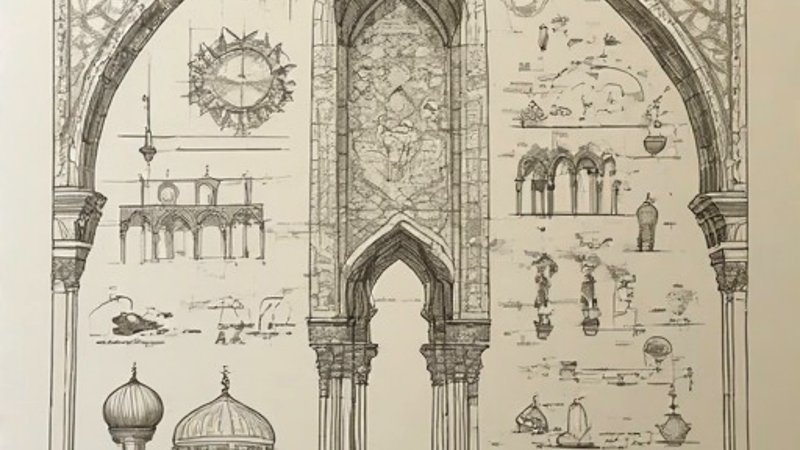
You are living under a great historical illusion. You believe the Industrial Revolution began in Britain, or that robotics are solely the product of 20th-century laboratories. The truth resides in Diyarbakır, eight hundred years ago, when the world was shrouded in darkness.


The Engineer Who Built Life from Brass and Wood

You are living under a great historical illusion. You believe the Industrial Revolution began in Britain, or that robotics are solely the product of 20th-century laboratories. The truth resides in Diyarbakır, eight hundred years ago, when the world was shrouded in darkness.

One man was creating life from brass and wood. You likely do not know his true name, yet you utilize his inventions every time you turn your car key, check your watch, or press a button on your phone. This man is Badi’ az-Zaman al-Jazari, the engineer who tamed the impossible and built machines that thought and moved before the world even grasped the concept of electricity. To learn more about his incredible impact, check out Al-Jazari: The Forgotten Genius Who Sparked the Industrial Revolution in 1205 CE. The question that must trouble you is: why did everything suddenly halt? And why did the world forget the primary benefactor of the technology you now possess? The answer is not found in standard history textbooks. It is hidden within the folds of a rare manuscript titled The Compendium of Knowledge on Ingenious Mechanical Devices.

The Engineer Who Built Life from Brass and Wood


Robotics in the Middle Ages: Automata and Mechanical Genius

Look at your hands now. Imagine creating a mechanical replica—a version that never tires and never errs. In 1206, this was not science fiction; it was reality in the court of the Artuqids. Al-Jazari was not merely a craftsman; he was a philosopher of matter. He designed self-propelled machines that served guests, poured water, and offered towels. Can you comprehend the magnitude of this shock? We are discussing fully functional robots in the Middle Ages. The Sultan watched, mesmerized, as an automaton emerged from a wooden cabinet, holding a golden ewer, pouring water with flawless precision, and then presenting a towel to the guest—all without human intervention.

How did he achieve this? The secret lay in:

  • Hydraulic balance
  • The exploitation of gravity as a mastermind
  • A complex, unprecedented system of gears and pistons

We must pause here. Have you ever wondered who invented the camshaft—that small component in your car engine that converts rotary motion into linear motion? The world credits Industrial Revolution engineers, but the bitter truth is that Al-Jazari drew and explained it centuries before them. In his manuscripts, you find the design for a double-piston water pump, the direct ancestor of the steam engine.


Beyond Luxury: The Philosophy of Machines and Global Statements

You see modern technology as a mass of wires and silicon chips, but Al-Jazari perceived it as music composed of water and gravity. He designed the famous Elephant Clock, which was not merely a timekeeping device but a coded political and cultural statement. The elephant represented India, the serpent Egypt, the dragon China, and the phoenix Persia. Al-Jazari was telling the world that knowledge has no homeland and that his machines united the Earth’s civilizations into one body.

But let us delve into the darker aspect of this story, the one everyone ignores. In my humble personal opinion, Al-Jazari was not just seeking luxury; he was pursuing the ‘deification of matter.’ He sought to prove that the human mind could simulate divine creation in motion. Most historians dismiss his inventions as mere ‘toys for sultans,’ which is where the dominant narrative completely collapses. If they were just toys, why the meticulous effort in documenting the finest engineering details? Why establish a precise system of measurements and numbering? Al-Jazari was writing the first ‘code‘ in history. He did not write in the programming language you know, but in the language of brass and zinc. If you look beyond the flashy titles, you realize that his automated hand-washing machine was the first automated system based on ‘feedback‘—the fundamental principle underpinning modern cybernetics.

Beyond Luxury: The Philosophy of Machines and Global Statements


Programmable Devices and a Lost Renaissance

You are now wondering: if this genius reached such heights, why did the world not change then? Why did the Industrial Revolution not ignite in Baghdad or Diyarbakır? Here lies the unsettling philosophy: perhaps humanity was not ready for that power. Al-Jazari was a thousand years ahead of his time, creating machines to serve humanity while the world was preoccupied with how to enslave one human by another.

Consider the ‘Automated Musical Ensemble‘ he designed: a boat floating on the palace lake carrying four automata playing drums and flutes with changing melodies. Al-Jazari invented the first programmable device in history. By repositioning pegs on a rotating cylinder, you could alter the rhythm—is this not the same principle computers operate on, storing data and modifying outputs based on inputs? The device in your hand today is the direct descendant of Al-Jazari’s musical band.

The truth that may pain you is that we lost this legacy. When Baghdad fell and Arab civilization retreated into isolation, these manuscripts vanished into oblivion, only to reappear in Europe during the Renaissance. Leonardo da Vinci himself, the genius revered by the West, has drawings in his notebooks strikingly similar to Al-Jazari’s designs. Is this coincidence? Or is it cultural appropriation masked by admiration? I do not accuse Da Vinci of direct theft, but I assert that Al-Jazari’s engineering spirit permeated the Mediterranean, igniting the spark of the European Renaissance, while we remained content praising the past without truly understanding it.


Challenging Time and Modern Perceptions

Imagine the scene in the Sultan’s palace: high humidity, the air thick with incense. Suddenly, the ‘Castle Clock,’ over three meters tall, springs to life. It displays the movements of the zodiac, the paths of the sun and moon, and five automata begin playing music every hour. This was not just an engineering display; it was a challenge to time itself. Al-Jazari sought to trap time in a metal box, desiring control over the finest details of existence. Do you feel fear regarding the intelligence of modern machines? Al-Jazari felt ecstasy and triumph, viewing the machine as a manifestation of the greatness of the intellect God bestowed upon humanity.

The problem with how we view Al-Jazari today is that we relegate him to a museum, seeing him as part of tedious folklore. I tell you, Al-Jazari is a pioneer whose genius reshaped the future centuries before it began.
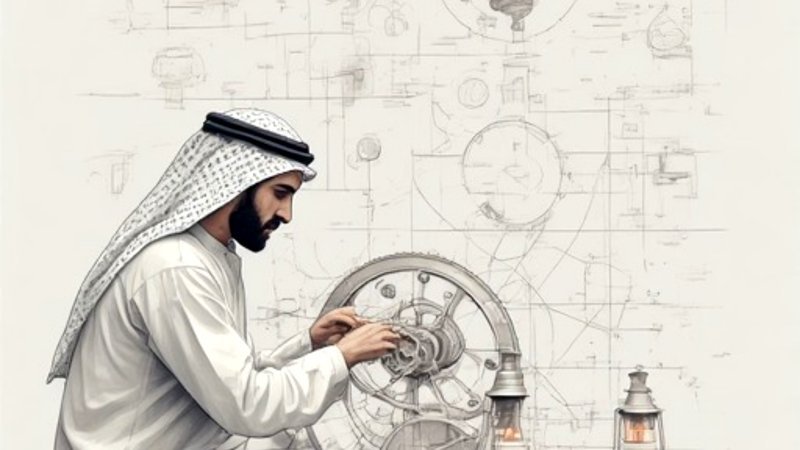
Challenging Time and Modern Perceptions


Frequently Asked Questions

Who was Badi’ az-Zaman al-Jazari?
Badi’ az-Zaman al-Jazari was a brilliant Arab engineer and polymath from Diyarbakır in the 12th and 13th centuries. He is credited with designing and building complex mechanical devices, including automata and programmable machines, centuries before the commonly accepted dawn of the Industrial Revolution.
What are some of Al-Jazari’s most significant inventions?
Al-Jazari’s significant inventions include self-propelled automata (robots) that served guests, the camshaft, the double-piston water pump (a precursor to the steam engine), the Elephant Clock, an automated hand-washing machine based on feedback, and the Automated Musical Ensemble, considered the first programmable device.
Why is Al-Jazari’s work not widely known in conventional history?
The text suggests a ‘great historical illusion’ and states that his manuscripts vanished into oblivion after the fall of Baghdad and the retreat of Arab civilization. His inventions were often dismissed as mere ‘toys for sultans,’ leading to a narrative collapse and the world forgetting his primary contributions.
How do Al-Jazari’s inventions relate to modern technology?
Al-Jazari pioneered fundamental principles seen in modern technology. He designed the camshaft, integral to car engines, and his double-piston pump was a direct ancestor of the steam engine. His automated hand-washing machine utilized ‘feedback,’ a core principle of cybernetics, and his Automated Musical Ensemble was the first programmable device, laying groundwork for computers.
Did Al-Jazari influence the European Renaissance?
The text asserts that Al-Jazari’s engineering spirit ‘permeated the Mediterranean,’ with drawings in Leonardo da Vinci’s notebooks strikingly similar to Al-Jazari’s designs. While not accusing direct theft, it implies a significant, often uncredited, influence on the spark of the European Renaissance.

Generated by AI Content Architect

About The Author

Leave a Reply

Your email address will not be published. Required fields are marked *