Mount Kailash: The Terrestrial Black Hole Defying Science and Time
Mount Kailash: The Terrestrial Black Hole Defying Science and Time
Mount Kailash, standing at 6,638 meters in the Tibetan highlands, is not merely a mountain; it is an enigma that has baffled scientists, defied mountaineers, and served as the sacred nexus for four major religions. Accounts suggest this peak operates as a ‘terrestrial black hole,’ distorting time and space around it, turning an achievable altitude into an impossible goal. Why has this colossal structure defeated human ambition and technological penetration?
Navigate Content
The Summit That Refuses Contact: Altitude vs. Impossibility
While Mount Everest towers over 8,800 meters, Mount Kailash remains unclimbed despite its significantly lower altitude. Adventurers attempting the ascent report impossible physics: the path seems to lengthen with every step, compasses spin wildly, and the weather shifts violently to repel intrusion. These experiences suggest the mountain actively defends its summit. Some legends state that reaching the top results in immediate death or irreversible madness, a warning heeded by all four religions that revere it.

A Colossal Pyramid and Cosmic Alignment
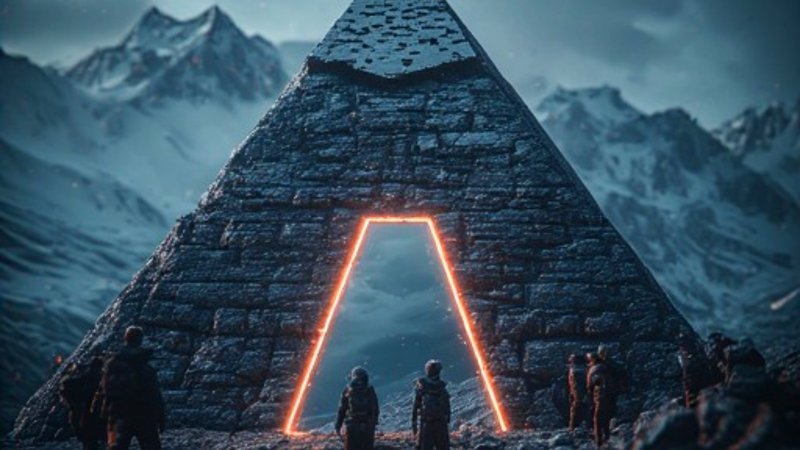
A 1999 Russian expedition brought chilling evidence that Kailash is not a natural formation. Its four faces align with startling precision toward the cardinal directions. The scientific consensus suggests it is not a mountain but the largest pyramid on Earth, surrounded by smaller structures and enigmatic rock mirrors. These mirrors are speculated to focus cosmic energy toward the summit. The structure’s precision defies natural geological processes, pointing toward deliberate, monumental engineering. For further study on anomalies that challenge known history, consider the mystery of Cholula’s Hidden Pyramid.
The Terrifying Reality of Time Dilation
The most unsettling discovery relates to the manipulation of time. Climbers near Kailash have reported measurable biological acceleration: twelve hours spent near the peak resulted in nail and beard growth equivalent to two weeks. This suggests an internal ‘temporal engine’ is operating within the massif. Another account details Siberian climbers who retreated after reaching a certain altitude, only to suffer rapid senescence—dying within a year as if they had lived decades in months. This extreme time field seems incompatible with human biology.

The Geographical Control Center of Earth
Beyond anomalous physics, the geometry of Kailash suggests a global purpose. Calculations reveal astonishing distances:
- The distance from Kailash to Stonehenge is exactly 6,638 kilometers.
- The distance to the North Pole is also 6,638 kilometers.
- The distance to the South Pole is precisely double that (12,676 kilometers).
This suggests Kailash is the Earth’s Axis Mundi or a geographical control center, mathematically placed at a precise coordinate. This precision contradicts the tectonic theory of mountain formation, implying deliberate placement by an incomprehensible force.
The No-Fly Zone and Sacred Silence
Even modern technology cannot breach the peak’s defenses. Pilots refuse to fly over Kailash due to sudden, inexplicable electronic failures and vertical wind vortices that actively drag aircraft down. The Chinese government strictly prohibits climbing, citing religious reverence, though whispers suggest dangerous physics experiments gone awry. Furthermore, monks report a faint, low electrical hum at the base, a sound said to alter brain waves, challenging our perception of reality. The contrast between the freshwater Lake Mansarovar (sun-shaped) and the saline Lake Rakshastal (crescent-shaped) only deepens the site’s esoteric significance.
Frequently Asked Questions
Generated by AI Content Architect
About The Author