
Nikola Tesla’s Lost Secrets: The Forbidden Free Energy They Hid

0
image_1-40


Nikola Tesla’s Lost Secrets: The Forbidden Free Energy They Hid

Imagine a world where the air around you pulsates with infinite energy. No wires marring the horizon. No energy bills draining your pocket. No geographical constraints preventing light from reaching the remotest village on Earth. Have you ever wondered why we live in a prison of copper cables when one man held the key to breaking these shackles a century ago? The secret isn’t in the technology we see today; rather, it lies in a truth deliberately buried beneath the rubble of a mysterious tower in the Long Island area. This man is Nikola Tesla, the genius who not only designed machines but sought to re-engineer the laws of the universe to serve humanity. Yet, he faced an unforgiving force: the power of money, which prioritizes profit over absolute progress. You are now about to embark on a journey into a mind that saw the future with terrifying clarity. But the question that will haunt you until the end of this video is: Was Tesla mad, or are we the ones living in an organized madness?


The Spark of Genius: AC Current and the War of Currents

In 1882, Tesla was walking in a park in Budapest. Suddenly, he stopped. He sketched a diagram in the dirt that changed the course of history. This was the scientific principle of the induction motor. Do you grasp the significance of that? Before Tesla, the world struggled with direct current (DC) – weak power that dissipated after a few kilometers. But Tesla saw what Edison did not: he saw the rotating magnetic field. Imagine a magnet spinning at immense speed without anyone touching it. This is pure physical elegance. The induction motor relies on the principle of electromagnetic induction: an alternating current (AC) generates a changing magnetic field, which then induces a current in the rotor. The result is mechanical motion with almost no friction, no deteriorating carbon brushes, and with an efficiency no one had dreamed of. You are using this innovation right now: in your washing machine, in your fan, and even in modern electric cars that bear his name. But was this all? Did his ambition stop at just a motor?

The answer will astound you. The motor was merely a means to prove the superiority of alternating current. Tesla waged the War of Currents against Thomas Edison. It was a battle between scientific vision and commercial greed. Edison used electrocuted elephants to scare people away from Tesla’s current. But Tesla was confident. In 1893, at the World’s Fair in Chicago, Tesla lit up the entire city. The world saw true light for the first time. High voltage and high frequency were his weapons; he was able to transmit power over vast distances with thin wires. Physicists at the time were amazed by Tesla’s ability to manipulate electrical voltage using transformers. But his triumph in Chicago was the beginning of an even more formidable project – a project that would render the power companies of that era worthless.
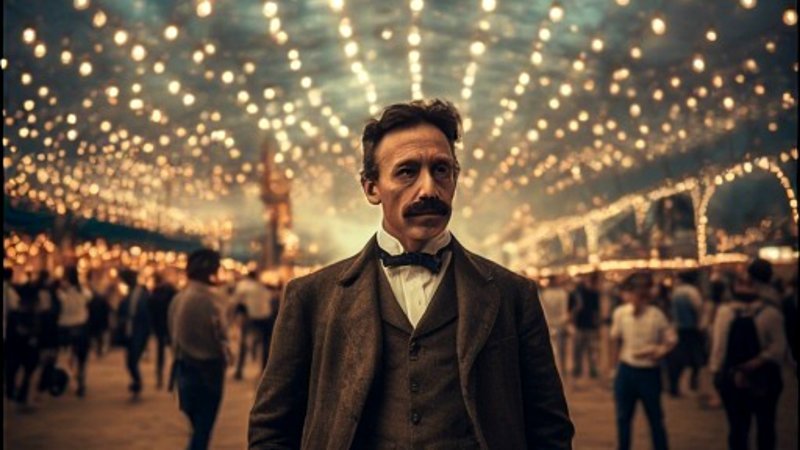
The Spark of Genius: AC Current and the War of Currents


Harnessing the Earth: Tesla’s Colorado Springs Experiments

You are now curious. What did Tesla do next? He moved to Colorado Springs. There, he began his experiments with very high frequencies. He created artificial lightning bolts up to forty meters long; thunder could be heard tens of kilometers away. Tesla discovered that the Earth is not just a deaf rock but a giant electrical conductor. He discovered Earth’s resonance. Tesla claimed he could inject energy into the Earth and retrieve it from anywhere else, just as you shake a bowl of water and the waves travel to the other side. Modern physicists are now studying what is known as Schumann resonance, a natural frequency of Earth’s atmosphere. Tesla was tinkering with these frequencies before modern science even knew of their existence. Can you comprehend the magnitude of genius here? For more on how ancient knowledge intersects with physics, explore Stonehenge’s Gravity-Defying Secret: Ancient Physics & Engineering Marvels.


Wardenclyffe’s Dream: Free Energy vs. Corporate Greed

We now return to the eye of the storm. In 1901, Tesla began constructing the Wardenclyffe Tower. The tower was intended to transmit information and power wirelessly. Yes, he dreamed of the internet and free electricity a century before their advent. Tesla relied on the principle of the World Wireless System. He wanted to use the ionosphere, a charged layer in the atmosphere, as a pathway for energy transmission. Physically speaking, Tesla was attempting to turn planet Earth into a giant resonant circuit. But here, he collided with a bitter reality. The project’s main financier was J.P. Morgan. When Morgan asked Tesla, “Where will I put the electricity meter to collect money?”, Tesla replied that the energy would be available to everyone. At that moment, the project’s death warrant was signed.

Imagine the frustration he felt. He saw the solution to global energy poverty, while they only saw lost profits. Funding ceased. The tower was demolished and sold for scrap to repay debts. The world lost a historic opportunity to break free from fossil fuels.
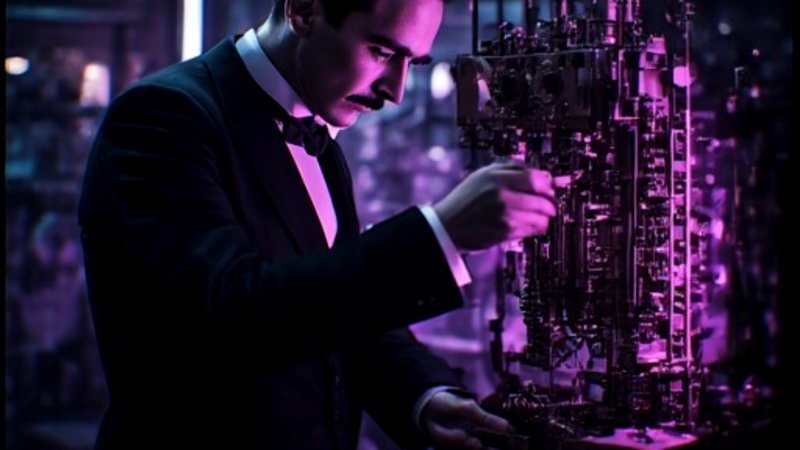
Wardenclyffe's Dream: Free Energy vs. Corporate Greed


The Echo of a Visionary: Tesla’s Enduring Digital and Cosmic Legacy

But did his ideas die? Look around you. Wireless communication technologies, Wi-Fi, radio, radar—all rely on Tesla’s patents. Even remote control. In 1898, Tesla demonstrated a radio-controlled boat. People cried “magic!” They didn’t realize it was the physics of electromagnetic waves. Tesla laid the cornerstone for the contemporary digital world amidst an environment still reliant on coal and horses. The implications of this digital age are profound, as explored in Deepfakes & Digital Reality: Is What You See Real? The Collapse of Trust in the AI Era.

Technical obstacles existed, but economic barriers were more formidable. Tesla was ahead of his time in understanding quantum mechanics and relativity in his own way. He believed that matter was merely condensed energy. He spoke of extracting energy from empty space—what we today call zero-point energy. Physicists today are rereading his notes with astonishment. How did he know all this? Was he communicating with other civilizations?


Frequently Asked Questions

What was Nikola Tesla’s most significant contribution to modern power systems?
Nikola Tesla’s most significant contribution was the development of the alternating current (AC) induction motor and the AC electrical system, which proved superior to direct current (DC) in transmitting power efficiently over long distances. This innovation is fundamental to how electricity is generated and distributed globally today.
What was the ‘War of Currents’ and who won?
The ‘War of Currents’ was a fierce rivalry between Nikola Tesla (championing AC) and Thomas Edison (advocating DC) in the late 19th century. Tesla’s alternating current system ultimately prevailed due to its efficiency in transmitting power over vast distances, becoming the dominant electrical standard worldwide.
What was the purpose of the Wardenclyffe Tower, and why was it never completed?
The Wardenclyffe Tower was Tesla’s ambitious project to build a ‘World Wireless System’ capable of transmitting both information and free electricity wirelessly across the globe. It was never completed because its primary financier, J.P. Morgan, withdrew funding when he realized Tesla’s vision of free, universally available energy would not allow for metered profits, effectively signing the project’s ‘death warrant’.
Did Tesla believe in concepts like ‘zero-point energy’?
Yes, Tesla held advanced theoretical views, believing that matter was condensed energy and speaking of extracting energy from ’empty space’—a concept closely related to what modern physicists refer to as zero-point energy. His notes on these ideas are still being studied today with astonishment.
How do Tesla’s inventions influence our lives today?
Tesla’s inventions profoundly influence modern life. Beyond the AC power system that powers our homes and industries, his work laid the foundation for virtually all wireless communication technologies, including radio, Wi-Fi, radar, and remote control systems, effectively ushering in the digital age.

Generated by AI Content Architect

About The Author

Leave a Reply

Your email address will not be published. Required fields are marked *