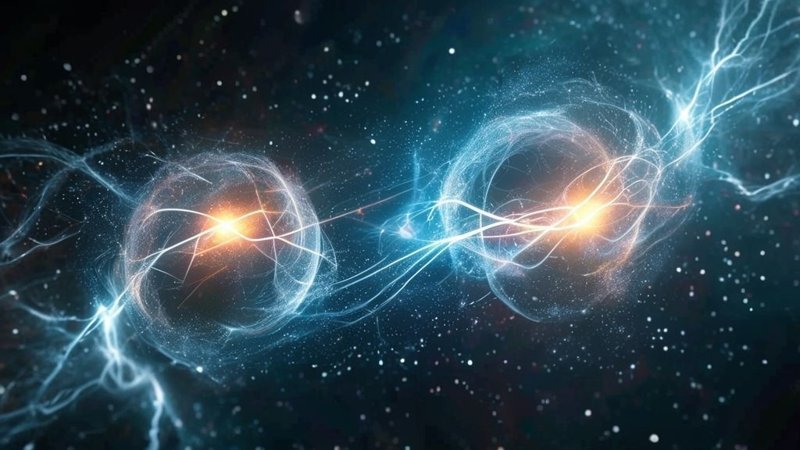
Einstein’s Terrifying Secret: Is Reality Just an Illusion? | Quantum Entanglement
Imagine holding a coin in your hand, and possessing another identical copy of it in the furthest galaxy of the universe. When you decide to flip your coin to show heads, the distant coin instantly flips to show tails, with no means of communication between them. This is not magic; it is the nightmare that haunted the greatest mind in modern history, Albert Einstein.
The story begins in 1935 when Einstein sat in his office, deeply troubled by a new generation of physicists. The world was abuzz with discoveries in quantum mechanics, a physics that posits particles do not possess a definite location until observed. Einstein never accepted this notion, once famously asking if the moon ceases to exist when no one is looking at it. However, the greater peril, in his view, was not in this uncertainty, but in a phenomenon he mockingly termed “spooky action at a distance.” He was referring to quantum entanglement: the moment two particles become linked by a mysterious bond that defies classical understanding. If you measure the properties of one particle, the other particle, no matter how distant, instantaneously assumes a corresponding or complementary state. It is precisely at this moment that our conventional understanding of space and time breaks down.
Einstein, along with his colleagues Podolsky and Rosen, attempted to prove the impossibility of this phenomenon in their renowned paper, which became known as the EPR Paradox. They argued for the existence of unseen “hidden variables”—something inherent within the particles that predetermines measurement outcomes, much like a pair of gloves, each placed in a separate box. If you open the first box and find a right glove, you immediately know the other is a left, but this doesn’t imply communication between the boxes. Einstein sought to preserve the principle of locality, which states that any physical influence requires time to travel from one point to another, and nothing can exceed the speed of light. However, physics harbored a secret more unsettling than Einstein could have imagined.
Bell’s Inequality and the Decisive Experiment
For decades, the scientific community believed Einstein might be correct, until 1964. In that year, physicist John Bell devised an ingenious mathematical equation to resolve this historical dispute. Bell posited that if nature operated as Einstein perceived it, there would be a specific limit to the correlation between particles that could not be exceeded. Conversely, if quantum mechanics held true, this correlation would surpass all classical expectations. Laboratories worldwide embarked on a frantic race to test Bell’s inequality. In 1982, Alain Aspect conducted a decisive experiment in Paris. He used photons emitted from calcium atoms and observed how they correlated across distances. The result was astonishing: Einstein had lost the bet. Particles communicate instantaneously, transcending the speed of light by billions of times, or perhaps they do not communicate at all, but rather act as a single, inseparable entity regardless of the distance. This experiment was a critical step in physics defied.
The Collapse of Locality and the Illusion of Space
You now stand before a truth that changes everything you know about your physical reality. Imagine a particle in your laboratory here on Earth, and another on Mars. If you alter the spin direction of the Earth-bound particle, its counterpart on Mars will respond instantly, before light even has time to traverse the distance between them. This implies that space is merely an illusion, or that a deeper dimension connects all atoms in the universe. Scientists have described this as the collapse of locality. The principle upon which classical physics was built has crumbled under the weight of quantum entanglement. Reality is not a collection of separate parts, but a terrifyingly interconnected network, revealing an unsolved mystery at its core.
The Quantum Revolution: Computing and Communication
But why should this matter to you, far from cold laboratory rooms? The answer lies in a technological revolution that will completely transform your life. We are talking about quantum computing. The traditional computers you use today rely on bits, which are electrical pulses representing either zero or one. However, quantum computers utilize qubits. Thanks to quantum entanglement, these qubits can work together in a state of super-correlation. This allows a quantum computer to perform millions of calculations simultaneously. A process that might take today’s most powerful supercomputer ten thousand years can be completed by a quantum computer in just three minutes. This will lead to a revolution in:
Designing advanced materials humans have never before dreamed of
Then there are quantum communications. Imagine an unhackable internet. Thanks to entanglement, any attempt to eavesdrop on information will instantly collapse the quantum state and alter the data, alerting both parties simultaneously. China already launched a satellite named Micius in 2017 and used quantum entanglement to transmit encryption keys between cities separated by 1,200 kilometers. We are talking about building a global network impervious to eavesdropping, relying on the very laws of nature to protect your privacy.
Quantum Teleportation and Philosophical Quandaries
But the most intriguing and bizarre aspect is quantum teleportation. No, we are not talking about transporting physical bodies as in science fiction films, but rather the transfer of quantum information. In today’s laboratories, scientists successfully transmit the state of a particle from one location to another instantaneously, without the particle physically traversing the intervening distance. The original is destroyed, and an exact replica appears at the other end. This raises profound philosophical questions about your identity and the fabric of your consciousness. If you are merely a collection of entangled quantum information, could you one day be teleported across the universe? Our concept of causality takes a decisive blow here. In classical physics, cause precedes effect, and influence requires a physical medium. But in the world of entanglement, there appears to be a form of correlation that transcends these classical rules.
Frequently Asked Questions
What is quantum entanglement?
Quantum entanglement is a phenomenon where two particles become linked in such a way that they share the same fate, regardless of the distance separating them. Measuring the properties of one particle instantly influences the state of the other, even if they are light-years apart.
Why did Albert Einstein call entanglement “spooky action at a distance”?
Einstein was deeply troubled by quantum entanglement because it seemed to violate the principle of locality, which states that physical influences cannot travel faster than the speed of light. The instantaneous correlation between distant entangled particles appeared to suggest communication far exceeding this universal speed limit.
How was quantum entanglement scientifically proven?
The existence of quantum entanglement was definitively proven through experiments based on John Bell’s mathematical inequality. Bell proposed a way to test whether particles’ properties were predetermined (as Einstein suggested with “hidden variables”) or truly influenced instantaneously. Alain Aspect’s experiments in 1982 provided decisive evidence that correlations between entangled particles surpassed classical expectations, confirming quantum mechanics over Einstein’s classical view.
What are the key technological applications of quantum entanglement?
Quantum entanglement is foundational to revolutionary technologies such as quantum computing, which can perform vast calculations simultaneously, and quantum communication, which enables unhackable internet security due to entanglement’s property of instantly alerting parties to eavesdropping attempts.
What is quantum teleportation, and what are its implications?
Quantum teleportation involves the instantaneous transfer of quantum information from one location to another without the physical particle traveling. While not yet capable of transporting physical objects like in science fiction, it raises profound philosophical questions about identity, consciousness, and the very nature of reality, suggesting that fundamental principles like causality might need re-evaluation.