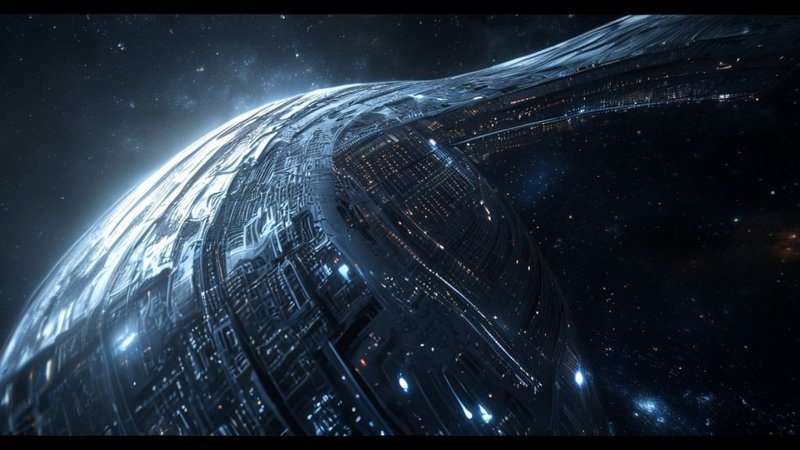
Dyson Spheres: Harnessing the Sun’s Energy and the Search for Type II Alien Civilizations
Look up now toward the dark sky and contemplate those countless luminous points. Have you ever considered that one of those stars might not be as brilliant as it appears, but is instead concealed behind a massive cage of advanced technology? We are not speaking of fleeting science fiction here, but of a mathematical and engineering reality that may represent the next evolutionary step in the history of any intelligent civilization in this vast cosmos.
Today, you live in an era entirely dependent on energy—from the phone in your hand to the colossal factories that drive the global economy. But have you ever pondered what will happen when the Earth’s resources are completely exhausted? When we reach a point where the wind and the meager sunlight falling upon our small planet are insufficient to meet our escalating human ambitions? This is where a concept both strange and alarming emerges: the Dyson structure. This gigantic construction is designed to completely encircle a star to capture every atom of energy it emits.
Freeman Dyson’s Radical Idea: Swarms, Not Shells
In 1960, physicist Freeman Dyson proposed a radical idea in a research paper that altered our perception of the universe. Dyson suggested that as a civilization advances technologically, it will inevitably reach a stage where its energy demands exceed what a single planet can provide. Imagine the Sun—that colossal nuclear fusion reactor at the center of our solar system. Every second, the Sun releases energy equivalent to the detonation of hundreds of millions of hydrogen bombs. Yet, due to Earth’s small size and distance, it captures only one billionth of that immense energy. The rest is wasted into the desolate vacuum of space.
For an advanced civilization, this waste is an offense against progress. Therefore, the solution is to construct a structure surrounding the star. It would not necessarily be a solid, monolithic shell, as initially envisioned, because such a shell might collapse under the star’s immense gravitational pressure. The more realistic concept is the so-called Dyson Swarm. Imagine millions, even billions, of gigantic solar panels and minute mirrors orbiting the Sun in precise trajectories. These panels act as a colossal net, capturing light, converting it into energy, and then transmitting it via laser beams or microwaves to the benefiting planet. This concept echoes the ingenuity seen in historical marvels like the Antikythera Mechanism, albeit on an astronomically larger scale.
The Price of Power: Consuming Planets for Progress
Building such a structure demands resources beyond imagination. You cannot construct a Dyson Swarm using the iron and cement available on Earth. It would require dismantling an entire planet. Yes, you heard correctly. An advanced civilization would need to consume a small planet like Mercury or even Venus. The planet would be entirely mined, its raw material converted into these intelligent solar panels. Picture swarms of self-replicating robots descending upon Mercury’s surface. These robots begin by building factories, which then begin producing copies of the robots. These robots then start constructing the panels and deploying them into orbit. It is a process akin to a cancer consuming the planet to transform it into astronomic technology. The implications of such advanced AI are explored in concepts like the day AI learned to lie.
This leads us to the famous Kardashev scale for classifying civilizations, proposed by astronomer Nikolai Kardashev in 1964. Humans currently rank at level 0.7; we have not yet reached Type I, which can control the energy of its entire planet. However, a civilization that builds a Dyson structure is a Type II civilization—one that controls the entire energy output of its parent star, an energy output of approximately $10^{26}$ watts. This massive figure implies sufficient energy for:
Interstellar travel
Simulating entire universes in supercomputers
Altering planetary orbits at will
The Great Silence: Searching for Cosmic Engineers
But the most terrifying question is: Where are they? If the universe is extremely old and contains billions of galaxies, there should be civilizations that preceded us by millions of years—civilizations that have already reached Type II and built their own Dyson structures. Why do we not see stars suddenly disappearing from the sky? Scientists are searching for the answer in an unexpected place: they are looking for heat. According to the Second Law of Thermodynamics, energy cannot be consumed without producing waste heat. A Dyson structure might absorb the star’s visible light, but it would heat up and radiate energy in the infrared spectrum.
If we observe a region of space radiating enormous amounts of infrared energy without a clear visible light source, we might have found the thermal signature of an extraterrestrial civilization. In 2015, a star known as Tabb’s Star (KIC 8462852) caused a global sensation. Scientists observed an irregular dimming of its brightness by up to 22 percent. Normal stars do not behave this way; planets passing in front of stars reduce light by only about 1 percent in a regular manner. The only explanation scientists could conceive, besides swarms of comets, was the existence of a massive, incomplete artificial structure surrounding that star. The mystery surrounding Tabb’s Star is one of many unsolved enigmas that challenge our understanding.
The Ultimate Paradox: Zenith or Endpoint?
Imagine the scene from there: clouds of colossal machines randomly obscuring the star’s light—a struggle for survival, or perhaps a construction project spanning millennia. Although natural explanations remain the most likely, the possibility persists. The search for Dyson structures is the search for giants in the darkness. We are looking for civilizations that have surpassed the planetary childhood phase and begun reshaping the galaxy to suit their needs.
However, there is a dark side to this idea. What if building a Dyson structure represents both the zenith and the endpoint of evolution? Some philosophers argue that a civilization possessing near-infinite energy within its solar system may find no impetus to travel to other stars. It might contract inward into perfect virtual worlds powered by the star’s energy, eventually becoming silent and dead to the rest of the cosmos. Or perhaps these structures are the tombs of civilizations that exhausted their resources and ended up trapped within the confines of their own creation. Such a fate could lead to a global silence across the universe.
Frequently Asked Questions
What is a Dyson Sphere?
A Dyson Sphere, or more realistically, a Dyson Swarm, is a hypothetical megastructure designed to completely encircle a star to capture nearly all of its energy output. Instead of a solid shell, it would likely consist of billions of solar panels and mirrors orbiting the star.
How would a Dyson Swarm be constructed?
Building a Dyson Swarm would require immense resources, far beyond what Earth can provide. It’s theorized that an advanced civilization would need to dismantle an entire planet, like Mercury or Venus, to acquire the raw materials. Self-replicating robots would mine the planet, build factories, and then construct and deploy the solar panels into orbit around the star.
What is the Kardashev scale, and where do humans rank?
The Kardashev scale classifies civilizations based on their energy consumption. A Type I civilization controls its entire planet’s energy, a Type II controls its parent star’s energy (like with a Dyson structure), and a Type III controls its entire galaxy’s energy. Humans currently rank at approximately 0.7, meaning we have not yet reached Type I status.
How do scientists search for Dyson Spheres?
Scientists search for Dyson Spheres by looking for their thermal signatures. According to the Second Law of Thermodynamics, any energy harnessed will produce waste heat. A Dyson structure would absorb a star’s visible light but radiate energy in the infrared spectrum. Detecting a region of space with high infrared radiation but no visible light source could indicate the presence of an extraterrestrial Dyson structure.
What is the “dark side” or potential negative implication of building a Dyson Sphere?
The ‘dark side’ suggests that achieving near-infinite energy within one’s solar system could lead to stagnation. A civilization might lose the impetus for interstellar travel, instead retreating into virtual worlds or simply exhausting its resources in the process, becoming ‘silent and dead’ to the rest of the cosmos, effectively creating a tomb rather than a beacon of progress.