Antikythera Mechanism: The World’s First Computer and Ancient Greek Astronomical Genius

0
image_1-105


Antikythera Mechanism: The World’s First Computer and Ancient Greek Astronomical Genius
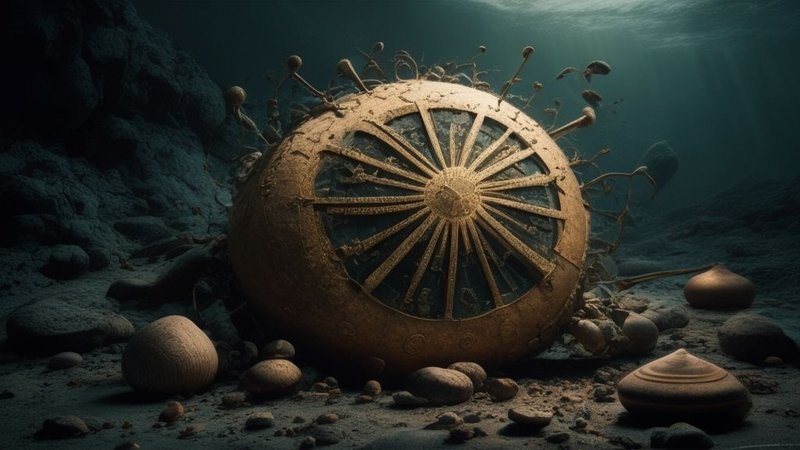
In the depths of the Mediterranean Sea, specifically near the small island of Antikythera, the sands concealed a secret capable of shattering everything taught in history books. Imagine yourself as a diver in the year 1900, battling treacherous waves and profound darkness, only to discover the wreck of a massive Roman ship. Yet, you find not merely gold, but a lost future embedded in the heart of the past. This corroded bronze device you see before you is not just an artifact; it is the first analog computer in human history, crafted two millennia ago.


Discovery: From Shipwreck to Scientific Shockwave

Your story begins in the spring of 1900, when a group of Greek sponge divers sought refuge from a fierce storm. Captain Dimitrios Kontos and his crew took shelter along the rugged cliffs of Antikythera Island. When the winds eventually subsided, diver Elias Stadiatis decided to descend to the seabed in search of livelihood. What Elias witnessed underwater made him tremble with fear; he described to the captain a horrific scene of decaying bodies strewn across the seafloor. These were not human remains, but magnificent marble and bronze statues, scattered from the wreckage of a Roman merchant ship that sank seventy years before Christ.

Amidst the retrieved treasures — statues of Aphrodite, wine amphorae, and jewelry — lay a greenish, unsightly bronze mass. Initially, no one paid it much attention, and it remained neglected in the storerooms of the National Archaeological Museum in Athens for two full years. Then, one day in May 1902, archaeologist Valerios Stais noticed that the mass had cracked, revealing a small metal gear with fine, distinct teeth. This sight sent an electric shock through the scientific community: how could complex mechanical gears exist in a wreckage dating back to antiquity? This discovery alone was capable of shattering everything taught in history books.

Discovery: From Shipwreck to Scientific Shockwave


Unveiling Ancient Greek Engineering Prowess

You now stand before a puzzle that baffled minds for decades. To grasp the magnitude of this astonishment, you must realize that the technology embedded in this device would not reappear in human history for another fifteen hundred years. We are talking about mechanical complexity comparable to 18th-century Swiss clocks. How could the ancient Greeks, whose knowledge we long believed to be solely theoretical and philosophical, have manufactured a device that integrates complex astronomy with precise mechanical engineering?

Consider the body of this device, which fragmented into eighty-two pieces. Scientists utilized the latest X-ray computed tomography techniques to unveil its internal mechanisms. Inside, they found an astonishing system comprising at least thirty bronze gears, interlocking with extreme precision. These gears were not ornamental; they functioned as a mechanical data processor. By simply turning a small knob on the side of the device, the gears moved to provide answers to grand cosmic questions.


A Portable Astronomical Computer

This device was a portable astronomical computer, truly a marvel of its age. Through its front face, a user could precisely determine the positions of the sun and moon across the zodiac. And it did not stop there; the device tracked the movements of the five planets known at the time: Mercury, Venus, Mars, Jupiter, and Saturn. Can you imagine the engineering effort required to calculate the retrograde motions of planets in the sky and translate them into metal gears? This demands a mathematical knowledge we never thought anyone possessed in that era.

On the back of the device are rotating dials that reveal fascinating time cycles. These included:

  • A dial dedicated to the “Metonic cycle,” a nineteen-year period used to reconcile the solar and lunar calendars.
  • Another remarkable dial, called the “Saros cycle,” which predicted solar and lunar eclipses with accuracy down to the hour. The device not only predicted eclipses but also indicated their color, size, and the expected winds during their occurrence.

A Portable Astronomical Computer


Culture, Instructions, and the Masterminds

But what might truly send shivers down your spine is the presence of a small dial dedicated to the Olympic Games. Yes, this ancient computer tracked the four-year cycle of major athletic games in ancient Greece, such as Olympia, Nemea, and Pythia. This signifies that the device was not merely a dry scientific instrument; it was a living part of culture and society, linking the movement of stars in the heavens with human festivities on Earth.

One of the greatest surprises revealed by X-rays was the existence of a “user manual” inscribed in minute lettering on the device’s bronze plates. Thousands of Greek characters, each no longer than a millimeter, explain how to operate the machine and detail the astronomical calculations it performs. These inscriptions proved that the device was not necessarily unique but was perhaps one of a series of devices manufactured and circulated among scientific elites, much like the enigma of the Voynich Manuscript.

Who created this marvel? Scientific consensus points to the island of Rhodes, which was a major center for astronomy and engineering at that time. The name that consistently surfaces is “Archimedes,” the Syracusan mathematical genius. Although Archimedes died decades before the ship sank, historians believe that this device represents the pinnacle of an engineering school founded by Archimedes himself. The Roman historian Cicero wrote of a “sphere” made by Archimedes that mimicked the movements of celestial bodies, and for centuries, everyone thought Cicero was exaggerating, until the Antikythera Mechanism emerged to silence all skeptics.


The Genius of Differential Gearing

Let us delve deeply into the technical details that make this device a true miracle. The gears inside the device are not ordinary gears; some utilize what are called “differential gears” or “epicyclic gears.” This type of engineering allows for the addition or subtraction of two different speeds to produce a third motion. The Greeks used this system to calculate what is called the “anomaly of the moon,” which is the slight change in the moon’s speed as it orbits the Earth due to its elliptical path. Do you grasp the magnitude of genius here? They knew that the moon’s orbit was not a perfect circle, and they succeeded in simulating this complex phenomenon through mechanical means, placing the Antikythera Mechanism among the most significant ancient engineering marvels, comparable to the Great Dam of Marib.

The Genius of Differential Gearing


Frequently Asked Questions

What is the Antikythera Mechanism?
The Antikythera Mechanism is an ancient Greek analog computer and orrery, discovered in a Roman shipwreck, that was used to predict astronomical positions and eclipses for calendrical and astrological purposes.
When and where was the Antikythera Mechanism discovered?
It was discovered in 1900 by Greek sponge divers near the island of Antikythera, off the coast of Greece, in the wreckage of a Roman merchant ship that sank around 70 BCE.
What functions could the Antikythera Mechanism perform?
The device could accurately track the positions of the sun, moon, and the five known planets (Mercury, Venus, Mars, Jupiter, Saturn) across the zodiac. It also featured dials for the Metonic and Saros cycles to predict solar and lunar eclipses, and even a dial to track the four-year cycle of the Olympic Games.
Who is believed to have created the Antikythera Mechanism?
While the exact creator is unknown, scientific consensus points to the island of Rhodes as its origin, a center for astronomy and engineering. Many historians connect its sophisticated design to the school of thought or direct influence of the legendary mathematician and engineer Archimedes of Syracuse.
What makes the Antikythera Mechanism so extraordinary?
Its extraordinary nature lies in its advanced mechanical complexity, including the use of differential and epicyclic gearing, which wouldn’t reappear in human technology for another 1500 years. It demonstrates a profound understanding of astronomy and precision engineering far beyond what was previously attributed to ancient civilizations.

Generated by AI Content Architect

About The Author

Leave a Reply

Your email address will not be published. Required fields are marked *