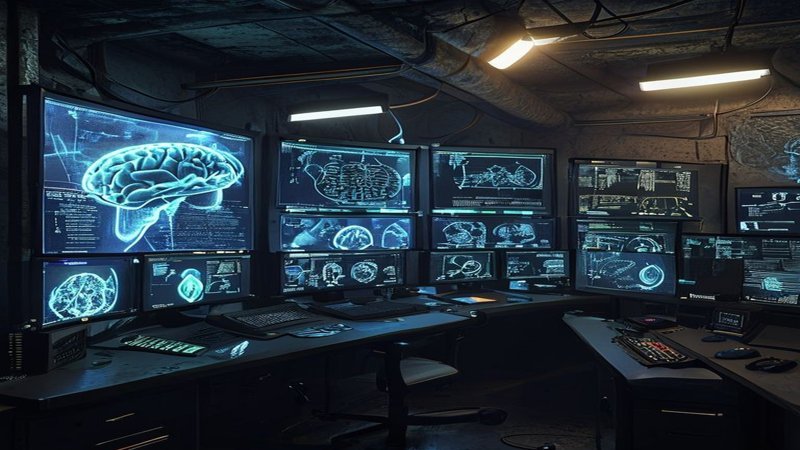
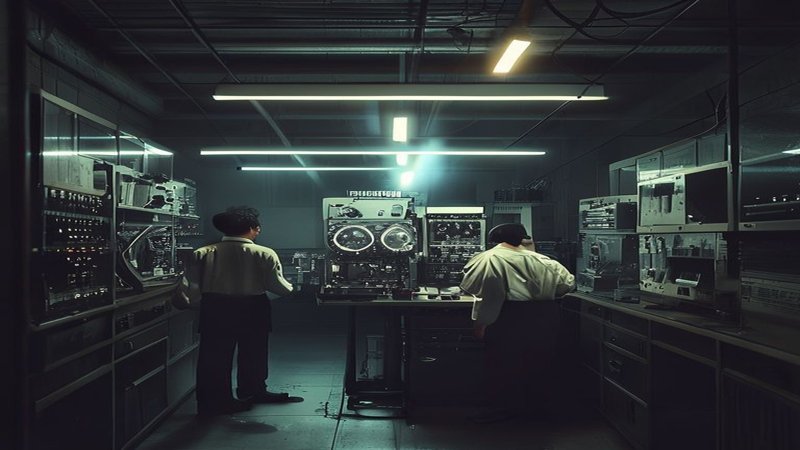
Project Stargate: US Intelligence, Remote Viewing, and Psychic Espionage
Imagine that the walls of your room are not as solid as you think. Imagine that the eyes reading these words are but one window among many possessed by your consciousness. Deep within the Cold War, as the world trembled in fear of devastating nuclear warheads, another war was being waged in absolute silence behind the closed doors of the Central Intelligence Agency (CIA). A war that did not employ bullets, but instead utilized the human mind as an intercontinental projectile. You are now entering a world where geography is merely an illusion, and time merely a constraint that can be shattered. Welcome to Project Stargate, a file kept secret for decades, which proves that the superpower attempted to transform metaphysical aspirations into a deadly strategic weapon.
It all began with a silent cry of alarm within the corridors of Washington during the early 1970s. Terrifying intelligence reports indicated that the Soviet Union was spending millions of rubles on enigmatic research related to psychic abilities. These were not mere superstitions; they were laboratory experiments aimed at remote espionage. The American leadership was seized with panic at the prospect of a psychic gap that could grant the Soviets the ability to read the President’s thoughts or penetrate highly secure nuclear sites using only the mind. From this apprehension, Project Stargate was born at the Stanford Research Institute (SRI), overseen by physicists Russell Targ and Harold Puthoff. They were not seeking magicians, but individuals possessing a capability they termed “remote viewing.”
The Protocol of Perception: How Remote Viewing Worked
Imagine yourself seated in a colorless, soundproofed room, with lighting so dim it borders on melancholic. An officer in civilian attire enters, placing before you a sealed envelope containing geographic coordinates that mean nothing to you. You have no idea if these numbers refer to the middle of the ocean or the heart of the Nevada desert. The officer instructs you to close your eyes, breathe slowly, and allow your consciousness to float thousands of miles to reach that point. In this moment, your pulse begins to slow, and the room’s coolness transforms into the scorching heat of a distant desert or the frost of a Siberian forest. You begin to describe buildings, radars, and even the faces of people you have never met. This was not imagination; it was a strict military protocol to which hundreds of soldiers and civilians were subjected.
Documented Wonders: From Jupiter’s Rings to Jungle Wrecks
One of the most renowned remote viewers was Ingo Swann. In a documented experiment in 1973, he was asked to “view” Jupiter before the Voyager 1 probe reached it. Swann described the presence of rings around the planet, a detail unknown to science at the time. Scientists scoffed at him then, but years later, when the spacecraft arrived, the world was stunned by the accuracy of his vision. How could a man sitting in a darkened room perceive details in deep space that the most powerful telescopes failed to discern? Here lay the terrifying power the U.S. military sought to exploit. The ‘viewing’ was not merely faint images; it was a complete sensory experience, allowing viewers to:
Smell the fuel at Soviet military bases.
Feel the cold steel of nuclear submarines beneath the ice.
The project transitioned through multiple codenames, from Gondola Wish to Grill Flame, culminating in Stargate in 1990. The objective was always singular: to acquire intelligence inaccessible to satellites or human spies. In one clandestine operation, remote viewers were tasked with locating a crashed Soviet aircraft in the African jungles. All modern surveillance techniques had failed, yet a single remote viewing session precisely identified the wreckage’s location, allowing U.S. forces to reach it before the Soviets. One can imagine the expressions of astonishment on the faces of generals as they saw maps drawn based on the words of a man who claimed to have traveled in spirit across continents. The profound psychology of mystery surrounding such capabilities only fueled the project’s pursuit.
The Dark Side: Psychological Costs and Ethical Abuses
But behind these dazzling successes lay a dark and painful aspect. These experiments did not come without a hefty psychological cost. Remote viewers suffered from debilitating mental exhaustion, where reality intertwined with distant visions. Some described a sensation of absolute void, as if their minds were torn between two places simultaneously. The military leadership exploited these individuals as tools, disregarding warnings that tampering with the boundaries of consciousness could lead to complete madness. There were even attempts to use these abilities for psychological influence, specifically to implant ideas into the minds of enemy leaders or even to remotely induce heart attacks. It is a thought that makes one tremble; if someone could see you in your closed room, what would prevent them from touching your mind or stopping your heart?
Official Termination or Deeper Concealment?
In 1995, the Central Intelligence Agency officially decided to review the project. The report, prepared by the American Institutes for Research (AIR), concluded that remote viewing had not demonstrated sufficient efficacy in field intelligence operations, despite acknowledging the existence of scientifically unexplainable phenomena. The project was officially announced as closed, and its 800 pages of documents were declassified for public access in 2017. But did it truly end? Experts in body language and psychological manipulation understand that military institutions do not easily abandon a weapon of such potency. The official justification for its closure might simply be a cover for transferring the research to more secretive black budgets, far from Congressional oversight. Consider the world today, where mind manipulation technologies and artificial intelligence have become dominant. Is it not possible that the Stargate experiments were the cornerstone of what we now perceive as psychological and informational warfare? The human capacity to perceive beyond the senses is a documented fact within these files, confronting you with a terrifying question about the future of intelligence. This echoes the concept of potent psychological weapons that can influence without direct confrontation.
Frequently Asked Questions
What was the primary objective of the Stargate Project?
The primary objective of Project Stargate was to investigate and weaponize psychic abilities, specifically ‘remote viewing,’ for espionage and intelligence gathering during the Cold War. The U.S. government feared a ‘psychic gap’ with the Soviet Union and sought to use the human mind as a strategic weapon to access inaccessible information.
How did ‘remote viewing’ purportedly work in Project Stargate?
Remote viewing involved individuals, often in soundproofed rooms, being given geographic coordinates they knew nothing about. They would then attempt to project their consciousness to that location, describing buildings, radars, people, and even sensory details like smells and temperatures. This was done under strict military protocol.
What were some documented successes attributed to Project Stargate?
Notable successes include Ingo Swann’s accurate description of rings around Jupiter before Voyager 1 confirmed them, and remote viewers precisely identifying the location of a crashed Soviet aircraft in African jungles when other surveillance methods failed.
What were the negative consequences for remote viewers involved in the project?
Remote viewers suffered significant psychological costs, including debilitating mental exhaustion and a sensation of their minds being torn between different realities. There were warnings that tampering with the boundaries of consciousness could lead to complete madness, and some abilities were reportedly exploited for psychological influence against enemies.
Why was Project Stargate officially closed, and is it truly over?
Project Stargate was officially closed in 1995 after a CIA review concluded it had not demonstrated sufficient efficacy in field intelligence operations, despite acknowledging some scientifically unexplainable phenomena. The documents were declassified in 2017. However, many experts speculate that the research may have simply been moved to more secretive ‘black budgets’ due to the perceived potency of such a weapon, leading to lingering doubts about whether the program truly ended.