Water Memory: Unraveling the Enigma of Nature’s Intelligent Liquid

0
image_1-62


Water Memory: Unraveling the Enigma of Nature’s Intelligent Liquid
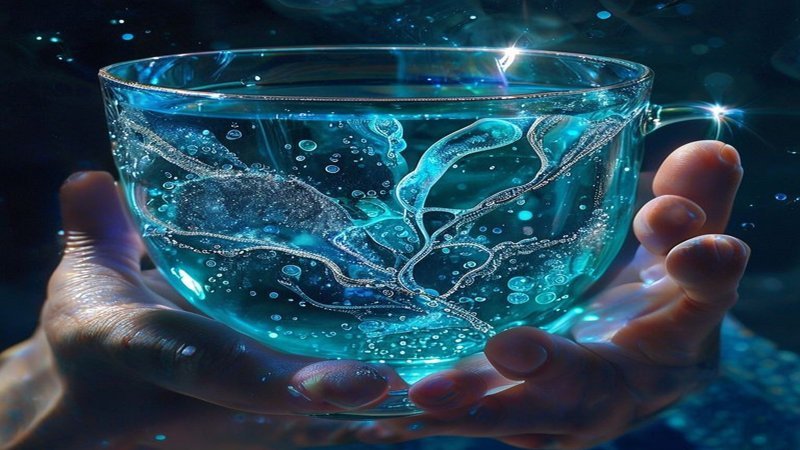
Imagine the cup you now hold in your hands carries secrets spanning millennia. It is not merely a simple chemical compound of two hydrogen atoms and one oxygen atom. Rather, it is the universe’s ultimate hard drive. Water is not just a liquid we touch; it is a silent witness, recording everything it encounters since the dawn of creation.


The Enigma of Water’s Memory: A Scientific Controversy

You live in a world that believes it has uncovered the secrets of matter. Yet, the truth resides within a single raindrop falling from a passing cloud. Have you ever pondered why you feel a sense of tranquility when sitting by the sea, or why your mood shifts when you drink pure water from a mountain spring? Conventional science might explain these as mere chemical reactions, but the reality runs far deeper. Water possesses memory. It does not forget. It stores frequencies. It records emotions. It preserves the imprints of history within its liquid depths.

In the late 1980s, specifically in 1988, French scientist Jacques Benveniste shocked the scientific community with his controversial research. This scientist claimed that water could ‘remember’ substances dissolved within it, even after being diluted to the point of complete disappearance. He termed this phenomenon ‘water memory’. He faced fierce attacks and was accused of scientific madness. However, he opened a door that no one has been able to fully close. His hypothesis proposed that water molecules arrange themselves into complex formations called clusters. These clusters act as biological codes, much like how computers store data in sequences of zeros and ones.
The Enigma of Water's Memory: A Scientific Controversy


Your Body: An Intelligent Aquatic Repository

Consider your body. You are composed of up to seventy percent water. This means you are not merely a mass of flesh and bones; you are, in fact, a mobile aquatic repository. If water stores information, what does the water in your body currently hold? Does it store your childhood memories? Is it influenced by your angry or calm emotions? Recent research suggests that the water surrounding your DNA is not just a protective fluid, but a vital part of the genetic information transfer system. Water dances around your cells, responding to every heartbeat and every thought that crosses your mind.


Earth’s Central Library: The Deep Ocean’s Secrets

Let us now turn our attention to the vast oceans that cover over seventy percent of our planet’s surface. These blue expanses are not merely saltwater; they are Earth’s central library. Reflect deeply on this: the oceans have existed for over four billion years. Throughout this immense period, the water has witnessed everything, from the emergence of the first living cell in the abyssal depths to the impact of giant meteorites and the disappearance of continents. Every organic interaction within the ocean has left a vibrational imprint in the aquatic medium. The oceans serve as an immense natural database, recording climatic changes, geological movements, and even the cries of creatures that went extinct millions of years ago.

Scientists are currently studying what is termed the ‘bio-signature’ of deep-sea water. They have discovered that water molecules in the deep layers differ in their arrangement from those near the surface. It is as if pressure and time compress information within the liquid’s molecular structure. This leads us to a fascinating, albeit daunting, question: Could we one day read Earth’s history by analyzing a water sample extracted from a deep well? Could water narrate the story of submerged civilizations, leaving no trace but their memory encoded within hydrogen and oxygen molecules?
Earth's Central Library: The Deep Ocean's Secrets


Masaru Emoto’s Visual Revelations: Water Crystal Experiments

Japanese researcher Masaru Emoto took this concept even further. He exposed water samples to various external influences: classical music, words of love, shouts of anger, and even chemical pollutants. He then froze these samples and photographed their crystals under a microscope. The results were astonishing, almost akin to science fiction. Water subjected to positive influences formed geometrically beautiful and complex crystals, whereas water exposed to negative influences displayed distorted and chaotic crystals. Although his experiments faced methodological criticisms, they planted an undeniable idea in our minds: water responds instantaneously to its surrounding environment. These influences included:

  • Classical music, which resulted in harmonious patterns.
  • Words of love, creating intricate and beautiful structures.
  • Shouts of anger, yielding fragmented and chaotic forms.
  • Chemical pollutants, also causing distorted crystal formations.


The Future of Water: Computing, Healing, and Environmental Peril

You are not separate from this global aquatic system. When you drink water, you introduce new information into your biological system. And when you breathe, you release water vapor carrying your unique code into the atmosphere. It is an infinite cycle of information exchange. The Earth breathes through its waters, and water serves as the planet’s nervous system, connecting forests, mountains, and oceans in a biological communication network billions of times more complex than the internet.

Imagine if we could harness this property in technology. Picture computers powered by liquids instead of silicon, possessing infinite storage capacity and mimicking the intelligence of nature. This is not mere fantasy; research is currently underway on aquatic computing. Scientists are attempting to understand how proteins communicate through water instantaneously. They are searching for the secret language water speaks with life.

Water also possesses a peculiar self-cleaning ability, not only from chemical impurities but also from detrimental information. When water evaporates and ascends to the sky, it undergoes a reset process. It returns pure, a blank slate ready to inscribe a new history. However, with the immense pollution humanity perpetrates today, have we begun to corrupt this database? Will the information we store in our oceans today—from chemical and radioactive waste—remain etched in water’s memory for thousands of years to come? This is the true fear: that we might leave behind a library contaminated with ruin instead of beauty.

You now realize that your relationship with water must change. When you stand before a mirror, remember you are looking at a mass of intelligent water. And when you walk in the rain, know that you are receiving messages from the sky, carrying new information.
The Future of Water: Computing, Healing, and Environmental Peril


Frequently Asked Questions

What is the core concept of “water memory”?
Water memory is the controversial theory suggesting that water can retain a “memory” or imprint of substances dissolved in it, even after extreme dilution, through changes in its molecular structure or clusters.
Which scientists are associated with the concept of water memory?
French immunologist Jacques Benveniste first proposed the term “water memory” in 1988 with his research on highly diluted solutions. Later, Japanese researcher Masaru Emoto conducted experiments showing water crystals reacting to various influences like words and music.
How might water memory relate to the human body?
Given that the human body is up to seventy percent water, proponents suggest that this water could store personal memories, emotions, and influence our well-being. Some research even posits water around DNA plays a role in genetic information transfer.
What did Masaru Emoto’s experiments reveal about water?
Masaru Emoto’s experiments showed that water exposed to positive influences (e.g., words of love, classical music) formed beautiful, complex ice crystals, while water exposed to negative influences (e.g., shouts of anger, pollutants) formed distorted and chaotic crystals, suggesting water responds to its environment.
What are the potential implications of water memory for technology and the environment?
The concept opens doors to futuristic ideas like “aquatic computing” with infinite storage capacity. However, it also raises serious environmental concerns, implying that chemical and radioactive waste from human pollution could be permanently “etched” into water’s memory, contaminating Earth’s natural database for millennia.

Generated by AI Content Architect

About The Author

Leave a Reply

Your email address will not be published. Required fields are marked *