The Voynich Manuscript: History’s Strangest Book Unsolved by AI
Imagine a book written in a language unknown to our world. It features illustrations of plants that have never grown on Earth. For six hundred years, the Voynich Manuscript has stood as humanity’s greatest unbroken cipher. You now stand before a puzzle that baffled World War II cryptographers and has challenged the smartest AI algorithms of our current era. This is no mere dusty old book on a shelf in a Yale University library. It is a wall of silence refusing to reveal its secrets.
Your journey today begins the moment antique book dealer Wilfrid Voynich touched this strange volume in 1912. This occurred at Villa Mondragone near Rome, where, amidst a collection of manuscripts discarded by Jesuit monks, Wilfrid discovered a treasure he would spend the rest of his life trying to comprehend. He didn’t know then that this volume would forever bear his name and become a source of frustration for every linguist who dared to approach it.
Look closely at the pages. You will find 240 vellum pages made from calfskin. Radiocarbon dating has revealed that this vellum dates back to between 1404 and 1438. This means the book is not a modern hoax, but a genuine product of the Middle Ages, unlike some debated historical texts. For more on historical records, consider Ancient China’s Forged History: The 200-Year Secret Emperors Erased. Yet its contents defy all known historical logic.
Decoding the ‘Voynichese’: A Language Like No Other
The text is written with a bird’s quill, from left to right. Its letters are strange and curved, sometimes resembling Latin and sometimes Greek, but belonging to neither. Scholars have named this language “Voynichese.” It possesses an astonishing grammatical structure, adhering to Zipf’s Law, a statistical law applicable to all genuine human languages, where short words occur more frequently than long words in specific ratios. This implies that the text is not mere random scribbles by a madman, but an organized message possessing a deep internal logic that your human mind has thus far failed to grasp. This linguistic mystery parallels other lost inscriptions, like those discussed in Lost Mero Inscriptions: Unknown Monarchs and Suppressed Egyptian History.
Unearthly Visions: The Manuscript’s Bizarre Illustrations
Let’s move on to the illustrations that will make you feel disoriented. The manuscript is divided into six sections based on its pictorial content:
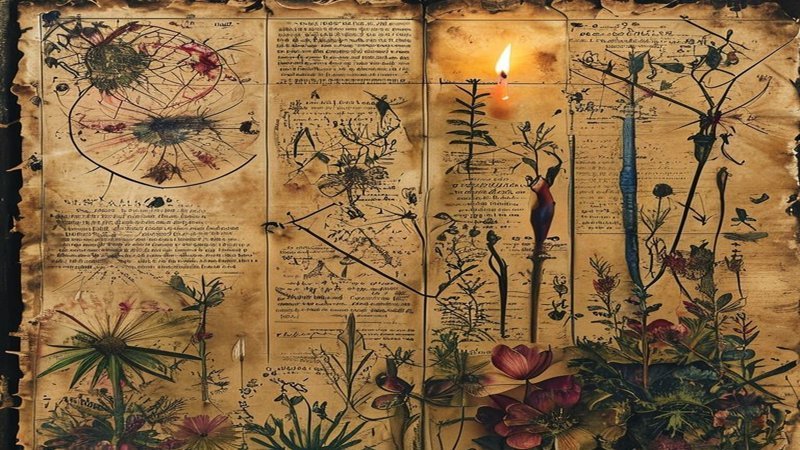
Botanical section: You will see plants drawn with incredible precision, but the shock begins when you try to match them to reality. Botanists worldwide have attempted to identify these species, finding roots of one plant connected to leaves of another, and flowers of a completely different type. These are hybrid plants, or perhaps from another planet or a different time.
Astronomical section: You will see star charts and zodiac symbols, but they do not match any sky map known to 15th-century astronomers. There are enigmatic solar and lunar circles that seem to depict the movement of celestial bodies we cannot observe from Earth.
Biological section: This part is the most unsettling and mysterious. You will see images of small, nude women bathing in bizarre pools connected by a complex network of pipes. These pipes appear to be bodily organs or channels for transmitting an unknown energy. The liquids they swim in are dark green. The women’s features suggest calm and serenity amidst this surreal scene. Some view this section as representing a complex chemical process, while others see it as evidence of lost biotechnology that existed during the Dark Ages, perhaps akin to the lost knowledge explored in Unbreakable Roman Glass: The Inventor Tiberius Executed & Lost Technology.
Pharmaceutical section: Containing jars and vessels holding parts of plants and bulbous roots.
Cosmological section: (Often combined with astronomical or distinct, depicting circular diagrams).
Finally, there is the section with continuous pages of text devoid of illustrations, which appears to be medical recipes or magical incantations.
The Unyielding Cipher: Humanity’s Failed Attempts
The greatest minds have attempted to crack this lock. In the mid-20th century, William Friedman, the man who broke Japan’s Purple cipher in World War II, formed a team to study the manuscript. He and his team spent years analyzing letter frequencies and patterns, ultimately admitting failure. He stated it was a language built so strangely that it resembled no known manual cipher. With the advent of computers, everyone thought the solution was imminent. Supercomputers were fed all known world languages and all types of encryption, from the simple to the most complex. Yet the manuscript remained silent. Today, artificial intelligence can translate extinct ancient languages, but when it confronts Voynich, it begins to hallucinate, yielding contradictory results. One moment it claims it’s ancient Hebrew, another it asserts it’s an extinct Turkish language, and another it perceives an ancient Mexican language. This technological confusion confirms that we are facing something that transcends conventional programming logic, touching upon themes of hidden control and unseen frequencies, much like those discussed in Atomic Clocks Reveal Time Manipulation: Cosmic Frequencies and Hidden Control.
Beyond Encryption: Theories of its Origin
Why hasn’t AI been able to solve it? The answer may lie in the possibility that the manuscript is not encrypted in the traditional sense. Perhaps it is written in an artificial language designed by one person for one purpose, or perhaps it is a form of automatic writing emerging from the subconscious in states of mystical ecstasy. However, the quality of the vellum and the cost of its production at that time were exorbitant. No one would waste such wealth and time writing meaningless nonsense. This leads us to more daring theories:
Or perhaps it is the work of a time traveler stranded in the Middle Ages, attempting to document their knowledge in a language their contemporaries couldn’t understand?
Consider this: If the plants don’t exist, the stars are unknown, and the language doesn’t match any human linguistic root, what is left for us? We are left with two possibilities, no third option. Either it is the greatest hoax in history, designed by a genius to defraud kings by selling them a fictitious magical book, or it is a truth we cannot comprehend. It is a window into a parallel world. Today, the manuscript is preserved in a secure vault at Yale University, safe from tampering hands. However, its images are available to you and the entire world online. Thousands of amateur researchers spend their nights trying to decipher its secrets.
Frequently Asked Questions
What is the Voynich Manuscript?
The Voynich Manuscript is an ancient book composed of 240 vellum pages, carbon-dated between 1404 and 1438. It is written in an unknown language, dubbed ‘Voynichese,’ and contains bizarre illustrations of unidentified plants, astronomical charts, and mysterious biological figures, making it one of history’s greatest unsolved ciphers.
Why is the Voynich Manuscript so difficult to decipher?
It’s difficult because its language, ‘Voynichese,’ adheres to grammatical structures like Zipf’s Law, suggesting it’s a genuine language, yet it resembles no known human language or traditional cipher. Expert cryptographers, including World War II codebreakers, and modern AI have failed to translate it, yielding only contradictory results.
What kind of illustrations are found in the manuscript?
The manuscript contains six sections of illustrations: botanical (unidentifiable hybrid plants), astronomical (unknown star charts and celestial bodies), biological (nude women bathing in strange pools connected by pipes, possibly depicting lost biotechnology), pharmaceutical (jars and roots), and continuous text (potentially recipes or incantations).
Has Artificial Intelligence been able to decipher the Voynich Manuscript?
No, despite advanced AI being capable of translating extinct ancient languages, it has been unable to decipher the Voynich Manuscript. When fed the text, AI algorithms ‘hallucinate,’ producing wildly contradictory results, suggesting the manuscript’s logic transcends conventional programming or known linguistic patterns.
What are the leading theories about the Voynich Manuscript’s origin?
The primary theories suggest it could be: 1) The greatest hoax in history, created by a genius to defraud royalty. 2) An artificial language designed for a specific purpose by one person. 3) A form of automatic writing. 4) Remnants of an advanced civilization. 5) The work of a time traveler documenting knowledge beyond its era.