Asteroid Impact: The Final Hours of Human Civilization & Planetary Defense
Imagine waking on a normal morning to find the sky split open by a light thousands of times brighter than the sun. This is not a new day, but the final harbinger of the end of everything you know. In this very moment, a colossal rocky mass is hurtling towards your home at a speed exceeding sixty-eight thousand kilometers per hour. You are now experiencing the final moments of human history as we know it. Science tells us this is not mere science fiction, but a standing probability awaiting its moment. Space is not a serene void, but a battlefield teeming with gigantic rocks traversing the darkness. Some of these rocks are the size of the Himalayas, moving with deadly precision towards our orbit. If a massive asteroid were to strike Earth tomorrow, there would be nowhere to hide. You are now witnessing the true horror scenario that global space agencies dread.
One hour before impact, birds will cease singing, and an ominous silence will descend upon nature. You will observe a thin thread of light in the sky rapidly transforming into a terrifying fireball. This ten-kilometer-diameter asteroid is now entering Earth’s atmosphere. The air in front of the asteroid compresses with immense force, raising its temperature to levels exceeding the Sun’s surface. Initially, you hear no sound because the asteroid travels many times faster than sound. The atmosphere that usually protects you is now transforming into a colossal gaseous furnace. Trees near the impact site will spontaneously combust from radiant heat before the asteroid even touches the ground. Entire cities will vaporize in fractions of a second as this monstrous object enters the lower atmosphere. The atmospheric pressure generated by air displacement will shatter windowpanes on distant continents.
The Cataclysmic Impact: A World Shattered
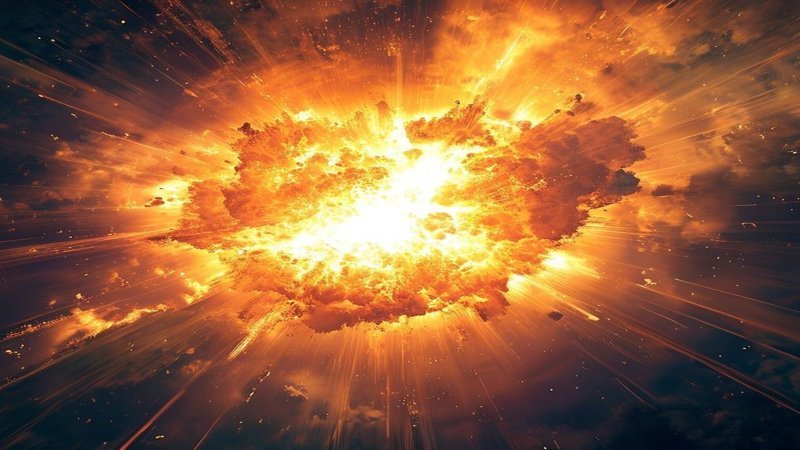
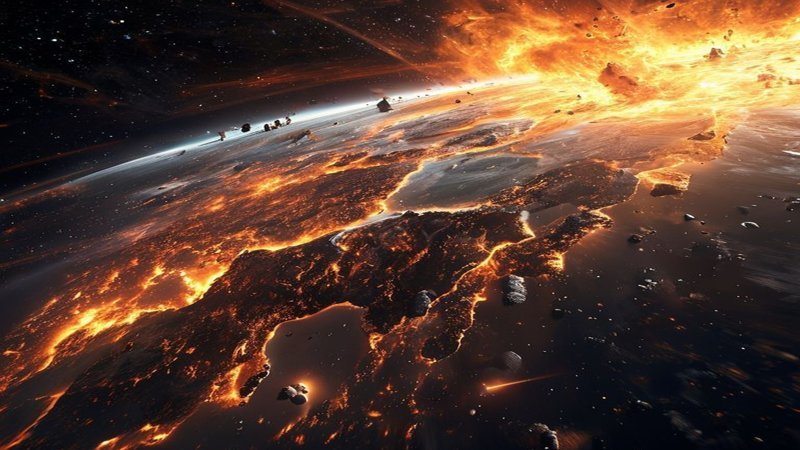
The moment of impact is when time stops for millions of people. When an asteroid of this magnitude strikes Earth, it doesn’t merely fall; it detonates with a force equivalent to billions of atomic bombs. The Earth’s crust will behave as if it were liquid, not solid. Tons of molten rock will be ejected into outer space, only to rain back down as incandescent embers across the entire planet. You are now confronting an earthquake unlike any humanity has ever witnessed. An earthquake exceeding twelve on the Richter scale will shake the very foundations of the planet. Mountains will collapse, and coastal cities will be submerged under tsunamis kilometers high. Water will spare no one, sweeping away everything humanity has built over millennia in mere minutes.
If you believe distance from the impact site will grant you safety, you are entirely mistaken. Dust and debris soaring from the explosion will completely obscure sunlight within a few hours. The world will plunge into a deep darkness, known as an impact winter. You will experience a sharp and sudden drop in temperatures, reaching minus thirty degrees Celsius in tropical regions. Plants relying on light for survival will perish within days. The food chain will collapse from its base, meaning hunger will become the primary adversary for the few survivors. The air you breathe will become toxic due to nitrogen and sulfur oxides resulting from atmospheric combustion. Acid rain will burn your skin and contaminate the few remaining water sources. This is the hell experienced by dinosaurs sixty-six million years ago, now repeating before your eyes.
Historical Precedents, Scientific Classification, and Planetary Defense
Let us return to history to comprehend the magnitude of the catastrophe we discuss today. In 1908, a relatively small asteroid struck the Tunguska region of Siberia. It did not hit the ground but exploded in the air, destroying eighty million trees and obliterating an area the size of major cities. Imagine if this asteroid had struck London or New York. Science informs us that thousands of Near-Earth Objects (NEOs) are monitored daily. NASA launched the DART mission in 2022 to test the ability to alter an asteroid’s trajectory. The mission was successful, but it targeted a small rock compared to the giants that could end civilization. We live in a cosmic minefield, and all that separates us from annihilation is pure physical luck.
Scientists classify asteroids based on their size and chemical composition.
Iron-nickel asteroids are the most destructive because they do not readily fragment in the atmosphere.
You are now considering an asteroid like Apophis, which will make a frighteningly close approach to Earth in 2029. If its trajectory were to deviate by even a millionth of a degree, we could face the catastrophe we are discussing.
An asteroid’s kinetic energy is calculated by multiplying half its mass by the square of its velocity. This implies that a minor increase in velocity exponentially multiplies its destructive power. Earth orbits the Sun at 107,000 kilometers per hour, and asteroids travel at similar speeds. When a head-on collision occurs, the force is sufficient to tear away parts of the Earth’s crust.
The Long Shadow: A World Transformed and the Glimmer of Hope
The long-term environmental effects will extinguish any remaining hope. A month after impact, dust will remain suspended in the stratosphere.
Global cooling will lead to partial freezing of oceans and disruption of marine currents.
You would live in a world devoid of agriculture, industry, and technology.
Satellite communications will cease as orbital debris from the impact destroys everything in orbit.
Humanity will regress to the Stone Age in the blink of an eye. Psychological distress and social collapse will precede the physical disaster itself. Fear will drive people to fight for the last can of food or the last drop of clean water. Chaos will engulf the streets before the physical shockwaves even arrive.
But is there a brighter side to this bleak picture I paint for you? Science works relentlessly to develop planetary defense systems. We are building advanced telescopes to detect dark objects hidden behind the Sun’s glare. There are plans to use laser beams to vaporize an asteroid’s surface, creating a jet thrust to alter its trajectory.
Frequently Asked Questions
What are the immediate signs and effects before a massive asteroid impact?
One hour before impact, an ominous silence would descend as birds cease singing. A thin thread of light would rapidly transform into a terrifying fireball entering the atmosphere. The air compression would create extreme heat, causing spontaneous combustion, and atmospheric pressure would shatter distant windowpanes before the asteroid even touches the ground.
What happens at the moment of impact and its direct aftermath?
A massive asteroid impact would detonate with the force of billions of atomic bombs, making the Earth’s crust behave like liquid. This would trigger an earthquake exceeding Richter scale 12, cause mountains to collapse, and generate kilometer-high tsunamis. Molten rock would be ejected into space, raining back down as incandescent embers globally.
What is an “impact winter” and its long-term effects on Earth?
An “impact winter” occurs when dust and debris from the explosion obscure sunlight, plunging the world into deep darkness and causing a sharp temperature drop (e.g., -30°C in tropical regions). This leads to the collapse of the food chain, toxic air, acid rain, and global cooling, potentially freezing oceans and disrupting marine currents, regressing humanity to a Stone Age existence.
Has humanity experienced similar events, and what are we doing about potential future impacts?
Yes, a relatively small asteroid exploded over Tunguska, Siberia, in 1908, destroying 80 million trees. To prevent future catastrophes, thousands of Near-Earth Objects (NEOs) are monitored daily. Missions like NASA’s DART in 2022 successfully tested the ability to alter an asteroid’s trajectory. Scientists are also developing advanced telescopes and laser-based planetary defense systems.
How are asteroids classified, and what makes some more destructive?
Asteroids are classified by size and chemical composition. Iron-nickel asteroids are considered the most destructive because they are less likely to fragment in the atmosphere upon entry, delivering their full kinetic energy. Their destructive power is exponentially increased by even a minor rise in velocity.