Greek Art’s Enduring Enchantment: Unveiling the Secret Code of Beauty and the Golden Ratio
Have you ever wondered why you feel a mysterious serenity when gazing at the facade of the Parthenon in Athens, despite it being merely inert stone? Have you ever considered that a secret code lies hidden behind the curves of marble statues, allowing your eye to perceive beauty before your mind can analyze it? You now stand before the greatest fusion in human history, where mathematics was not merely about numbers, but the true sovereign of art and beauty.
Imagine yourself standing in the heart of ancient Greece over 2,400 years ago. The air carries the scent of freshly carved marble and the dust of labor fills the atmosphere. You are not just seeing workers building walls; you are witnessing philosophers embodying existence in geometric forms. These people did not believe that beauty was a matter of perspective or personal taste. For you and for them, beauty was a fixed, unchanging cosmic law, just like the movement of stars and the cycle of seasons. You seek harmony, and they found this harmony in a single magical number, later known as the Golden Ratio.
This number, which approximates 1.618, is not merely a fleeting numerical value. It is the proportion that connects the whole and the part in a way that makes the human eye experience instant satisfaction. In those eras, mathematics was the language spoken by the gods, and the artist had to learn this language to approach perfection. When you look at any classical Greek artwork, you are, in fact, reading a visible mathematical equation. The Greek architect did not place stone upon stone haphazardly but followed a pattern called rhythmic symmetry.
The Parthenon’s Geometric Illusions
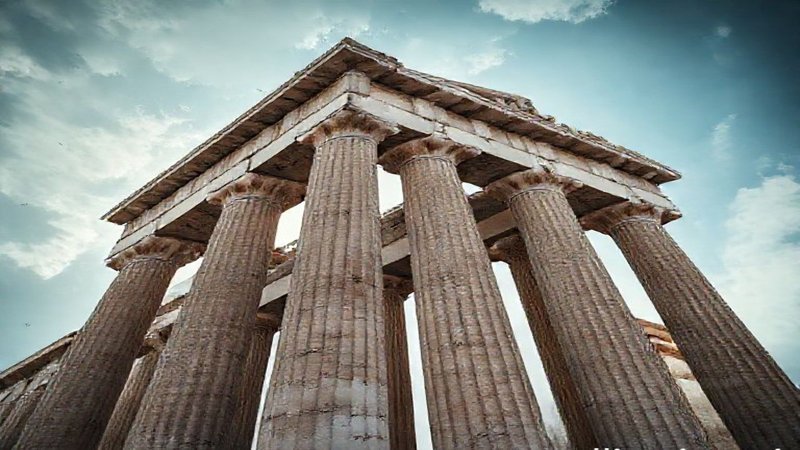
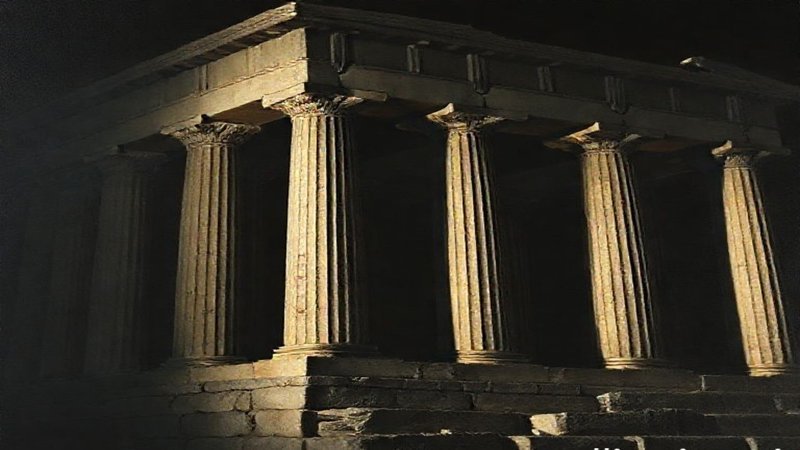
Let us delve into the depths of the Parthenon, this edifice that stands majestically atop the Acropolis hill. If you observe it from afar, you might assume its lines are perfectly straight and its angles precisely right. Yet, the astonishing truth is that you are experiencing an ingenious geometric optical illusion. The designers, Ictinus and Callicrates, understood that the human eye errs in perceiving long straight lines, making them appear to curve in the middle. Therefore, they subtly curved the columns and the base outwards so they would appear perfectly straight to your eye. This profound understanding of optical physics and mathematics is what granted the temple its visual immortality.
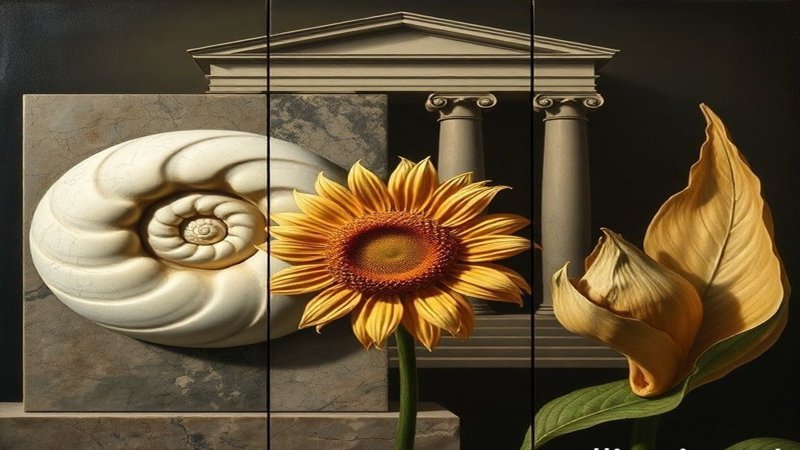
Every part of this temple adheres to the Golden Rectangle ratio. From the width of the facade to its height, and from the distances between columns to the size of the friezes. You perceive a harmony uninterrupted by any visual dissonance. This proportion creates a psychological balance within you because your human mind is evolutionarily programmed to seek these patterns in nature. The Greeks discovered that this number exists in the veins of leaves, the spirals of a nautilus shell, and the arrangement of sunflower seeds. They decided to transfer this natural system into stone, making their buildings appear to have grown from the earth rather than merely built upon it.
The Human Form in Perfect Proportion
Now, let us transition from architectural engineering to the engineering of the human body. Consider the Spear-Bearer statue by the sculptor Polykleitos. This artist did not sculpt an arbitrary body but applied an entire treatise he authored on the rules of proportion, known as the Canon. In this work, you will find that the head constitutes one-eighth of the total body height, and the distance from the navel to the feet and from the navel to the head adheres to the Golden Ratio with astonishing precision. You are not looking at a man of marble, but at a physical embodiment of the idea of absolute balance.
Beyond Aesthetics: Philosophy, Scale, and Democracy
This concept prompts us to question your own relationship with beauty in our current era. We live in a world that sometimes deifies randomness or drowns in abstraction devoid of rules. Yet, the Greeks always remind you that true freedom for the artist lies in adhering to cosmic laws. When you comply with mathematical proportions, you do not restrict your creativity but rather give it wings to soar towards eternity. The Greek artist spent years studying geometry before touching a chisel because they believed that beauty is truth, and truth is mathematics.
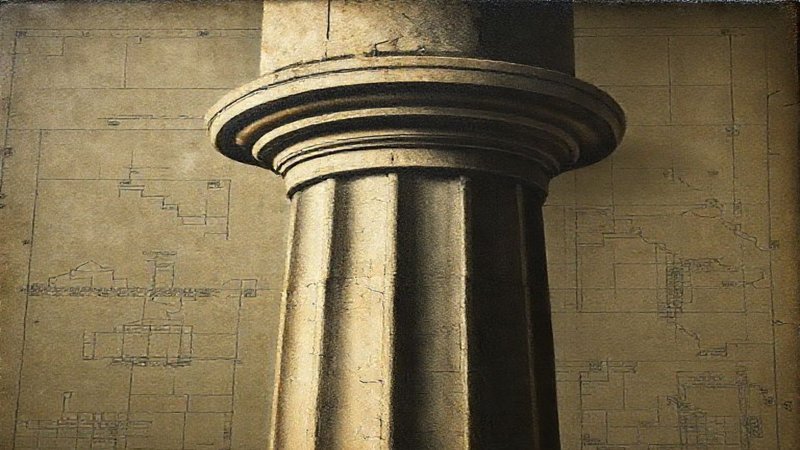
Reflect on the concept of human scale. The Greeks did not build colossal temples that made you feel insignificant and overwhelmed, as the pharaohs did with their pyramids. They desired temples that embraced humanity and were proportioned to its dimensions. The Golden Ratio was the bridge connecting the grandeur of the divine with the modesty of human size. When you stand beside a Doric column, you feel that you are part of this system, not an outsider to it. This sense of belonging to the place is the secret to the psychological comfort provided by classical architecture.
Mathematics in Greek art was an expression of political and social philosophy as well. Athenian democracy demanded a balance between the individual and society, and this balance was reflected in their art. Consider how this mirrors the principles of the Golden Ratio:
No single part dominates another.
The whole serves the part, and the part dissolves into the whole.
Exactly as in the Golden Ratio equation, where spaces are distributed in a way that allows the eye to move smoothly without fatigue. Here, you experience a visual democracy, where every element has its rightful place within a fair geometric system.
Entasis: Bringing Stone to Life
Let us discuss the subtle details that might escape the untrained eye. Have you ever noticed that the columns of Greek temples are not regular cylinders? They swell slightly in the middle, a phenomenon called entasis. This slight bulge gives the impression that the column is exerting muscular effort to support the roof, much like human muscles. Here, mathematics transforms from dry numbers into vibrant sensations. You feel the pressure of the roof and the strength of the column because the artist used geometry to emulate life. This is the Greek ingenuity that made rigidity resemble suppleness.
Frequently Asked Questions
What is the Golden Ratio and why was it important to Greek art?
The Golden Ratio, approximately 1.618, is a mathematical proportion that connects a whole and its parts in a way that creates instant visual satisfaction. Ancient Greeks considered it a cosmic law, embodying harmony and beauty, and believed that incorporating it into art allowed artists to approach perfection.
How did the Parthenon utilize optical illusions in its design?
The designers of the Parthenon, Ictinus and Callicrates, understood that human eyes perceive long straight lines as curving. To counteract this, they subtly curved the columns and the base outwards. This ingenious optical correction makes the lines appear perfectly straight to the viewer, granting the temple its visual immortality and harmony.
What was Polykleitos’s Canon and how did it relate to Greek sculpture?
Polykleitos’s Canon was a treatise on the rules of proportion he authored, which served as a guide for sculpting the ideal human body. For instance, it dictated that the head should be one-eighth of the total body height, and specific distances like from the navel to the feet and to the head should adhere to the Golden Ratio, creating an embodiment of absolute balance.
How did the Greeks view the relationship between mathematics, beauty, and artistic freedom?
For the Greeks, beauty was truth, and truth was mathematics. They believed that adhering to cosmic mathematical laws, such as the Golden Ratio, did not restrict an artist’s creativity but rather gave it wings to soar towards eternity. This deep study of geometry was considered essential before any practical artistic work began.
What is entasis in Greek architecture and what purpose does it serve?
Entasis is a subtle swelling or bulge in the middle of Greek temple columns, making them appear not as regular cylinders. This slight curve gives the impression that the column is exerting muscular effort to support the roof, mimicking human muscles. It transforms static geometry into a vibrant sensation, making rigidity resemble suppleness and adding a sense of life to the structure.